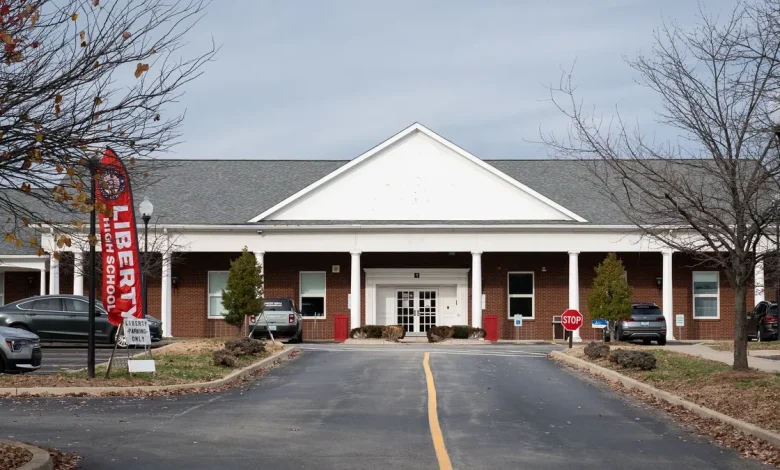
Liberty High student makes her case for the school to remain open
JCPS held a listening event to talk about how decisions were made to close multiple schools. Supporters of those programs made their voices heard.
- Jefferson County Public Schools is proposing to close Liberty High, an alternative school, to help cut over $130 million from its budget.
- Students and staff argue Liberty is more than a credit recovery school, providing individualized support and a sense of belonging for students who struggled in traditional settings.
- District officials state that credit recovery resources are now available across all high schools, making the stand-alone Liberty model unnecessary and costly.
It’s been two years since Millie Larkins graduated, but she still tears up trying to talk about how rough things had gotten before she transferred to Liberty High, an alternative school that leaders of Kentucky’s largest school system are seeking to close.
“When I got there, I really wasn’t doing well,” Larkins recalled while choking back tears. The COVID-19 pandemic disrupted her freshman year, though she said she’d already began to disengage from classes beforehand. When schools reopened, she was far behind and felt her teachers weren’t offering her the help she needed to catch up. She was at one of Jefferson County Public Schools’ most highly rated non-magnet high schools, but she felt alone. Her disillusionment grew, as did her mental health issues and thus her truancy.
When she was offered the chance to go to Liberty, she worried it’d strip her of the traditional high school experiences, but Larkins said she was excited to try something new, hoping it would pull her out of the dark hole she was in. The school ended up giving her far more than she expected, including the chance to go to prom, donate blood and enjoy spirit week.
“I really found myself there,” Larkins said. “When I got there, I was a shell of a human and that’s not the case now.”
As JCPS leaders work to cut more than $130 million from next year’s budget, they’ve presented a list of schools to close or relocate as a means to meet that goal. That list includes Liberty, which they argue is a costly school that is giving students the same opportunity to recover credits that they can get in any other high school.
To Larkins, her dad and several others connected to the school, though, that representation of Liberty is misleading and narrow.
“It’s more than just a credit recovery school,” Larkins said. “I did go there for that, but I got so much more out of the experience.”
Plus, she said, she wouldn’t have made it across that finish line if she’d stayed at her former school.
“It was so refreshing to be able to go to a place that cared about me and how I learned,” she said. “If I stayed … I would not have made it through.”
Liberty staff, students question reasons for proposed closure
In his short five months leading JCPS, Superintendent Brian Yearwood has made the district’s financial woes his largest focus, declaring that rather than the $50 million previously cited by his predecessor, $132 million needs to be cut from the 2026-27 budget.
To achieve that goal, he’s promised central office cuts will be prioritized, and he recently indicated his team has identified the vast majority of what will be cut overall. So far, no details of what that looks like have been shared with the community, save for his plan to close three schools and relocate two others, which is expected to save the district about $4 million annually.
This alone is an optics issue, said Melissa Brooks, who recently retired from Liberty after 19 years at the school.
More than that, Brooks questioned why Liberty is being targeted for closure when reasons provided by the district don’t match the same reasoning for other proposed closures. She also wondered whether Yearwood has enough information about the school to propose such a decision.
Four out of the five schools that are being targeted in Yearwood’s plan have been listed on a critical needs list based off the operations’ teams Facility Profile Index, a new tool being used to identify which schools might be ideal candidates for closure. Liberty is the outlier, the one out of five not on that list.
In its explanation for seeking to close the school, the district has pointed to the high cost of running Liberty and said “well-rounded credit recovery resources are implemented across JCPS, making the stand-alone Liberty model no longer necessary.”
Other schools, however, do not offer the same path toward graduation for students who have fallen behind that Liberty does, people familiar with the school said.
“It is not simply this credit recovery place where kids are putting on a computer and that’s how they are reaching their graduation components,” Brooks said. “It’s not that at all.”
Liberty students may have experienced bullying in their previous schools or, like Larkins, felt out of place and unimportant. They must be at least a year behind in classes to attend Liberty, and upon acceptance, Liberty staff hone in on what the student’s career interests are and what academic standards they are missing to build all of their experiences around that.
“Liberty High School was designed to be an opportunity for very capable and unmotivated students,” Martha Katz, a retired Liberty teacher, said at the first of three community forums about the proposed closures. “We knew there were students in conventional high schools that did not fit into the classrooms of 30 or more students. They were not succeeding, they were falling through the cracks.”
If a Liberty student wants to become a mechanic, the school will find job shadows and internships in that field and build lessons around that interest for them. For example, a history lesson could focus on which automotives were used during World War II.
Larkins remembers that when she first got to Liberty, she was interested in becoming a photographer. Within three weeks, she said, a trip to the zoo to take pictures of the animals was organized.
“It shocked me how fast that happened,” she said. “I’d just go there and they were already so willing to help me.”
Later, when her photography passions grew into an interest in journalism, the school organized trips to local news stations and supported Larkin when she launched the school’s first student newsletter.
In addition to this individualized approach to engage students, Liberty is able to more quickly catch students up because they are assessed and earn credits based on standards, not classes. This same method is currently being used by Newcomer Academy to catch up immigrant students who arrive to the school lacking formal education, or having lots of education experience but no transcripts to show for it. In both schools, the goal is to catch students up and get them across the finish line before they age out of the system.
To accelerate students’ learning, Liberty students use online learning platforms that do exist in other JCPS high schools, but they also receive live instruction that covers a variety of their missing standards that are rooted in their interests. If closed, Liberty students would be sent back to their resides schools, where the options for credit recovery are to enroll in the course they previously failed — an option only provided if space is available and lasts for the whole semester — or they will be able to enroll in summer school or do the coursework online, which is faster.
Those online platform options include eSchool, Edgenuity or Edmentum — the last of which has been the focus of criticism among teachers and parents, locally and nationally, who say the program allows students to buzz through lessons without actually learning anything.
The district has also pointed to the costs of running Liberty as a reason for its impending closure.
JCPS spends just under $67,000 per Liberty student — which is significantly higher than the district’s other multi-level schools, though it is on par with Breckinridge Metropolitan High, another JCPS alternative school with roughly the same number of students. Students are court-ordered to attend Breck-Metro, though, while students apply to attend Liberty.
Two reasons for the higher costs are that more than 70% of the teachers at Liberty hold master’s degrees and the years of experience for the faculty is significantly higher than the district’s (about 16 years compared to less than 13) — factors that drive up their salaries and the cost of running the school.
It is the district’s hidden gem, Brooks said of why more experienced teachers work at Liberty. There’s nowhere else she’d rather have spent nearly two decades in the district.
JCPS plan calls for Liberty students to return to larger high schools
Despite the passion within those connected to Liberty, JCPS leaders have to make a choice about how they will save money, and there are passionate voices urging them to reconsider closing two elementary schools, as well as relocating the district’s teen mom program to another campus, too.
“These decisions are not easy,” Yearwood said during a Dec. 1 forum. “No one wants their school closed. Making this kind of decision is not easy. When we have to close schools, it is emotional. It is draining. It affects students, it affects families.”
If schools aren’t closed, though, “What’s going to happen to our school district in 2027 when we cant pay our teachers?” he asked. “What is going to happen in 2027 when we can’t pay our bills?”
In announcing its proposed closure, JCPS said Liberty students will have personalized learning plans at their next stops, which will include a “clear, attainable graduation timeline,” “recommended coursework or credit-recovery opportunities,” “social-emotional and wraparound supports based on the student’s needs” and “regular check-ins to monitor progress and adjust the plan as needed.”
Asked how an ongoing staffing shortage might negatively impact this plan, JCPS’ Chief of Schools Robert Moore said, “While we remain mindful of broader staffing pressures that affect many districts, we are confident personalized supports can be delivered through a layered, team-based approach.”
The personalized plan, he continued, “will not depend on a single staff member; instead, each student’s plan will be supported by a coordinated team to ensure continuity and consistency.”
Despite assurances, students and staff said Liberty’s model and environment is a unique combination larger high schools can’t provide.
“That’s why they left and were not successful,” Brooks said of the other schools Liberty students came from. “Why is there this assumption that that will somehow miraculously work for them now?”
“I think they need to understand that the program works and that to say these students are going to seamlessly transition into another school that they likely just came from for specific reasons is unlikely,” she added.
Asked if what’s being done at Liberty can quickly be replicated in JCPS’ other high schools, Brooks said, “Not a chance.”
Corrie Shull, chair of the Jefferson County Board of Education and Liberty’s representative, agreed that referring to Liberty as simply a credit recovery school is wrong.
“I think it’s an incomplete articulation of what Liberty does,” Shull said. “Liberty has provided a place for students who were not as successful as we wanted them to be in larger schools. It is credit recovery, but it also is helping students find a sense of belonging.”
Asked if he felt other high schools can quickly offer what Liberty has, Shull said, “The education professionals tell us it can — I have to trust their word on that.”
The closure will require board approval, with members set to vote on the measure Dec. 9.
Shull said he hasn’t made up his mind on whether or not he will support all of or any of Yearwood’s plan.
“I’m listening to the community conversations, making sure I am exploring all of the info that is being presented and I will make a decision closer to the time,” he said.
Krista Johnson covers education and children. Have story ideas or questions? Contact her at kjohnson3@gannett.com and subscribe to her newsletter.
Thanks to our partner and fiscal sponsor, Journalism Funding Partners, a verified 501(c)3 nonprofit organization (tax ID #84-2968843), you can invest in the future of this reporting. Make your tax-deductible donation today at givebutter.com/cj-giving and support local news that serves the Louisville community.