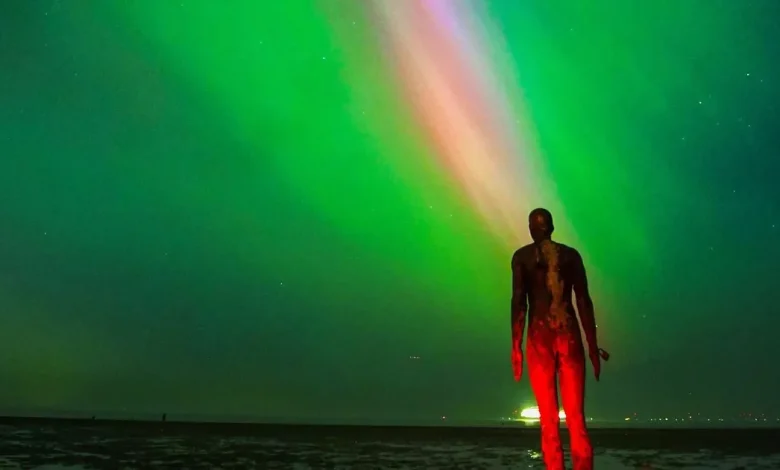
A red alert has been issued by Lancaster University showing there is a high chance of seeing the Northern Lights tonight
The aurora borealis over Crosby Beach, Liverpool(Image: PA)
Everything you need to know about spotting the Northern Lights tonight
- Red alert issued in UK tonight: Stargazers across the UK could be treated to a spectacular display of the Northern Lights tonight, as Lancaster University has issued a red alert, its highest level for auroral activity. This indicates strong geomagnetic activity, currently measured at around 280 nanotesla, which dramatically increases the likelihood of seeing the Aurora Borealis both with the naked eye and on camera.
- What causes the Northern Lights: The Aurora Borealis, or Northern Lights, is a natural phenomenon that creates mesmerizing light displays in the sky, appearing as shimmering waves, curtains, or rippling patterns of green, pink, and red. These occur when charged particles from the Sun, carried by the solar wind, collide with gases in Earth’s upper atmosphere, exciting the gases and producing vivid, dancing lights. People have been captivated by these displays for centuries.
- Best visibility in the UK: Although the red alert means auroras could potentially be seen nationwide, the best chances remain in northern regions due to their proximity to Earth’s magnetic poles. Areas like northern Scotland, northern England, North Wales, and Northern Ireland offer the highest likelihood, while sightings further south are possible but less certain, particularly if cloud cover obscures the sky.
- Influence of solar activity: Aurora visibility depends on solar activity. A fast solar wind from a coronal hole or a glancing coronal mass ejection (CME) can enhance the auroral oval, potentially making the lights visible at lower latitudes than usual. Tonight’s geomagnetic conditions are particularly favourable, meaning even those in central or southern parts of the UK might catch a glimpse if skies are clear.
- Viewing tips for best chance to see the Northern Lights: Choose a dark location away from city lights. Give your eyes 15–20 minutes to adjust to the darkness. Look northwards, where auroras are most likely to appear. Consider using long-exposure photography to capture fainter displays. Monitor aurora forecasts and cloud coverage, as clear skies are essential for visibility.
- Future Opportunities: If you miss tonight’s display, there’s still hope. 2026 is expected to be the best year in a decade for Aurora viewing, due to a once-in-a-decade solar maximum, when the Sun’s magnetic activity peaks. Scientists predict the peak will last until March 2026, providing excellent viewing opportunities, particularly in January and February, when nights are longest and skies darkest.
- Alternative viewing locations: You don’t need to travel to the Arctic to witness the Northern Lights. Many locations in Europe, including Iceland, Norway, Sweden, and Finland, are within or near the Arctic Circle and provide frequent, dramatic displays. These destinations are ideal for Aurora enthusiasts and offer higher chances of seeing the lights, even if weather or cloud cover in the UK prevents local sightings.
SEE THE FULL STORY HERE: Northern Lights forecast for UK tonight following rare red aurora warning