The Ashes enter the Twilight Zone: What makes pink-ball, day-night cricket so different — and difficult? – The Athletic

The Athletic has launched a Cricket WhatsApp Channel. Click here to join.
No team sport is quite so obsessed by the colour of the ball as cricket.
Where the annual shift in English Premier League footballs from white to yellow during winter passes without much comment, red-ball and white-ball have become shorthand to distinguish between cricket’s two main codes: multi-day and one-day matches.
But at Brisbane’s Gabba on Thursday, Australia and England will use a ball of another colour.
The second match in the 2025-26 Ashes series will be only the 25th pink-ball Test in the format’s 148-year history. They were initially devised as an innovation to make multi-day cricket playable at nighttime — the standard, dark red ball is too difficult to see under floodlights — and thereby boost the sport’s finances.
Five-day Test matches unavoidably span weekdays, and later start times (play begins at 2pm local time on Thursday, compared to 10.20am for the first Test in Perth) enable fans to work at least a half-day before attending matches, while simultaneously pushing the final session of play into primetime for domestic TV audiences.
This being cricket, it is not quite that straightforward.
The specifics of each ball are fundamental to how each game progresses, and there is no global standard within Test cricket. In the most recent Ashes series in 2023, Australia complained that the umpires’ decision to replace a red ball that had gone out of shape cost them the decisive Test match at the Oval.
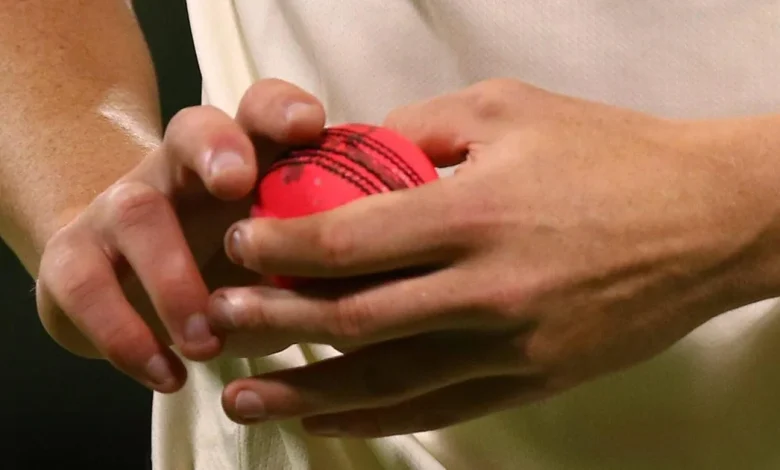
Colour is not the only thing that separates red, pink and white balls: the manufacturing process is slightly different for all three. They share the same fundamentals: a spherical cork core, spun in yarn, bound in leather, and stitched together to create a seam. In men’s cricket, the ball must weigh between 5.5 and 5.75 ounces (about 160g), and must measure 8.81-9 inches (22.5cm) in circumference — a slightly lighter, smaller version is used in the women’s game.
The pink ball on the outfield under the Gabba’s floodlights (Chris Hyde/Cricket Australia via Getty Images)
Leather’s natural colour after tanning is off-white; it is bleached before use in white balls, and dyed before use in red or pink balls.
Where the red ball is greased and waxed before it is finished with a thin cellulose lacquer, the white ball has extra polish applied to it and the pink ball is given a thin spray-coat of paint before they are both finished with a slightly thicker lacquer. It is an intricate process, and only three manufacturers — Kookaburra, Dukes and SG — create balls used for the international level.
The disparities are subtle but international bowlers will tell you that each coloured ball not only feels different in their hand to the other, but behaves differently too.
The pink ball is by far the newest type — it was only cleared for use in Test cricket a decade ago — and is therefore treated with the most mistrust. Many players believe that it is much more unpredictable than the red ball in how it moves laterally, and that it has an outsized impact on the game.
Australia’s captain Pat Cummins, who will miss the Brisbane Test, poses with the pink and red cricket balls (Matt King/Getty Images)
“I don’t think you need it in an Ashes series — absolutely not,” the England batter Joe Root, the second-highest run scorer in Test history, said on Sunday. “I don’t mind it. I don’t think it’s as good as traditional Test cricket. But it’s in the schedule.”
The former England fast bowler Stuart Broad who, like Root, has played in each of his country’s seven previous day-night Tests, subscribes to the widely-held view that the pink ball is significantly more difficult to face in the so-called ‘Twilight Zone’ as night starts to fall: “It’s a bit of a lottery,” he said on his For the Love of Cricket podcast this week.
“The previous Tests I’ve played with a pink ball, it hasn’t got darker until later,” added Root. “Here in Brisbane, it looks like we’ll have half of a day under floodlights. The twilight phase is in the middle session, but that usually comes around the back end of the second session and the start of the last session.
“There will be different elements to contend with, but that is all part of the fun, right? Can we be skilful enough and brave enough to be better than Australia in those big moments?
“We’ve got to play it, and just got to make sure we’re better than them at it.”
Stuart Broad prepares to bowl with a pink ball at Edgbaston against the West Indies in 2017 (Nick Potts/PA Images via Getty Images)
Broad also suggested that the toss becomes disproportionately important.
Fifteen of the 24 (62.5 per cent) previous pink-ball Tests have been won by the team batting first — and therefore starting their first innings in daylight — compared to 194 out of the 396 (49 per cent) red-ball Tests in the same timeframe.
Australia head into Thursday’s Test in Brisbane with a formidable record in day-night Tests: they have played 14 pink-ball matches, more than any other team, and have won 13 of them. The only exception was in January 2024, when hitherto unknown Guyanese fast bowler Shamar Joseph took seven second-innings wickets to lead West Indies to an improbable and historic victory at the Gabba.
“I could think of it as it was yesterday,” Joshua Da Silva, their Trinidadian wicketkeeper, tells The Athletic.
Da Silva, who top-scored with 79 in West Indies’ first innings, jokingly suggests an element of sorcery in the pink ball’s behaviour. “(Facing) the pink ball during the daytime, it seems like the flattest track in the world to bat on,” he says. “It feels like you’re just always going to score runs. But as that little ‘Twilight Zone’ hits, and the sun is setting…
“We call it ‘a jumbee’ in the Caribbean: a jumbee hits, and the ball starts to dance all over and do whatever it wants. That’s when it gets challenging.”
Joshua Da Silva eases the pink ball through the covers as night closes in at Brisbane (Bradley Kanaris/Getty Images)
His comments reflect a common but misplaced perception that playing under floodlights makes the ball swing more in the air.
“All of the research I’ve done about batting under lights — and the impact of floodlights on cricket-ball swing — suggests that visibility is the real issue,” Aaron Briggs tells The Athletic. Briggs should know: he completed a PhD on ‘The aerodynamics of cricket ball swing’ at the University of Cambridge in 2022, and now works as a consultant at the England and Wales Cricket Board (ECB).
“Ball-tracking data tells us how much the ball is moving, and you don’t see any indication that the ball swings or seams more in twilight,” Briggs says. “Sometimes, some dew forms on the pitch (at night) which might influence conditions a bit. But the difficulty stems from the fact that it’s just not as easy to see the ball.”
Briggs believes that the reputation of the ‘Twilight Zone’ stems partly from its nomenclature. “It helps that it’s got a great name,” he adds.
Batters are used to tracking different-coloured balls according to the format, but the pink ball under floodlights presents a unique challenge.
“In twilight, you transition from tracking a dark object on a light background to tracking a light object on a dark background,” Briggs explains. “Somewhere in the middle, it becomes very difficult to see. As soon as that ball does anything that you’re not expecting, your reaction time increases substantially and, at international level, that really matters.”
Alastair Cook, the former England captain, believes that the visibility issue arises “when the floodlights shine off the pink leather”, making it harder to see the ball’s black seam. “If you can’t see the seam as a batsman, you’re in big trouble,” he wrote in his Sunday Times column.
It was noticeable that Steve Smith, Australia’s stand-in captain again in Brisbane in the absence of the injured Pat Cummins, batted in the nets this week during the hosts’ floodlit session wearing ‘eye blacks’ — the small, black, adhesive strips worn on the cheekbone which are commonplace in several U.S. sports — under his eyes to reduce potential glare from the floodlights.
Steve Smith wearing the black strips under his eyes at Australia’s net session in Brisbane (Matt Roberts/Getty Images)
The strips are designed to absorb the light that would otherwise reflect off the skin. The West Indian batter, Shivnarine Chanderpaul, pioneered their use most prominently in cricket.
Several former players, including Australia’s Chris Rogers and England’s Gary Ballance, have cited their colour-blindness as a major obstacle for them in pink-ball matches. Root, at least, has welcomed the adoption of the black seam in preference to its white predecessor on the pink ball.
“The white seam was a nightmare — it was just like a bullet,” he told reporters. “(The black seam) felt pretty good when facing it. It’s actually a nice way of really focusing on the ball: look hard at that seam and give yourself as many cues as you can from that point of release.
“Of course it’s going to have its different challenges and nuances from the red ball, but that’s all part and parcel of it.
Joe Root is bowled by Scott Boland during the day-night Test between England and Australia at Hobart in 2022 (Steve Bell/Getty Images)
It can still be useful for bowlers to buy into the myth that the ball moves more under lights. When it comes to swing, perception can become reality.
“When people think that conditions are suitable for swing bowling, they attempt the skills at a much higher rate, and therefore see a much higher rate of the ball actually swinging,” Briggs says. “It is self-reinforcing… the ball won’t swing unless you try to swing it.”
Whatever the reason, batting against the pink ball under floodlights is a significant challenge: in Australia, a wicket falls every 45.1 balls during the third and final session of a day’s play in each pink-ball Test, a drop from once every 52.8 balls across the first and second sessions.
It is a dynamic that lends itself to unusual tactics: on the opening day of England’s most recent pink-ball Test, in Mount Maunganui in February 2023, captain Ben Stokes declared their first innings at the fall of their ninth wicket, allowing them 18 overs to bowl at New Zealand under floodlights. And it worked. England took three early wickets, and went on to win by 267 runs.
It made for an exhausting week for New Zealand’s Neil Wagner, who bowled 16.4 overs on the opening day then batted as a nightwatchman under floodlights. “You go back to the hotel, it gets to midnight, and your head is still busy,” Wagner explains to The Athletic. “You don’t turn off until 1am, and then you just naturally wake up at 7.30am. You try to kill time until the day starts, walking around, but you feel like you’re constantly on.
“I felt shattered. It does play a little bit with the whole rhythm that you’re used to in a Test match.”
Neil Wagner (centre) celebrates the dismissal of England’s Ben Foakes in the twilight in Mount Maunganui (Phil Walter/Getty Images)
A word of caution: it is possible to overthink the dynamics of a pink-ball match and forget the fundamentals of the game.
In February 2021, England were so obsessed with the notion of swing under the floodlights that they picked four seamers for a Test match in Ahmedabad. Their opponents, India, took one look at the dry, dusty pitch and loaded their side with three spinners, who took 19 wickets between them in a 10-wicket win. England’s record in day-night Tests overall reads: won two, lost five.
Large chunks of pink-ball Tests still play out during daytime, and the pink ball tends to stop swinging quicker than a red ball.
“What you’ll see is that swing drops off a cliff in the same way that it does in white-ball cricket,” Briggs explains. “That’s just because you can’t polish the ball in the same way, so the swing doesn’t last.”
Wagner believes that dynamic is exacerbated by the ICC’s ban on using saliva to polish the ball, a result of the Covid-19 pandemic. “When the pink ball first came in, you could get a bit of shine back on it,” he says. “Now, it seems to stop after 12 or so overs — a bit quicker than a red ball.”
The West Indies’ Kevlon Anderson is bowled by Mitchell Starc – the king of the pink ball – in July (Randy Brooks/AFP via Getty Images)
England’s players have far less experience of pink-ball cricket than Australia. The UK’s climate — with chilly summer evenings — is ill-suited to the format. England staged its only day-night Test in 2017, and ditched the pink-ball rounds from the County Championship a year later.
In Brisbane, they will cling to the fact that Australia’s only pink-ball defeat came at the Gabba, which was chosen to host the lone day-night Test in this series ahead of the Adelaide Oval.
A decade into the pink-ball experiment, various unknowns remain: how will the high humidity levels in Brisbane affect its behaviour this week? Is trying to hit the shine off the new ball a viable strategy, as it is in white-ball cricket? Will dew play a significant role?
If anyone is equipped with answers, it is Mitchell Starc: Australia’s spearhead has taken 81 wickets in pink-ball Tests, nearly twice as many as any other bowler, including 6-9 against West Indies in Jamaica earlier this year, as the hosts were bowled out for 27.
England, beware.