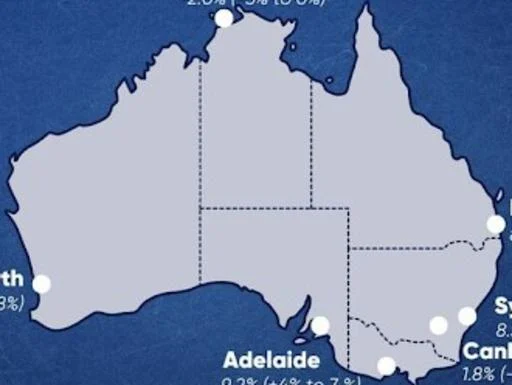
Recent home price rises have not been universal and there were price drops in some areas.
Property prices have fallen by as much as $50,000 in select pockets of Australia, defying the wider interest-rate-cut-fuelled surge that pushed much of the housing market sharply higher throughout 2025.
While most capitals have generally roared back to life on cheaper credit and renewed buyer confidence, fresh data shows some areas slipped backwards even as surrounding markets broke records.
The areas included pockets of Melbourne and Sydney, along with parts of regional NSW, Victoria, Tasmania and South Australia.
The decline was sharpest for houses in Melbourne’s inner east, where house prices tumbled an average $50,000 over the year to October, according to the PropTrack Market Trends report.
Home prices rose nationally by an average of about 6 per cent over the same period.
Melbourne’s inner east region includes popular suburbs such as Hawthorn, Kew and Surrey Hills.
MORE: Hemsworths eye Aus ‘billionaire playground’ amid surprise sale
Prices for units in inner Melbourne dropped over the past year.
The region had the largest fall for any capital-city area and contrasted the double-digit growth in markets such as Brisbane and Perth.
Parts of Melbourne’s west and northeast, along with the CBD, also recorded unit price declines, which ranged from $5,000 to $18,000.
Property analysts said these falls reflected softer investor demand.
Large pockets of the city, especially those dominated by high-rise apartment towers, still face a cautious investor market, traditionally the main buyers for these types of homes.
With investors returning only tentatively after years of rising interest rates, changing landlord regulations and weak rental yields, demand for high-density units has lagged the rest of the market.
MORE: Lisa Wilkinson’s new $15m ‘castle’ after cash loss
Sydney’s Ryde area had pockets of unit oversupply, which moderated prices.
Canberra’s unit market faced similar declines, with apartment prices across the ACT falling by an average of $15,000.
In Sydney, unit prices in Ryde fell $6,000, with agents citing an ongoing glut of investor-grade stock close to transport hubs.
Even the Northern Territory’s Outback unit market, one of the country’s smallest by volume, recorded a substantial drop of $20,250.
Property analysts warned that developers overbuilt certain categories of apartments during the 2010s and early 2020s, particularly one-bedroom units.
Suburb Data analyst Jeremy Sheppard said pockets of oversupply were common features of some capital city unit markets because of the long lead time it took projects to get off the ground.
Developers’ new projects were often released to the market at the same time, which gave new buyers an abundance of choice and took pressure off them to bid up prices, Mr Sheppard said.
Home prices have been rising across most markets since the first interest rate cut earlier this year. Picture: Sam Ruttyn
Different forces pushed down prices in other areas.
The Southern Highlands and Shoalhaven, once one of NSW’s most pandemic-frenzied lifestyle markets, saw unit prices slip $15,000 over the past year.
This reflected a continuation of a price correction that began once international borders reopened and interest rates climbed over 2022 and 2023.
A similar trend appeared in Victoria’s Mornington Peninsula, a boom market during Covid, where house prices dropped an average of $4000 over the past year.
Volatility in some local industries played a role in price falls across select regional areas.
There were price falls in regions exposed to agriculture and mining, including Latrobe–Gippsland (down $14,750) and South Australia’s Barossa–Yorke – Mid North (down $10,000).
Back to major cities, pockets of suburban markets weakened at the margins.
Baulkham Hills and the Hawkesbury in Sydney recorded a $6,000 drop for house prices.
Geelong posted declines in both houses (-$10,900) and units (-$7,800).
Tasmania’s Launceston and North East region saw unit values fall $5,000.
Economists stress that these isolated declines are not signs of a faltering national market so much as reminders that Australia’s housing landscape is increasingly fragmented.
REA Group economist Eleanor Creagh said: “We’re seeing a broad based uplift across the capital city markets.”
“This year’s series of interest rate cuts, population inflows, investor activity and the expanded home guarantee scheme will continue to bolster demand along with upgrade activity,” Ms Creagh said.
“Meanwhile, stock on market has been pretty tight this year, despite having seen an uplift over the past month with the spring selling surge.
“The delivery of new housing remains constrained, so conditions have been tilted towards sellers and I’d say that’s going to remain the case.”