Sign up for our free Health Check email to receive exclusive analysis on the week in health
Get our free Health Check email
Get our free Health Check email
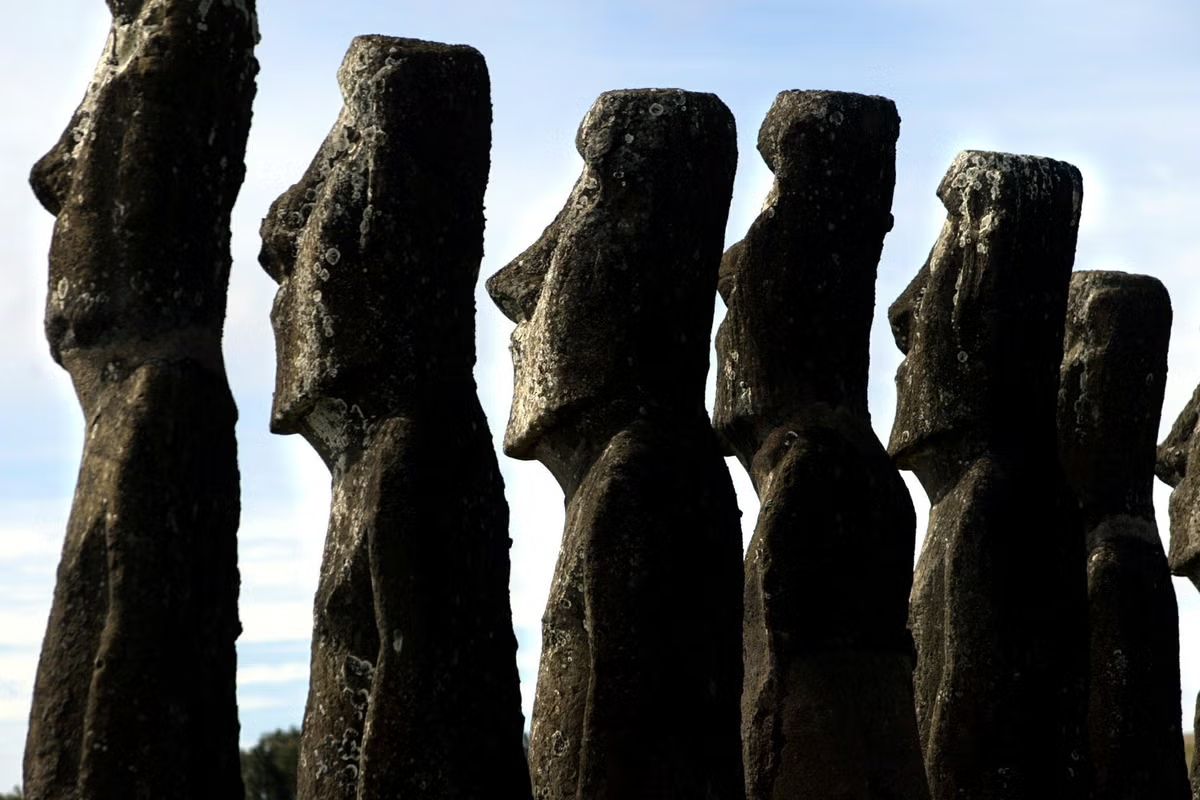
Easter Island’s Rapa Nui statues were carved by several independent groups, including competing families, without any central authority overseeing them, according to a new study.
The iconic Moai statues, measuring around 4m in height, are monolithic human figures carved by the island’s Polynesian inhabitants between 1250AD and 1500AD.
They were carved from the main Moai quarry and transported to stone platforms around the perimeter.
But exactly what drove the native population to unite in carving and transporting such giant statues remained unclear.
Previous studies found that the indigenous inhabitants were not politically unified at the time, consisting instead of small and independent family groups.
Now, researchers say there is evidence that the construction of the over 1,000 Moai was also similarly decentralised.
open image in gallery
Unfinished Moai attached to bedrock by ‘keels’ along their backs (Carl Philipp Lipo et al, PLOS One (2025))
The latest study challenges previous assumptions that the population building and arranging the giant statues was under hierarchical control.
Instead, scientists say, a “complex cooperative behaviour” emerged among different family groups to build the statue arrangement.
In the study, researchers assessed whether the production of the statues at the main Moai quarry, Rano Raraku, was centrally controlled or if it followed the decentralised pattern found elsewhere on the island.
They collected and compiled about 11,000 drone images of the island to create a comprehensive 3D model of the quarry, including hundreds of Moai preserved in various stages of completion.
This analysis revealed about 30 distinct centres of quarrying activity on the island, featuring a variety of carving techniques.
“Our analysis reveals 30 distinct quarrying foci distributed across the crater, each containing redundant production features and employing varied carving techniques,” according to the study published in the journal PLOS One.
open image in gallery
Comprehensive 3D map of main quarry (Carl Philipp Lipo et al., PLOS One (2025))
Researchers also found evidence for the transport of carved statues out of the quarry in many different directions, hinting that Moai construction, like the broader Rapa Nui society, was not organised by central management.
“This spatial organisation, combined with evidence for multiple simultaneous workshops constrained by natural boundaries, indicates that Moai production followed the same decentralised, clan-based pattern documented for other aspects of Rapa Nui society,” they wrote.
Scientists suspect several small and independent family groups, collaborating and sometimes competing with each other, built these statues.
The findings challenge the idea that building such a monument requires hierarchical control.
Instead, the new evidence points to complex cooperative behaviours emerging from different types of cultural sharing of information.