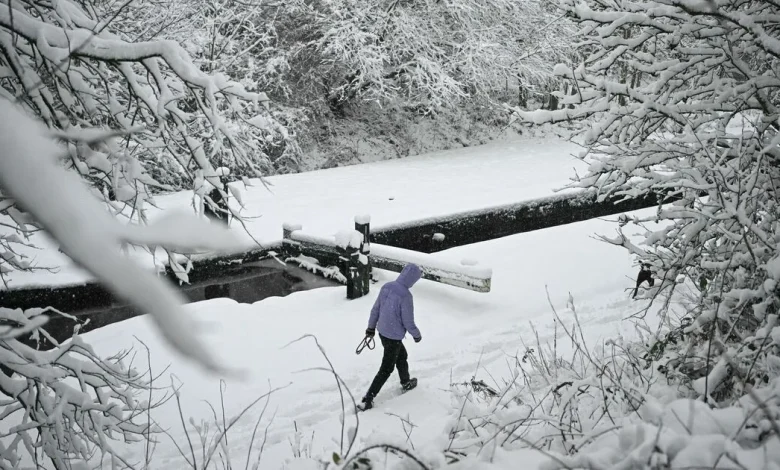
Weather maps have suggested that snow is set to cover parts of the UK. WXCharts predicts that the wintry precipitation will fall over the Scottish highlands to the north of Glasgow and west of Dundee on Saturday. The white patch also includes an area more northwards, to the southwest of Aberdeen. Inverness just escapes it at 3am, it seems. Blobs also appear south of Glasgow, between Dumphries and Kilmarnock, as well as a little further east.
Meanwhile, a little patch is seen across the border in England, in the countryside to the west of Newcastle. The Met Office, however, does not currently forecast snow. Its outlook for Saturday to Monday reads: “Brighter with blustery showers on Saturday, but the return of more rain on Sunday. A more settled spell for Monday with sunny spells, before turning unsettled again in the evening.”
Forecasting snow is a challenge, the Met Office says, because conditions can change rapidly, and small variations in temperature or wind direction can mean the difference between rain, sleet or snow.
Specialists say that water falls as snow when the air temperature is below 2C, and it is a myth that it needs to be below 0C.
The Met Office adds: “In fact, in this country, the heaviest snowfalls tend to occur when the air temperature is between 0C and 2C.
“The falling snow does begin to melt as soon as the temperature rises above freezing, but as the melting process begins, the air around the snowflake is cooled.
“Snowfall can be defined as ‘slight,’ ‘moderate’ or ‘heavy’. When combined with strong winds, snowfall can create blizzards and drifts.
“If the temperature is warmer than 2C then the snowflake will melt and fall as sleet rather than snow, and if it’s warmer still, it will be rain.”
Scotland’s areas dominate the snowiest in the UK.
Experts ranked the Cairngorm Chairlift as the top, with an annual average of 76.2 days of snowfall.
Baltasounds came second, in front of Fair Isle.
Then came the Loch of Hundland.
Copley in County Durham is the highest English location in the list, and then it is back to Scotland with the village of Leadhills.
The English return with Widdybank Fell in the Pennines next.
Eskdalemuir, Kinbrace and Knockan complete the list.