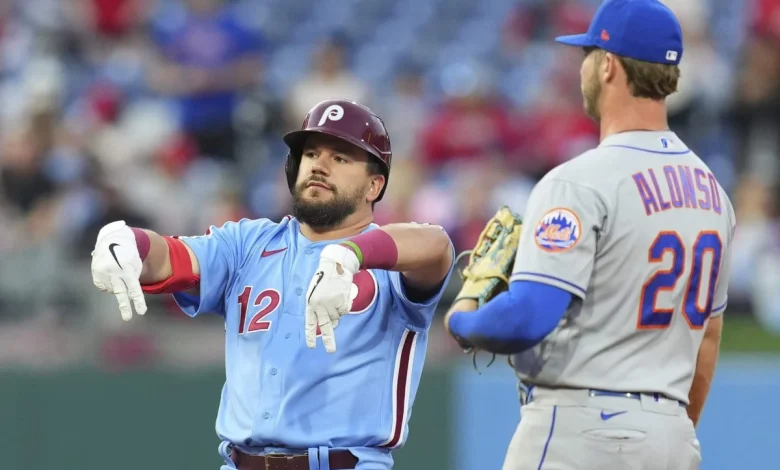
After partially sufficing their rotation needs with the addition of Sonny Gray, the Boston Red Sox are expected to turn their attention to the lineup, with a focus on acquiring at least one big bat for the middle of the order. With the Winter Meetings set to commence next week, Pete Alonso and Kyle Schwarber are both primary targets.
“Someone who is a threat who can hit in the middle of the order and can lengthen our lineup is going to be something we’re going to pursue,” chief baseball officer Craig Breslow said at MLB’s GM meetings. “That is absolutely a path to improving our team.”
Last season, the Red Sox finished exactly in the middle of the league (15th) in home runs with 186 longballs and a .745 OPS (ninth). MLB league average was 188 homers and a .719 OPS.
When Boston traded Rafael Devers to the San Francisco Giants in June, the club saw a hit in the power department before Roman Anthony’s rise helped level things. However, injuries to Anthony, Alex Bregman and Wilyer Abreu ultimately flatlined their production in the second half to the point where Trevor Story’s 25 homers led the team. (For what it’s worth, Devers finished with 35 homers.)
Yet, even with a full season of Anthony and a healthy lineup, the Red Sox need more thump. Because of that, attention this offseason has been focused on the market’s two biggest power bats.
Neither is a perfect fit, but both represent an upgrade to the current lineup.
The case for signing Schwarber
Over the last four years, Schwarber has been one of the league’s most prolific home run hitters, finishing his 2025 campaign with an NL-leading 56 homers, one more than Shohei Ohtani and four fewer than MLB’s home run champ, Cal Raleigh (60).
He also led MLB in RBIs (132) and played in all 162 games. In each of the last four seasons, Schwarber has hit at least 38 homers, posting a 134 OPS+.
Traded to the Red Sox at the 2021 deadline, Schwarber posted .957 OPS in 41 games
When the Red Sox traded for Schwarber at the deadline in 2021, they were looking for a boost to their lineup, but they also found a player who was a terrific fit in Boston, handled the pressure and expectations well and became a fan favorite in a very short amount of time. In addition to strengthening the lineup, he also had an enormous impact as a veteran voice in the clubhouse, taking on a leadership role over two and a half months.
All of those attributes fit the current Red Sox club, one in need of a strong voice in the clubhouse, a veteran bat to guide the lineup and a personality that understands the media and fan expectations.
Ranked as the No. 4 free agent in The Athletic’s 2025 Top 50 big board, Tim Britton projected Schwarber to sign a five-year, $145 million deal that would take him through his age-37 season. The $29 million average annual value of that deal, if traditionally structured, would put the Red Sox past the first luxury tax threshold by $8 million, making payroll $252 million.
The case for not signing Schwarber
As a left-handed hitter, Schwarber doesn’t help the balance of the lineup, one that already features a slew of lefties in Anthony, Abreu, Jarren Duran, Triston Casas, Marcelo Mayer and Masastaka Yoshida.
Speaking of Yoshida, he’s currently the club’s primary designated hitter, and signing Schwarber would almost certainly mean the Red Sox would need to trade Yoshida. The 32-year-old has seen limited time in the outfield, but is best suited as a DH. Schwarber, similarly, has seen limited action in the outfield and a handful of games at first base (but not since he played in Boston), so he, too, realistically is only a DH.
In finding a trade partner for Yoshida, the Red Sox would likely have to take on a chunk of the remainder of his two-year, $36 million contract. Meanwhile, Philadelphia extended a one-year, $22.05 million qualifying offer to Schwarber, which he declined.
Since the Red Sox surpassed the luxury tax threshold in 2025, if they a free agent with a qualifying offer attached, they’d lose their second- and fifth-highest selections in the 2026 draft, as well as $1 million in international bonus pool money. Breslow did say at the GM Meetings he would not rule out signing qualifying offer free agents under the right circumstances.
The case for signing Alonso
Like Schwarber, Alsonso ranks near the top of the league in homers over the course of his career, averaging 39 homers in each of the last five years. In 2025, he slugged 38 homers and a National League-leading 41 doubles for an .871 OPS, his highest OPS since his 2019 Rookie of the Year-winning season. Alonso also posted a career-high .272 average while also playing 162 games for the second straight season.
Alonso, who turns 31 on Sunday, is a right-handed hitter and would offer balance to a lefty-leaning lineup. He might not be as well known for his clubhouse presence as Schwarber is, but he’d still be a strong veteran voice on a younger team. Having playing his entire career for the New York Mets, he’s well accustomed to the pressures of a big market.
As a right-handed hitting first baseman, signing Alonso would also give the Red Sox options at first. The team could have first baseman Triston Casas begin the year at Triple A to build up reps after missing almost all of 2025 with a ruptured left patellar tendon. Alternatively, they could platoon Casas and Alonso at first, easing Casas back into action.
There’s also a scenario in which one serves as DH while the other plays first base.
The Athletic’s Tim Britton projects Alonso to sign a five-year, $140 million a deal that would take him through his age-35 season. The $28 million average annual value of that deal, if traditionally structured, would put the Red Sox past the first luxury tax threshold by $7 million, making team payroll $251 million.
The case for not signing Alonso
Alonso’s subpar defense at first base may be the biggest detriment in signing him, given the Red Sox have struggled with infield defense the last few seasons. At the moment, the team is also without a starting second and third baseman so adding a below average defensive first baseman would set the defense back further. Alonso has posted a minus-9 Outs Above Average at first in each of the last two seasons.
For context, Casas posted a minus-2 OAA over 61 games in 2024 after a negative-10 OAA in 2023.
Scott Boras, Alonso’s agent, said at the GM Meetings that Alonso is willing to serve as designated hitter for a winning team, though he has said he’d prefer more time at first overall. If the Red Sox present him a plan as more of a primary DH, he may prefer a club that allows him to play the field more.
The Red Sox have been hesitant to label Casas as the Opening Day first baseman, but that doesn’t mean his future with the team is in jeopardy. Rather, because of the severity of his injury, the timeline for a full return is a bit fluid, and as noted above, since Casas has minor-league options, they may opt to ease him back that way.
If the Red Sox do see Casas as their future first baseman, they’d need to sell Alonso on a full-time DH role later in the contract. Meanwhile, similar to Schwarber’s scenario, if the Red Sox plan for Casas and/or Alonso at DH, they’d need to find a way to move Yoshida either way.
Verdict
Neither Schwarber or Alonso fits the Red Sox roster perfectly, but given the team’s dire need for power, both represent the best opportunity to upgrade the offense. Despite the subpar defense at first, Alonso, as a righty hitter, does seem to offer a slightly better fit, especially if platooned with Casas.
Either way, not signing one of the two hitters could be a major missed opportunity for a team with aspirations of contending for a championship.