Former KPMG auditor fined for professional misconduct in connection with Laurentian’s pre-insolvency audit

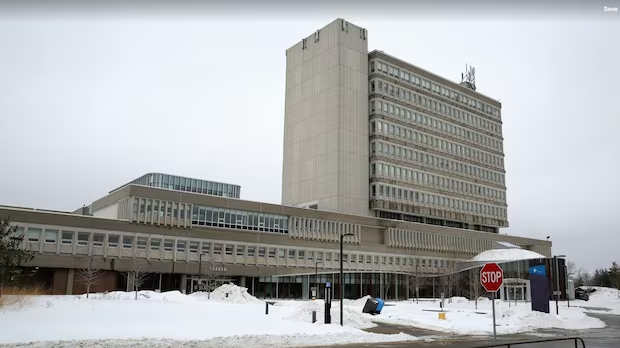
The Chartered Professional Accountants of Ontario (CPA Ontario) have fined a former auditor with KPMG for work done on the audit that preceded Laurentian University taking the shocking and unprecedented step of declaring insolvency in February, 2021.
The financial crisis led to the termination of 195 faculty and staff and led to the closure of dozens of programs.
As outlined in a settlement agreement on the regulatory agency’s website, Laurie Bissonette admitted to professional misconduct and failing to maintain professional standards as part of the KPMG audit team for 2020.
She has been fined $50,000 and ordered to pay two-thirds of the cost of the investigation, as well she has lost her status with CPA Ontario, although she has been retired since September, 2020.
The allegations stemmed from the audit of Laurentian University of the year ending April 30, 2020.
During the preceding months, Bissonette’s role was to oversee the audit planning, implement it, manage the team and review the riskier parts of the file.
The professional conduct committee (PCC) of CPA Ontario alleged that from March 1, 2020 through September 30, 2020 she “failed to appropriately evaluate and document management’s assessment of the entity’s ability to continue as a going concern,” and to “exercise professional skepticism.”
The term “going concern” means whether Laurentian was financially viable.
Although the issue of viability was raised at times throughout the process, especially because of COVID, the statement indicates Bissonette did not follow up certain points, and didn’t document discussions.
At one point, the statement said that Bissonette believed, “notwithstanding the $12 million deficit forecast for 2019, that sustainability measures were in place and LU would be at a break even for 2021.”
Although the statement said that Bissonette had numerous discussions with key members of Laurentian’s management about its viability, it found no documentation of them.
The committee said that Bissonette requested managers at Laurentian conduct an assessment of the assumption that the university was a “going concern” but none was ever prepared.
It found that she relied too much on management’s cash flow forecasts.
It found that in June of 2020, a manager at Laurentian advised Bissonette by text that the university was engaging TGF, but that she didn’t bother to ask what TGF stood for.
Auditor showed lack of “professional skepticism”
If she had, she would have found it was a Toronto law firm specializing in commercial litigation and insolvency.
On August 24, Bissonette was asked to present at a special meeting of the finance committee, without questioning why she was being asked to do so.
She was not invited to the in-camera portion of the meeting during which the option of pursuing creditor protection was discussed, without her knowledge.
On Sept. 4, 2020, Laurentian hired Ernst & Young to help out with various initiatives, including a potential Companies’ Creditors Arrangement Act (CCAA) filing and potentially to act as the court-appointed mediator.
The legislation was designed for commercial businesses and had never been used by a publicly-funded post-secondary institution.
In the statement, Bissonette indicated she was aware of the hiring of Ernst & Young, but she assumed the firm was brought in to assist with Laurentian’s internal controls and did not seek clarification.
By September 2020, Bissonette told investigators that she was reassured by a key manager at Laurentian that enrolment was ahead of the prior year’s numbers, and other revenues were positive, and that cash flow was being monitored.
“Bissonette admits that as the 2020 Audit engagement partner she chose to believe that if LU [Laurentian University] did not meet its financial targets, a primary course of action was for the provincial government to bail out LU,” the committee wrote in its statement.
She retired on Sept. 30, 2020.
Auditor learned of insolvency along with everyone else
“Bissonette asserts that she first became aware that LU was filing for CCAA protection on Feb. 1, 2021, when the public announcement was made,” wrote the committee.
The committee for CPA Ontario cited a subsequent investigation by the auditor general of Ontario, Bonnie Lysyk, in November of 2022, which found that Laurentian University’s administration strategically planned and chose to file for protection under CCAA and failed to disclose their plans to KPMG.
The president of Laurentian University’s staff union (LUSU), Tom Fenske said that he wasn’t shocked by the conclusions in the professional investigation of Bissonette, noting it mirrored that of the 2022 auditor general’s report.
But he does commend the the regulatory body for taking the matter seriously, and hopes it’s a warning for other accountants.
“They probably wanted to make sure a message was sent, not just to this person but beyond,” he said.
A spokesperson for CPA Ontario said in a statement that fines in varying amounts are part of the usual request for sanction at discipline, and wouldn’t say whether the one in this case was typical.
She also said the costs of investigations vary, so it’s not clear what bearing two-thirds of the costs of that will mean for Bissonette
Laurentian University emerged from creditor protection in November, 2022 but is still dealing with the aftermath, including the sale of key buildings on campus to the province and having to lease them back.
In June of 2024, changes were made to legislation to exclude public post-secondary institutions from using CCAA to deal with financial crises.