READ MORE
Carolina Hurricanes 2006 Stanley Cup Champions
Twenty years ago, the Carolina Hurricanes galvanized hockey in the Triangle by winning the Stanley Cup. Here’s a look back at that pivotal season, and where the players and coaches are now.
Expand All
Raleigh
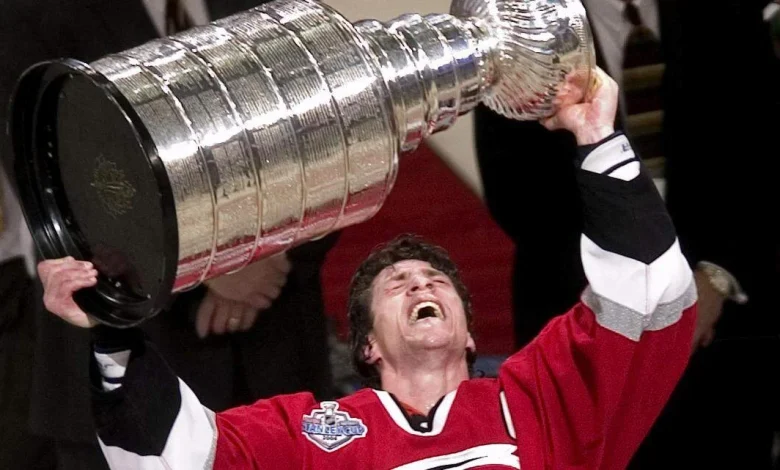
Eleven months before Rod Brind’Amour ripped the Stanley Cup out of Gary Bettman’s hands and thrust it over his head, he wasn’t even yet the captain of the Carolina Hurricanes. He was just a veteran, days from turning 35, coming off a lost season that saw him flee to Switzerland just to get some game action, one of the bigger names on a half-filled roster.
Coming out of the NHL lockout, the Hurricanes didn’t exactly have a blank slate or a blank check to fill it. They still had the spine of the team that came within three wins of the Cup in 2002, a new young star in Eric Staal and a handful of players who had been added ahead of the lockout that wiped out the entire 2004-05 season. Their coach, Peter Laviolette, finished out the previous season in charge and knew the lay of the land. More than a year earlier, they had traded for a goalie, Martin Gerber, who had yet to play for the team. Yet it was far from a finished product, and as the NHL in July 2005 prepared to return to action that fall, the Hurricanes had work to do.
Carolina Hurricanes Captain Rod Brind’Amour hoists the Stanley Cup after the Canes defeated Edmonton 3-1 on June 19, 2006, in game seven of the Stanley Cup finals at the RBC Center, now known as the Lenovo Center. Robert Willett rwillett@newsobserver.com
General manager Jim Rutherford didn’t have the full amount of the new salary cap to spend, but he quickly landed Cory Stillman, a player he had long sought to acquire, before striking out in his search to add a top-pairing defenseman and elite winger, settling for other targets instead. It was fair to wonder then if the Hurricanes had taken advantage of the opportunity the lockout had presented them, a chance to reset their roster on what should have been a more even financial playing field.
Only one team — the rebuilding Washington Capitals — was given longer odds to win the Stanley Cup.
But on the inside, Brind’Amour was already excited at what the Hurricanes had done. A team that had never done much in free agency had added three legitimate NHLers — Stillman, Oleg Tverdovsky and Ray Whitney — to go with a few other players acquired in trades or signed the previous summer.
Rod Brind’Amour cleans one of his skates after practice at the RecZone skate center in Raleigh on Sept. 7, 2005. tar heel of the week File photo
“I remember us getting Stiller because I first saw it on a ticker,” Brind’Amour said. “I was like, ‘We just picked up Cory Stillman, and it was like for nothing?’ Then Ray Whitney, for nothing. And the big one for me was Gerber. We got him to add to that team, and I was thinking, ‘This guy’s a great goalie when we played against him. ‘ All these pieces and we weren’t taking anything off the team.
“I remember thinking, ‘This is adding some serious firepower.’ I was certainly happy we were adding these players that no one was talking about, that I knew were elite players.”
Sowing the seeds
What no one on the outside knew then is how much groundwork had been laid leading into the lockout. What no one (other than Laviolette) knew then is how much the post-lockout rule changes and style of play would benefit the players the Hurricanes already had. What no one knew then was how deftly Rutherford had spent the money available to him in that first week of free agency. Or what kind of leader Brind’Amour, appointed captain in late August, would turn out to be.
Then-Carolina Hurricanes head coach Peter Laviolette, right, confers with assistant coach Jeff Daniels during an exhibition game against the Atlanta Thrashers at the RBC Center on Sept. 21, 2005. TRAVIS LONG tlong@newsobserver.com
After losing the opener at the Tampa Bay Lightning, sitting in the visiting dressing room beforehand watching a video Laviolette made expressly for that moment as the Lightning raised their Stanley Cup banner after a year’s delay, the Hurricanes won 14 of the next 17, getting off to a hot start that never really cooled.
They endured injury after injury, surviving thanks to the depth assembled over the summer and, later, the two massive in-season trades for Doug Weight and Mark Recchi that cemented their status as a contender — and gave them the kind of star players they had been hoping to land in August.
A Carolina Hurricanes fan’s license plate photographed Dec. 11, 2004, in the parking lot of the RBC Center, now known as the Lenovo Center. Chris Seward N&O File Photo
By December, as the new players had fully meshed with the remaining spine of the 2002 team that came within three wins of a Stanley Cup itself, it was clear the Hurricanes had stumbled onto something special. Their coach had met the game where it was going, not where it had been. Their players thrived with a fresh start after a year away from the game. And their general manager had one of the shrewdest offseasons of his career.
“It was the one year that gave us a chance to be on an even keel with the other teams, when the cap eventually came in,” Rutherford said. “It was $39 million at the time, and it’s amazing where it is today compared to where it started. It was pretty wide open for us to go and add players. Fortunately we added a group of guys that really came together and Peter did a terrific job that year bringing that group together.”
The way that team played — fast, aggressive, dangerous and, most of all, successful — cemented the future of hockey in the Triangle after the lockout that could have killed it. The players had the kind of chemistry that usually only comes from playing together for years, but the team was actually assembled in pieces over the course of two offseasons.
Eric Staal (12) celebrates the Hurricanes’ first goal against Ottawa making the score 2-1 as Jason Spezza (19, left) reacts at the RBC Center on Nov. 22, 2005. TED RICHARDSON N&O File Photo
First steps
In the last official act of the NHL before the owners locked out the players for what ended up being the entire 2004-05 season, Raleigh hosted the NHL draft at what was then called the RBC Center, an event that usually heralds the future — especially with No. 1 pick Alexander Ovechkin already anointed as a future superstar — instead conducted under a pall of dread. The battle lines between the NHL and NHL Players Association had long been drawn, and few expected a quick resolution, even if few expected things to drag on as long as they did.
The Hurricanes had missed the playoffs by 15 points after firing Paul Maurice in December and replacing him with Laviolette, who had done the impossible by taking the woebegone New York Islanders back to the playoffs before getting fired himself. Laviolette used the last four months of the season to assess the roster he’d been handed. Clearly, it needed work, but there was still a core of players who had taken the Triangle on a wild ride to the Stanley Cup finals in 2002, and a future franchise player in Staal, the No. 3 overall pick in the 2003 draft who made his NHL debut that fall at 18.
“For me, coming in before the lockout, we didn’t make the playoffs and that was disappointing, but there were pieces there who were going to be really important pieces moving forward, once we came out of the lockout,” Laviolette said. “I thought we played really well down the stretch. The last 20 games, we started to play a better brand of hockey. Then we went into the lockout, but that to me was promising, the way we were playing down the stretch. I liked the style we were playing. We started to understand a little bit of the identity we were looking for.”
A week before that draft, they put the first new piece of their Stanley Cup puzzle in place. Rutherford traded prospect defenseman Tomas Malec for a goalie he had identified as his new No. 1. Gerber arrived from the Anaheim Mighty Ducks, where he was stuck behind Jean-Sebastian Giguere but had played well in spot duty. Along with the January trade that brought Justin Williams from the Philadelphia Flyers, two of the biggest new building blocks were already in place.
At the draft, the Hurricanes made a splash by trading up for the No. 4 overall pick and taking Andrew Ladd, a big winger from Western Canada. It was a doubly smart move: Not only did Ladd end up providing much-needed depth in 2006, the player the Hurricanes likely would have drafted at No. 8 — Michigan State defenseman A.J. Thelen — was one of two first-round picks that year never to appear in an NHL game. (Only three players in that draft ended up scoring more career goals than Ladd, and two of them were Ovechkin and Evgeni Malkin.)
Andrew Ladd puts on the ceremonial jersey after being drafted No. 4 in the first round of the 2004 NHL Draft by the Carolina Hurricanes held at the RBC Center, now known as the Lenovo Center. At left is Canes GM Jim Rutherford; at right is head coach Peter Laviolette. Chris Seward File photo
The NHL lockout ‘advantage’
As the summer rolled on, teams tried to pretend everything was normal even as a very obvious lockout of undetermined length loomed. Hurricanes owner Peter Karmanos was a vocal supporter of Bettman’s efforts to shut down the league as long as it took to institute a salary cap, but the Hurricanes had to continue with business as usual from a hockey perspective.
Meanwhile, even before the post-lockout changes to the NHL rules, Laviolette was already pushing for his kind of players then: Faster, mentally and physically, capable of playing at the relentless pace he demanded. Rutherford grabbed two: Frantisek Kaberle, a slight, puck-moving defenseman who wouldn’t be out of place in today’s game, and Matt Cullen, a quick, nimble center who had bounced around a bit in his career looking for the right fit, and who gave the Hurricanes three solid options at that position along with Staal and Brind’Amour.
“We liked both players, but we all knew things were changing,” Rutherford said. “We didn’t know exactly to what extent and where it was going to go, but we liked how they fit with our team. Cullen had great character and leadership. You can never have enough of that.”
And then everything stopped. For a month. For three months. For a season.
Then-Carolina Hurricanes General Manager Jim Rutherford, left, Matt West, vice president of business operations, and Jason Karmanos, vice president and assistant general manager, watch a televised news conference as NHL Commissioner Gary Bettman announces the cancellation of the 2005 season, Feb. 16, 2005. Takaaki Iwabu File photo
The lockout changed everything. Without it, the Hurricanes probably wouldn’t have had a shot at a Stanley Cup in 2006.
There were many reasons for that, and not all of them financial. Most notably: As part of the league’s return-to-play plan, a group led by Brendan Shanahan explored ways to break the league out of what had become known as its Dead Puck Era, when the fast-and-furious ’80s of Wayne Gretzky’s Edmonton Oilers gave way to the neutral-zone trap, goalies who looked like the Michelin Man, 2-1 slogfests and Lou Lamoriello’s New Jersey Devils, full stop.
Officials were instructed to call hooking and holding with more scrutiny, restricting the clutching and grabbing that was happening all over the ice. The two-line pass came out of the rule book, encouraging more aggressive long passes up the sheet. Penalty shots became commonplace. Exit ties, enter the shootout. The goal: Open up the game, let speed and skill flourish, pick up the pace and juice scoring.
“You couldn’t hold anymore, couldn’t corral people anymore the way that you did,” Laviolette said. “That was the word and the rumor, so you just started working on it right away.”
Pace, and patience
Laviolette had always leaned toward a more possession-oriented style than the dump-and-chase that teams played in the hook-and-hold era to fight their way through teams clogging the middle of the ice. But now the game was changing to meet him there. His vision for the Hurricanes was a fast, attacking team that held onto the puck and fought ferociously to get it back when it lost it, with defensemen jumping into the play and everyone encouraged to take risks that would have been previously unthinkable.
That doesn’t sound very revolutionary today — it’s still the foundation of the Hurricanes’ style under Brind’Amour now, and just about everyone else in the league is trying to do the same thing — but it was 20 years ago, in part because no one really knew what the game was going to look like after the lockout.
“He gets a lot of credit for having a plan and obviously he had the roster to be able to push that pace,” Staal said.
With a hockey stick and a whistle in his hands, then-Carolina Hurricanes head coach Peter Laviolette directs his team during a 2006 practice session. Robert Willett rwillett@newsobserver.com
That was already going to play into the strengths of holdover players like Erik Cole and Staal and Williams. Not every player Rutherford signed in the summer of 2005 fit that mold. But many of them did.
The post-lockout changes to the financial landscape gave Rutherford the freedom to pursue that strategy. When the Hurricanes lost to the Detroit Red Wings in the Stanley Cup finals in 2002, the Red Wings’ payroll was twice Carolina’s. Coming out of the lockout, payrolls were capped at $39 million, $26 million less than Detroit spent that season.
The Hurricanes still intended to stay below the $28 million that would allow them to participate in the league’s new revenue-sharing plan, but what had once been a yawning chasm was now — in theory — small enough to be overcome by good coaching and good management, even if $11 million was enough to sign two legit stars in the free-agent bonanza that followed the lockout, no small talent gap.
It also forced teams like Detroit to buy out players on existing contracts just to become compliant. One of them, Whitney, would become a key player for the Hurricanes while the Red Wings were still paying him more in 2005-06 than his new team.
Making the most of a lost year
There was one other fringe benefit for the Hurricanes in particular: While veterans had to sit out, and some like Brind’Amour ended up in Europe once the season was officially canceled, younger players could go to the AHL. That included Staal, coming off a long rookie year when he wasn’t yet physically capable of handling the relentless grind.
“It was disappointing, for sure,” Staal said. “You’re just starting out your career, you’re very young, and you just got a taste of the big leagues and you’re told you can’t play. Obviously when it comes to labor stoppages and all that stuff, you try to look with some perspective because it’s bigger than you, but for a 20-year-old kid, you’re like, ‘I don’t care, I want to play.’
“Once I realized we weren’t going to get started, I got the chance to go down and be that guy, connect with a team, push all that aside and focus on what you’re doing daily. Obviously, the next season, I don’t know if I have the year I had without having that year in the AHL.”
That experience playing for the Lowell (Mass.) Lock Monsters of the AHL, not exactly the most glamorous of destinations, allowed Staal to dominate in a league elevated by the presence of talented players like him who would otherwise be in the NHL. As a learning experience, it was priceless. The swagger he had as a junior player got knocked out of him as a rookie. That season in the AHL gave it back to him. Staal arrived back in the NHL in the fall of 2005 overflowing with confidence, knowing he could dominate pros. And did.
A lost season was a stiff price to pay for all of that, and if the Hurricanes had struggled coming out of the lockout, the damage done might have been irreparable. There was a gamble inherent in Karmanos’ support for the lockout, that the value of the new landscape was worth a year away that could have killed a franchise still struggling to capitalize on the magic of that 2002 playoff run. Obviously, it paid off. What happened next was a big reason why.
Post-lockout moving and shaking
The lockout officially ended on July 13. Within two weeks, even before free agency opened, the Hurricanes were already making moves. At the belated draft in Ottawa at the end of July, Rutherford gave up relatively little to obtain a pair of depth defensemen: Big Mike Commodore, who like Staal had thrived in the AHL — and on the same team, as the Hurricanes and Calgary Flames shared an affiliate that season — and power-play specialist Andrew Hutchinson.
(That draft also saw the departure of franchise stalwart Jeff O’Neill to the Toronto Maple Leafs, days after his older brother’s death in a car accident. The Hurricanes agreed to send him home to Ontario at his request.)
Free agency officially opened on Aug. 1, and the Hurricanes saw many of the players they hoped to attract sign elsewhere: defensemen Adrian Aucoin, who had racked up huge minutes for Laviolette with the Islanders, Bryan Berard and Brian Rafalski; former Hurricanes winger Gary Roberts; future Hall of Famer Paul Kariya. With about $5.5 million to spend on three players to stay below their self-imposed cap, the Hurricanes were priced out of the market at first.
They landed one of their top targets, though: Rutherford had long appreciated Stillman’s intelligence and ability to make his linemates better but was never able to trade for him; the veteran winger became the Hurricanes’ first marquee signing and yet another chapter in the book of “Jimmy always gets his man, eventually.” Tverdovsky, a veteran NHL defenseman who had been playing back in his native Russia, arrived two days later to help fill out the blue line. And then they thought they had a third on the hook, their big splash.
“We thought we had Paul Kariya,” Rutherford said. “There was a lot of conversation and it was all going in that direction. Then I got the phone call to say he had changed direction and he was going to Nashville. I was driving down I-95 that day, coming back from being with (Karmanos) for free agency, and right away I made the call to get Ray Whitney.”
It was the kind of intervention of fate that can tilt a contender into a champion.
“That turned out really well for us,” Rutherford said. “He fit in for a lot of different reasons, but that was probably the strangest part of putting that whole team together.”
Whitney, a salary-cap casualty with the Red Wings, turned out to be exactly what the Hurricanes needed on and off the ice, a skilled veteran with a loose-cannon personality. In a room full of intense competitors, he had the unpredictable wit to puncture an ego or get a grim room to laugh, as needed. Kariya couldn’t bring that, not like Whitney. No one brings that quite like Whitney.
“He was the MVP at that,” Laviolette said.
Carolina Hurricanes’ Ray Whitney and Ottawa’s Anton Volchenkov collide against the boards Oct. 24, 2005 at the RBC Center, now known as the Lenovo Center. Whitney turned out to be exactly what the Hurricanes needed on and off the ice in the 2005-06 season, a skilled veteran with a loose-cannon personality. Walt Unks File photo
There was only one signing left to make: The annual late-summer dance with veteran Glen Wesley, who signed another one-year deal in mid-August to round out a blue line that still needed to sort itself out. The roster was set, with the exception of a minor trade at the end of training camp that saw former Hurricanes forward Craig Adams return.
In the space of two weeks, the Hurricanes added five players who would put them over the top in 2006. The group had grown, and it wasn’t just the players.
Laviolette took pains to include the players’ families, and the staff and their families, and all of their parents, in the preseason team-building events. Hockey culture had often treated the dressing room like a sanctuary, but even after the preseason, there were kids in their dad’s sweaters running around before and after games. Laviolette didn’t invent the idea of taking the players’ fathers on a road trip, but he embraced it.
“The guys really liked each other,” Laviolette said. “Everyone got along really well — the staff, management and players were all kind of in tune. The families, the dads coming in. It became really strong, to the point where sometimes inside of teams you don’t know how you’re going to win sometimes, but there’s not a chance you can lose. And that’s before the puck even drops.
“That mindset, that feeling inside of a room, it can’t be learned, but just grown over time. When it does, and it blossoms, it becomes very powerful. It builds a strength inside the entire organization and sometimes that strength is too much to overcome.”
Carolina Hurricanes player Kevyn Adams, left, coach Peter Laviolette and owner Peter Karmanos speak at a press conference at the RBC Center July 22, 2005, about the new NHL collective bargaining agreement. Chris Seward File photo
Putting it all together
Still hamstrung by finances despite losing an entire season to enter a new system, the players the Hurricanes did sign fit what they were trying to do and had credibility in the dressing room. They had a No. 1 goalie, even if no one knew it for sure yet. They had a half-dozen young players all simultaneously primed to take a great leap forward.
And they had a coach who could build a team out of nothing — leaning heavily on Brind’Amour, a natural captain given his first chance to fill that role, en route to his best season in a Carolina uniform — and knew exactly what strings to pull, emotionally, to get the most out of it.
That first string was pulled for him, as the players watched the Hurricanes sign free agents they actually knew and wanted to play with, for once.
“It was a deviation from what we were used to,” said veteran defenseman Aaron Ward. “I always thought about the guys we brought into Carolina. A lot of times from when I got here in 2001, we got guys who underperformed elsewhere. We got guys like Pavel Brendl and hoped he would find himself. Jimmy that summer sent the message to everybody. These were established, well known veterans. You knew their names because they played top minutes elsewhere.
“Really, that was the first sign things were going to change. We knew a little about Lavy from the little taste we got before the lockout. We didn’t know he was going to upset the balance of the league. But Jimmy bringing in those guys, that was the first signal something was different in Carolina.”
Not everything went as planned. Kaberle filled the power-play role Tverdovsky was expected to play. Injuries were a constant plague, although Ladd and Chad LaRose arrived from the minors to fill in, and the Hurricanes never really missed a beat. The in-season trades for Weight and Recchi could never have been anticipated beforehand, not the names nor the ambition they connoted. (By then, the Hurricanes were using that extra salary-cap room.) And the biggest surprise of all: rookie goalie Cam Ward supplanting a struggling Gerber in the playoffs and emerging victorious over his hometown Edmonton Oilers in Game 7.
Yet this group had built a resiliency from scratch that allowed it to weather every storm. The chemistry among the group was apparent 10 years later in 2016, and it will be apparent again now. There was a depth of character in the room and a diversity of experience that allowed what was essentially an expansion team to play like a group with years of hard-won battles behind it, as the current Hurricanes are today.
“A lot of it was Lavy, at least from my perspective,” Commodore said. “The veteran guys, they were veterans, but they were welcoming and they were easy to be around. They were demanding, but that’s good. There were just a few of us who were there, but I think that lockout year was a big part of it too. All the guys who were in Lowell were close, so I was new to Carolina but it’s not like I didn’t know anybody. I just spent the lockout riding around with a bunch of them.”
There was a plan from the start, a vision that quickly came to fruition once hockey came back to life and the Hurricanes established themselves as far ahead of the curve. They came at other teams in waves, wearing them down, dominating third periods to the point where an opposing lead often meant nothing, successfully gaming out the new shootout to collect all those skills-contest bonus points.
Carolina Hurricanes Jim Rutherford, president and general manager, and Peter Karmanos, owner, are congratulated by fans as they celebrate the Stanley Cup Championship June 19, 2006 after the Canes won Game 7 of the Stanley Cup Final 3-1 against the Edmonton Oilers. Kevin Seifert File photo
The Hurricanes had built something that would stand the test of the season and stand the test of time. The lockout wiped out an entire year of hockey and threatened a franchise standing on fragile legs, but the team the Hurricanes built after that made the lost season forgettable. That group — assembled in bits and pieces from scratch to grow into an inseparable whole — made sure it would never be forgotten.
Never miss a Luke DeCock column. Sign up at www.newsobserver.com/newsletters to have them delivered directly to your email inbox as soon as they post.
This story was originally published December 3, 2025 at 5:30 AM.
Related Stories from Raleigh News & Observer
Luke DeCock
The News & Observer
Sports columnist Luke DeCock joined The News & Observer in 2000 and has covered nine Final Fours, the Summer Olympics, the Super Bowl and the Carolina Hurricanes’ Stanley Cup win in 2006. He is a past president of the U.S. Basketball Writers Association, was the 2020 winner of the National Headliner Award as the country’s top sports columnist and is a three-time North Carolina Sportswriter of the Year.