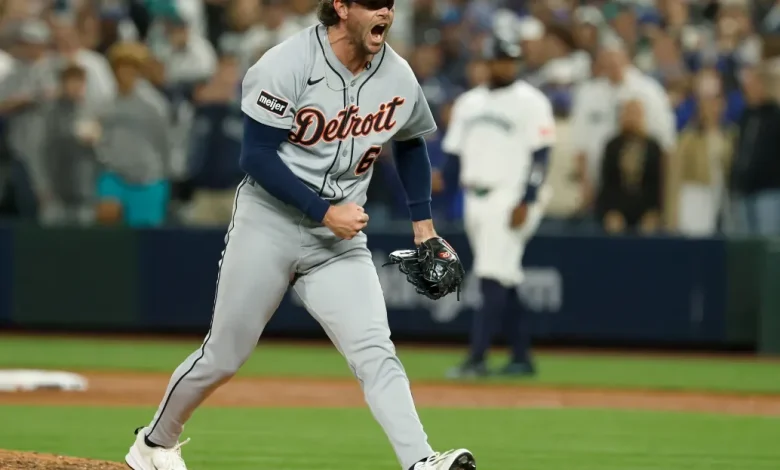
As we at BlessYouBoys continue to write up interesting free agents that the Detroit Tigers should, or are reported to be interested in, only one free agent from the 2025 team stands out for a potential reunion. That would be right-hander Kyle Finnegan, who posted a stellar August after a midseason trade and quickly became a top leverage reliever for AJ Hinch.
The fit is fairly obvious. Detroit needs extensive help in the bullpen and already has targeted Finnegan twice in recent years for that job. Meanwhile, Finnegan just posted one of the best months of his career immediately after joining the Tigers and making a few changes to his arsenal. Both sides benefitted greatly the first time and Finnegan also seemed to fit right into the clubhouse culture. It’s so obvious, in fact, it’s already being reported that there’s mutual interest in a reunion.
Initially, Finnegan’s addition to the bullpen elicited mostly quiet optimism, with many considering him a quality pitcher but probably not enough to stave off Detroit’s mid-season swoon. That response was pretty well earned, given his solid, but uninspiring, career to that point. Finnegan was consistently the best pitcher on a bad Washington Nationals, which earned him tons of saves but didn’t necessarily make him a dominant closer.
From his debut in 2020 to the 2025 Trade Deadline, 108 relievers threw 200 or more innings. Among them, Finnegan placed 8th in saves, but 62nd in ERA and 85th in FIP. It reached the point Washington non-tendered him after a 38-save 2024 because his projected arbitration salary wasn’t worth an ERA in the upper 3’s and less than one strikeout per inning. They brought him back, though, and flipped him to Detroit for a pair of decent young project arms in RJ Sales and Josh Randall at the deadline.
The Tigers had a clear plan for Finnegan. It started with throwing his best pitch, his splitter, a lot more and using his fastball a bit more judiciously. His splitter usage spiked from 30% to 55%, and his strikeout rate followed. As a National, Finnegan struck out 23% of all batters faced; with Detroit, that was 35%. There were a few other changes, such as a slight increase to his arm angle, and all of that points to Finnegan’s breakout being mostly legitimate. The only thing that slowed him down was a groin injury late in the year which seems likely to have impacted his playoff performance, too. It’s entirely possible he hurried back a little early from that injury. Either way he was never the same in late September and in the postseason.
Teams interested in Finnegan are surely all asking the same question: how much of his Tigers’ success was luck and how much was due to sustainable improvements? There are a handful of ways to answer that.
One would be the “luck” stats, like BABIP and LOB%; in Detroit, Finnegan’s BABIP was an unsustainable .211 and LOB%, which is the rate he stranded baserunners, was a barely sustainable 86.2%. Ok, so the 1.50 ERA is probably not his new talent level, fine. At the same time, his barrel and hard hit rates all decreased, too, which suggests some tangible improvements to contact suppression. Maybe a lower BABIP is reasonable, just not that low.
What about his newfound strikeouts? His contact rate dropped from 86.2% with Washington to 71.4% in Detroit, which suggests he earned a lot of those strikeouts. More whiffs and weak contact is a good place to start, and we already know he changed his pitch selection. There’s a lot of evidence that Detroit’s version of Finnegan was a better pitcher than Washington’s, but also a luckier one. Sometimes those go hand in hand, though.
There’s one more thing to consider, however: sample size. Finnegan pitched 16 games for Detroit. You don’t need me to tell you that’s not very many! What if that’s just an OK pitcher on a hot streak? Or that he simply benefited from much better catching and a smarter, savvier coaching staff? In that case the Tigers could theoretically do the same thing cheaper by acquiring a different pitcher who hasn’t had a tantalizing, if short, breakout with them already. It wouldn’t be the first time a reliever overperformed for a few weeks. How can we tell the difference from here?
That’s not the easiest question to answer. To try, I looked at Finnegan’s career in 16-game samples to see if this was an outlier or if he frequently had stellar stretches like this before fading back to his norm. My theory was if this is common, then it’s likely just sample size noise, but if this 16 game stretch stood out, it might represent a real breakout.
Here’s Finnegan’s rolling strikeout and walk rates for every 16 game stretch of his Major League career. Over on the far right – precisely when the strikeout rate starts to climb and the walk rate starts to drop – is his first game with Detroit. I’m not prepared to say this stretch of his is entirely unprecedented, since he’s had similar hot stretches before, but none had higher strikeout rates than he reached with Detroit. At the least, it’s further support that this one was a little different. When paired with the improved soft contact rates and a change to his pitch mix, it makes it fairly easy to predict a better Finnegan moving forward.
Contract predictions have Finnegan in the bottom of the second tier of free agent relievers this winter, generally around arms like Luke Weaver or Emilio Pagan. That type of player typically signs for a short, medium-value contract, like 2 years and under $25M total. That’s hardly a prohibitive cost for a good player with some latent upside. It’s especially reasonable when the team knows the player and just helped him to the best month of his career. If Detroit wants Finnegan back, and at this point it’s likely they do, this should be a straightforward process. Sometimes, things really are as simple as they seem.