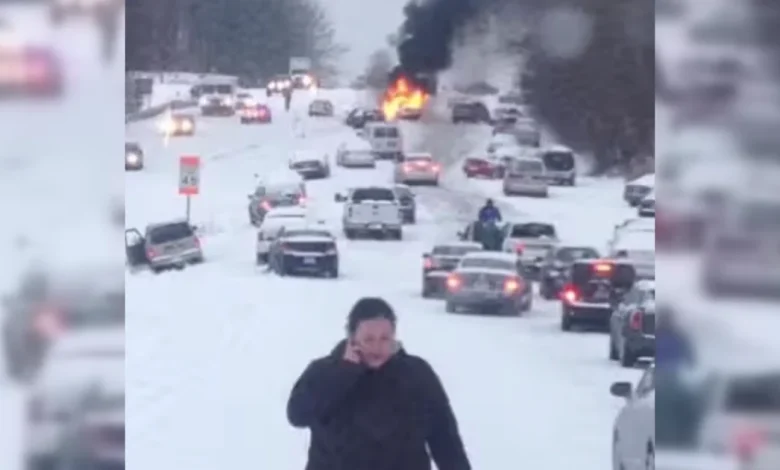
While snow is expected to remain mostly north of the Triangle on Friday, Raleigh has a history with significant snowfalls.
Forecasters with the National Oceanic and Atmospheric Administrator [NOAA] give a 71% chance of La Niña conditions from October to December and a 54% chance of it in December to February.
In Raleigh, 64% of La Niña winters yield below-average snowfall.
The normal snowfall for central North Carolina is around 5 to 6 inches of snow. This winter, the WRAL winter weather outlook calls for 1 to 3 inches of snow.
Here’s a look at the most significant snowfalls that have blanketed Raleigh and left a mark on its collective memory.
Early snowfall tales: The ‘Hard Winter’ of 1783-1784:
Raleigh’s snow history dates back to the late 18th century, with the arrival of European settlers coinciding with heavy snowfall and bitter cold.
The winter of 1783-1784, known as the “Hard Winter,” started in June 1783 after the Icelandic volcano Laki is speculated ot have caused an unusually dry fog and cold in North America, according to Geophysical Research Letters by the AGU.
“The Hard Winter” set the stage for Raleigh’s encounters with significant snowfall, marking the beginning of a snowy legacy.
Raleigh’s great snowfall of 2000: A record-breaking winter wonderland:
On Jan. 25, 2000, Raleigh experienced a snowfall for the ages. This record-breaking storm, often dubbed the Raleigh Snowmageddon or Raleigh Snowpocalypse, lasted an entire day, leaving behind more than 20.3 inches of snow. The city transformed into a winter wonderland, with piles of snow lingering for weeks and power outages challenging residents in the aftermath.
Jan. 3, 2002: A snowy day to remember
Fast forward to Jan. 3, 2002, when Raleigh witnessed another impressive snowfall.
This winter storm deposited 10.8 inches of snow on the Triangle, prompting then-Gov. Mike Easley to encourage residents to stay home and indulge in snowy family activities.
The storm caused widespread power outages and travel disruptions, leaving a lasting imprint on Raleighites.
The white Christmas of 2010: A holiday gift of snow
December 2010 gifted Raleigh with a historic winter storm, delivering a white Christmas to the delight of many.
The snow started falling early on a Sunday morning, culminating in more than 12 inches of snow by Monday morning. Mother Nature granted the wish for a white Christmas, creating picturesque scenes across Raleigh and central North Carolina.
Feb. 12, 2014, nor’easter: A memorable snowfall and viral moments
In February 2014, a powerful nor’easter swept through the Southern and East Coast regions, leaving up to a foot of snow in its wake.
While Raleigh recorded 3.3 inches of snow, it was the chaotic aftermath captured in a viral photo that etched this storm into collective memory.
Raleighites navigating the snow-laden streets became the subjects of creative memes that circulated widely. Some called it the “snowpocalypse.”
Winter weather on December 9, 2018: A challenging yet beautiful event:
Dec. 9, 2018, marked another intense winter storm that dumped snow across North Carolina.
Up to 11 inches fell in parts of the Triangle before transitioning to rain, affecting around 200,000 people who lost power.
Despite the challenges, the storm left a picturesque layer of snow, with concerns about black ice lingering in its wake.
As much as 5 inches fell in January 2022
Up to 5 inches of snow fell from Jan. 20-22, 2022, across central North Carolina.
People went sledding at Dorothea Dix Park in Raleigh. The snow accumulation and ice made for treacherous road conditions.
Snow drought ends in January 2025
After three years with no snow, Jan. 10, 2025, broke the drought. Snowfall totals in Wake County ranged from 1 to 3 inches. The official measurement at Raleigh-Durham International Airport was .7 inches.
The National Weather Service said it ended a 1,076-day drought of measurable snow in Raleigh.
The longest stretch without measurable snow in Raleigh was 1,164 days, which ended on Feb. 19, 1993. Records go back to 1887, according to the National Weather Service.