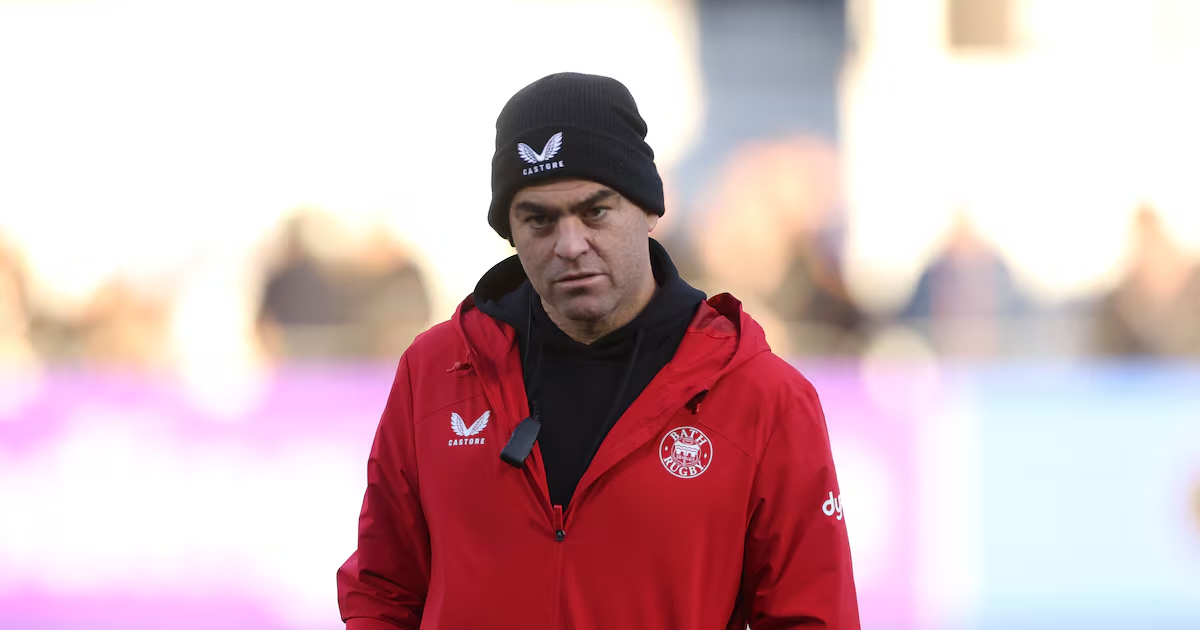
Conor Murray: Johann van Graan made one early decision that proved very costly for Munster

“We quickly find out that we are dealing with two very different human beings. The outgoing boss was hard as nails, full of his own authority, a man to be feared as well as respected.
“Johann was quiet, understated, sincere and courteous; he had a deep religious faith; you’d rarely hear him swearing.
“In terms of the overall ambience, it was a very different vibe to the Rassie/Jacques Nienaber regime.”
***
Excuse the shameless plug of my autobiography Cloud 9 (in book shops this Christmas), but it makes sense to remember Johann van Graan’s five years at Munster ahead of the Champions Cup opener against Bath at The Rec.
It was November 2017 when Munster replaced one South African with another as Rassie Erasmus returned home to become the greatest coach of the greatest team rugby has ever seen.
By guiding Bath to the Premiership last season, Van Graan has proved that he is a highly competent coach but eight years ago he was an unknown, soft-spoken, 37-year-old charged with replacing a Springbok icon.
It was a different vibe all right. Johann had no head coaching experience.
Still, I had a soft spot for Van Graan during his time in charge, even as Munster continued a trophy-less period in Leinster’s shadow. He is low risk tactically, but a good coach nonetheless, and a decent man who poured himself into the Munster project.
We now know that nobody could have done a better job than Rassie. We also lost Jacques Nienaber, his sidekick, who had made an immediate impact at training.
Van Graan made one early decision that proved very costly. He picked Alex Wootton over Simon Zebo for the 2018 semi-final against Racing 92.
Sun shining. The Red Army down in Bordeaux. A monumental contest was promised. The game was over inside 22 minutes as Teddy Thomas sprinted down our left wing for three tries.
Being the epitome of French flair, Thomas gave up his hat-trick in the in-goal area by nonchalantly tossing the pill to Maxime Machenaud.
Racing’s Teddy Thomas crosses the line before setting up Maxime Machenaud for his side third try against Munster in Bordeaux in April 2018. Photograph: James Crombie/Inpho
Van Graan was trying to reward Alex’s form in lesser games. By sticking to his principles, he learned a valuable lesson for any coach in any sport: never go to war in a European semi-final without a big game hunter like Zebo.
Semi-finals are all or nothing affairs. Leinster learned a similarly harsh lesson during last season’s loss to Northampton when they benched Jordie Barrett, Andrew Porter and Jack Conan.
Johann benefited hugely from his time coaching Munster, going on to become a top coach in the English system and one day, if Rassie ever decides to step down, he has the CV to lead the Springboks.
What sticks in my craw from those days is Munster stood still when myself, Keith Earls, CJ Stander and Peter O’Mahony were desperate to build on the achievements of the O’Connell-O’Gara era that delivered European titles in 2006 and 2008.
Like the Leinster sides that won four Champions Cups in nine years, that Munster group was full of Ireland starters but it was clever recruitment that made the difference in semis and finals. Men like Trevor Halstead, Doug Howlett, Rua Tipoki, Rocky Elsom, Brad Thorn and Isa Nacewa drove both provinces over the line against the best English and French clubs.
That’s how European titles are won, by identifying and addressing weak areas.
I am encouraged by Munster’s recruitment since I retired last summer. For starters, Clayton McMillan has come in with a hard-nosed New Zealand mentality. I hear he is a cultural fit.
What has impressed me the most about McMillan, so far, is he has not tried to reinvent the wheel. The attack is still run by Mike Prendergast, the defence is still coached by Denis Leamy. He has let his local assistants get on with their jobs when previous head coaches have completely changed the game plan.
Prendergast’s approach to rugby is similar enough to what McMillan had the Chiefs doing in New Zealand. When Leamy speaks, players listen.
Concerns at tight head prop were identified and addressed by the arrival of Michael Ala’alatoa after another South African scrum (the Stormers) gave an Irish pack a torrid time last Saturday in Thomond Park.
Munster losing 27-21 to the Stormers, having led 21-3, can be passed off as a blip in an otherwise impressive start under the Kiwi.
Bath under Van Graan is another level up from the Stormers. Irish fans will be familiar with Ross Molony and Quinn Roux, while Munster people might remember Thomas du Toit’s three month stint in 2016 before he returned home to become the Springbok tight head.
Now 30, the Aviva Stadium witnessed du Toit’s power surge a few weeks ago.
So, the scrum will be under pressure at The Rec. If it crumbles, or any area of Munster’s performance is off, Finn Russell will rack up the points for Bath.
This is a perfect game for Munster. It should tell McMillan everything he needs to know about the squad he has inherited. A trip over to play the English champions is the closest the players will get to a test match ahead of the Six Nations.