Open this photo in gallery:
Former Canadian men’s national team member Atiba Hutchinson answers questions during a FIFA legends panel discussion at The Kennedy Center in Washington on Wednesday.Dan Mullan/Getty Images
With notable exceptions – such as the error-strewn farce ahead of the 1982 tournament – the World Cup draw usually goes off without a hitch.
Lottery balls are plucked from buckets, the identities of the teams are revealed, the groups are methodically filled, and fans across the planet can start plotting their teams’ path to glory.
While there is nothing to suggest that on the surface, Friday’s event will be anything but a success, others whisper quietly that it could be improved.
Improvements aren’t sought in the amount of pomp around the star-studded event but in the process that is used to fill each of the round-robin groups.
After dividing the teams into tiered pots – generally seeded according to the world rankings – FIFA employs a sequential method to fill the groups in order, so that each will contain one team from Pot 1, one from Pot 2, and so on. There are various constraints added on top of that, such as restricting the amount of teams from each of the six confederations to one per group – with the exception of UEFA, which is allowed at least one and no more than two per group, owing to the 16 European teams in the draw.
Everything you need to know about the World Cup draw
However, these constraints, alongside the sequential method – which moves the conflicted team to the next available group – introduce the possibility for inherent bias in the proceedings.
That’s the opinion of Jeffrey Rosenthal, a professor of statistics at the University of Toronto. Rosenthal collaborated with Gareth Roberts, a colleague at Britain’s University of Warwick, three years ago to produce a paper looking at World Cup draws, specifically examining the probabilities surrounding the draw for the 2022 tournament in Qatar.
What they found was that FIFA’s sequential method slightly tweaked the purely random possibilities of certain teams ending up with certain other teams. For example, with the host Qatar – which was seeded in Pot 1 despite being the world’s 50th-ranked team at the time – getting drawn in that group became a far more desirable outcome than alongside teams such as Spain or Argentina.
But while Canada should have had a 15.4-per-cent chance of ending up with the Qataris in a truly random draw, with FIFA’s process, it was 16.5 per cent. Similarly for the United States, what should have been a 9.06-per-cent chance rose to 12.5 per cent under the sequential system.
Open this photo in gallery:
Canadian players sing the national anthem ahead of their Group F World Cup match against Morocco in Doha, Qatar, on Dec. 1, 2022.Nathan Denette/The Canadian Press
“It can change it by some number of per cent,” Rosenthal said. “That was a relative increase of 38 per cent, that is to say it was 38 per cent more likely that the United States would be in the group with Qatar based on their sequential draw than it would have been with a truly random draw.”
In the end, the extra percentage points made no difference, as Canada and the U.S. were drawn with Belgium and England respectively from Pot 1.
While neither Rosenthal nor Roberts were able to find the time to study this year’s draw in depth, Rosenthal thinks that much of the same level of bias will still be present. And that’s even with the addition of another 16 teams, with 48 teams being divided into 12 groups in what is the biggest men’s World Cup in history. Also, FIFA has introduced pathways to ensure that the top four seeds won’t meet until the semi-finals, provided they win their groups.
“I think probably the amount of sort of non-uniform bias just rose,” he said, noting that there are more teams, more groups, rules and constraints this time around.
“Basically, if there weren’t any constraints, it’s just any team can be in any group, and there’s no rules, then the sequential method would be just fine. There’d be no bias, there’d be no problem.”
Cathal Kelly: The 2026 FIFA World Cup will be the one that goes off the rails
Open this photo in gallery:
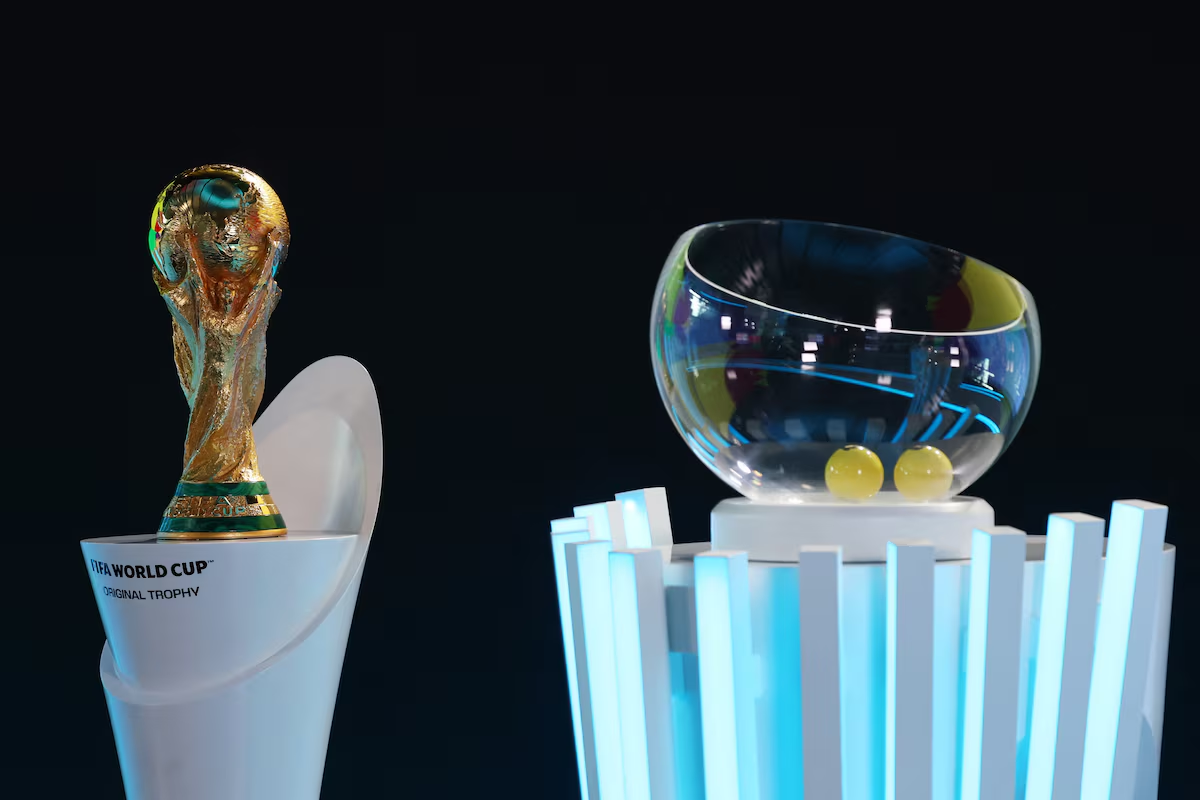
The original FIFA World Cup trophy is on display during the draws for the World Cup Playoff Tournament and European Playoff draws on Nov. 20 in Zurich.Denis Balibouse/Reuters
In their 2022 study, Rosenthal and Roberts came up with three alternative methods that would have removed the possibility of additional bias. While at least one of them wouldn’t have worked for FIFA’s draw – it was basically a computer program, with no need for a red-carpet event – one would have maintained the use of lottery balls and could have done the job. Rosenthal said that Roberts reached out to a contact who worked for FIFA, but to no avail.
“They had some back and forth e-mails or something,” he said. “But it didn’t go too far.”
Three years ago, Rosenthal accurately predicted Canada would not make it out of its World Cup group.
However, he did give Canada a 97.3-per-cent chance to score a goal – a feat it had been unable to achieve during its three previous men’s World Cup games, in 1986. He was proved right in the second game as Alphonso Davies found the back of the net.
As a seeded team this time around, there is an above-average chance that Canada gets a much more palatable group, whatever the percentage level of bias in the proceedings.
“I think there’s certainly a very good chance they’ll have their best World Cup showing ever,” Rosenthal said.
“And I’d say there’s quite a decent chance they’ll make it out of the group stage and into the elimination rounds, and I’ll be rooting for them all the way. I haven’t looked so I don’t have a specific probability prediction, but I think they’ll probably do well.”





![How to Watch Disney Plus in Thailand [Quick Steps]](https://cdn1.emegypt.net/wp-content/uploads/2025/12/How-to-Watch-Disney-Plus-in-Thailand-Quick-Steps-390x220.webp)