Opinion: Liberals nervously await the effects of Steven Guilbeault’s resignation on the party’s Quebec fortunes

Open this photo in gallery:
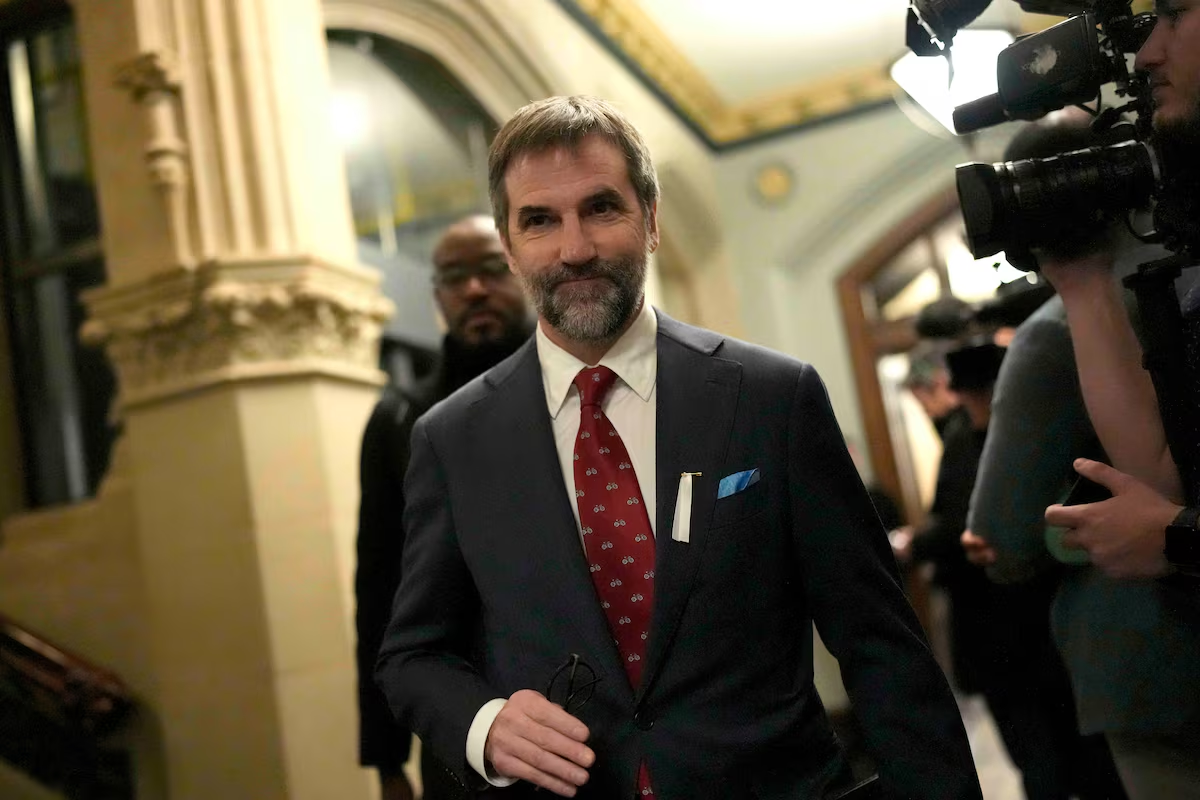
Liberal MP Steven Guilbeault’s resignation from Prime Minister Mark Carney’s cabinet generated a minor earthquake in Laurier—Sainte-Marie.Justin Tang/The Canadian Press
The Montreal riding of Laurier–Sainte-Marie is ground zero for Quebec’s media elites and the beating heart of the province’s cultural industries. Not surprisingly, it skews progressive and has reliably sent left-leaning MPs to Ottawa for more than three decades.
Last week’s resignation of local MP Steven Guilbeault from Prime Minister Mark Carney’s cabinet generated a minor earthquake in Laurier—Sainte-Marie whose aftershocks are being nervously monitored in federal Liberal circles in Quebec.
Leading francophone media outlets treated his departure as a bombshell – which it was, for them at least. After all, Mr. Guilbeault had been the Quebec media’s favourite environmentalist long before he entered federal politics in 2019. He was a fixture on Radio-Canada, regularly slamming the climate inaction of previous Liberal and Conservative governments.
As environment minister under Justin Trudeau, Mr. Guilbeault championed two of the most controversial aspects of the government’s climate-change policy – a proposed cap on oil-and-gas sector greenhouse gas emissions, and regulations aimed at achieving a net-zero electricity grid by 2035. Since neither measure imposed direct costs on Quebec – which produces no oil or gas, and whose electricity sector is already essentially carbon-free – the plans were naturally popular in a province that likes to see itself as greener-than-thou.
Opinion: Alberta-Ottawa MOU is a climate breakthrough, despite Steven Guilbeault’s misplaced outrage
Steven Guilbeault resigns from cabinet in protest against Carney’s Alberta energy deal
Mr. Guilbeault quit as Mr. Carney’s culture minister and Quebec lieutenant after the Prime Minister agreed to scrap those and other climate measures as part of a memorandum of understanding (MOU) with the Alberta government to facilitate a new bitumen pipeline to the West Coast.
The question now is how much damage Mr. Guilbeault’s decision to quit does to the Liberals in Quebec. He was widely seen in the province as the environmental conscience of the Carney government. His repudiation of the MOU should be bad news for Mr. Carney, no?
That is far from certain. Mr. Guilbeault may be a Quebec media darling, but his departure is at best a neutral development in many regions of the province that depend on resource development. As environment minister, Mr. Guilbeault’s opposition to proposals for a liquified natural gas terminal in the Saguenay region and threat to ban logging to protect woodland caribou herds were deeply unpopular in many areas of Quebec.
An online Abacus poll conducted after Mr. Guilbeault’s resignation suggests that much of his reputation as a popular politician in Quebec may be a media construct. Only 25 per cent of Quebec respondents said they had a favourable opinion of the former Greenpeace activist, compared to 34 per cent who were neutral and 19 per cent who had a negative view of him. By contrast, Mr. Carney had a 48-per-cent favourable rating in Quebec, giving him a net positive score of plus-25 percentage points in the province, according to Abacus.
Mr. Guilbeault, meanwhile, garners net-negative impressions in the rest of the country. “In Alberta, his net score is a staggering minus-31, and even in Quebec, it’s barely positive at plus-6. Nationally, his net impression sits at minus-12, putting him well behind” Mr. Carney and even Alberta Premier Danielle Smith, Abacus noted.
Culture Minister Steven Guilbeault resigned from Prime Minister Mark Carney’s cabinet on Thursday to protest his government’s new pact with Alberta on a proposed new pipeline. The environmentalist and longtime climate activist was the face of the previous Liberal government’s ambitious climate agenda for more than half a decade.
The Canadian Press
Support for the MOU is lower in Quebec than any other region except Atlantic Canada. Even so, more Quebeckers (52 per cent) consider the deal to be “a worthwhile compromise” than characterize it as a “betrayal” on the environment (28 per cent).
This does not mean that Mr. Carney need not worry about some fallout from Mr. Guilbeault’s resignation in Quebec, where the Liberals currently hold 44 of the province’s 78 seats. Under Mr. Carney, the Liberals gained nine Quebec seats in the April federal election compared to 2021. Those gains came at the expense of the Bloc Québécois, which lost 10 seats overall, ending up with 22 MPs. The Liberal candidate in the suburban Montreal riding of Terrebonne won by a single vote, and only then after a postal code error on a voter registration card prevented a committed Bloc elector from casting a ballot.
Terrebonne and several other narrowly won Liberal seats could easily swing back to the Bloc in a by-election or snap federal vote. Bloc Leader Yves-François Blanchet, who vows to support the B.C. government in its opposition to a northern B.C. pipeline, will milk any internal dissension within Liberal ranks over Mr. Carney’s climate climb-down to woo back progressive voters who switched from his party to the Grits in the last election amid Donald Trump’s tariff threats.
For now, Mr. Guilbeault’s decision to stay in the Liberal caucus suggests he is keeping his options open.