Jesse Marsch exclusive: ‘Don’t tell me about making history unless you’re willing to sacrifice’ – The Athletic

The Athletic has live coverage of the FIFA Men’s 2026 World Cup draw.
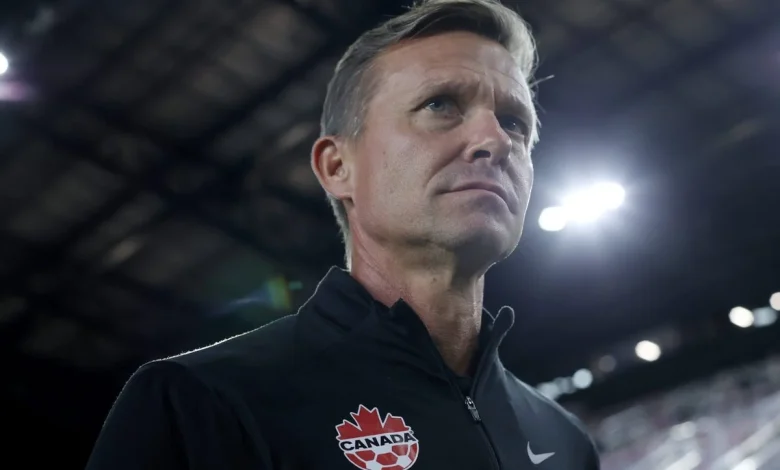
NEW YORK – Jesse Marsch has one unwavering goal in mind for Canada at next summer’s World Cup.
“We want to win our group,” says the men’s national team head coach.
How Canada can achieve that will be revealed when Marsch and the rest of the world learn who they will play in Friday’s draw. As co-hosts, Canada are in Pot 1 alongside the United States, Mexico and the best teams in the tournament but could still find themselves pitted against nations such as Colombia, Norway — led by one of the world’s best strikers and Marsch’s former player at Red Bull Salzburg, Erling Haaland — and even Italy, should they win their play-off games.
But it will be no surprise to anyone who has met Marsch that the American is confident about Canada winning their first men’s World Cup game next summer. Across his year and a half in charge of the national team, Marsch has already guided Canada to a Copa America semifinal and the best FIFA ranking (26th) in the program’s history.
Direct and uncompromising over an absorbing one-hour discussion in the heart of Manhattan on Tuesday, Marsch spoke to a small group of reporters from The Athletic before Friday’s 2026 World Cup draw.
“I could walk away from football right now and not think twice about ever going back,” says Marsch, 52. “And I’m different that way from a lot of football coaches. A lot of football coaches are attached to work and their role and maybe the fame and money. I don’t give a s–t about any of that. I’ve already achieved way more than I ever thought I would.
“I’m old enough now that I just want to do the things in my life that are meaningful to me. I like football, but love coaching teams that I love.”
If Canada are going to get their best result at a World Cup — getting out of the group stage after going 0-3 in their previous two World Cups — they’ll need to learn from their disappointing run in 2022 in Qatar. Topping the group would enable Canada to have a last-32 game in Vancouver rather than Los Angeles, where the Group B runner-up will play.
To achieve that, Marsch believes Canada must learn to manage pressure and expectations better.
“There was a lot of internal fanfare around being at the World Cup,” says Marsch. “All these packages in (Canadian player’s) rooms, decorated doors, all these different rooms for the team to meet in, meetings here and there, everything was grandiose. Like, ‘Now we’re at the World Cup!’ Which in some ways created a new feeling in the team and this new pressure.
“Now, we’re going to be at a home World Cup. I don’t need to f—ing put something on their door for them to know that they’re at a home World Cup, right? And I’m not criticizing, I’m just saying what I’ve talked to the team about is: We’re going to stay calm. We’re going to just treat this like every other camp and experience we’ve had.”
Marsch wants Canada to show how much more self-assured they can become. He knows his side has talent — names such as Alphonso Davies, Jonathan David and Moise Bombito speak for themselves – but there is another layer, with a more hardened mentality, his team has to hit next summer.
“Whether it’s the arrogance or growing up or the aggression in their game, those things were all lacking a little bit,” Marsch says of how his team acts now compared to when he took over in 2024, describing how he has tried to get his humble Canadian side to act more American in his 27 games in charge. The thirteen wins, six draws and eight losses (including penalty shootouts) they have achieved appear to show it is working.
“I never meant to insult them, but really get them to understand how they needed to improve,” Marsch says. “I had to be very direct and say, ‘It’s not good enough here.’
“In the beginning… they would say things like, ‘We want to make history.’ And I’m like, ‘Don’t f—ing tell me about making history unless you’re willing to sacrifice and understand in real ways how you have to get better. And then we can talk about it, right?’
“And by the way, every time they get to where I want them to or rise to the challenge or exceed my expectations, the thing I always say is, ‘Good job, guys, but now the bar’s higher.’
Jesse Marsch believes being direct with players pays off (The Athletic)
“There’s been very few times where I’ve talked about how much I love being their coach and how proud I am to be their coach, but I’ve been more about raising the standards every time we’re together. And they love it.”
Being direct with his players has helped.
“Most f—ing coaches in Europe don’t give the lineup until 30 or 60 minutes before the game,” he says, warming to his theme. “And usually it’s because they don’t want to have a conversation with the player about why he’s not playing. They don’t want to bother.
“I usually give (the lineup) the day before. And then I usually have the conversations with the players about why they’re not starting. Because that’s what I believe in; in showing them respect.”
When recent dual national recruit Alfie Jones was waiting for his Canadian passport during the November international window, for example, he was not eligible to play in a 0-0 draw against Ecuador but did play in a 2-0 win against Venezuela days later.
“I was like, ‘Guys, I’m not sure if he’s going to get (his passport),’” says Marsch. “If he gets it, he’s starting. If not, then we’re doing this. They’re mature enough if you’re f—ing honest with them, they’re not children.”
Marsch’s attitude comes in part from his own experience, as a player for 14 seasons in Major League Soccer before serving as an assistant coach for the United States at the 2010 World Cup. And partly because of what he’s learned since moving from being a club-level coach, including stops at Leeds United, RB Leipzig and Salzburg.
He says he “thought I was going to be the U.S. coach” after an interview process that resulted in Mauricio Pochettino’s appointment with the U.S. men’s national team, but then shifted focus to Canada and how he could implement his desired style of soccer — pacy, uncompromising and Red Bull-inspired — with the Canadian player pool.
“I heard two things when I became an international manager: you can’t have a style of play and you can’t develop players,” he says. “And we’ve done the exact opposite.
“I met with a lot of national team coaches before. I met with (former England head coach) Gareth Southgate, (Austria national team coach) Ralf Rangnick, and (former Germany head coach) Hansi Flick. They all had their own versions of things that were important.
“Ralf said he coached the national team almost exactly the same as how he coached club teams. Now, he has a lot of players who grew up in Red Bull systems, so maybe it’s easier. I haven’t coached exactly the same, but I learned mostly from when I went to Leeds.
“It was the first time I went to a team mid-season, as opposed to having a full start of a preseason. And I learned about the precision of communication and the precision of transforming a team into a tactical vision and the precision of that there. And I learned from my successes and failures there as well, and then adapted that to be what I thought was necessary for the Canadian national team.”
Jesse Marsch celebrates Alphonso Davies after Canada’s Copa America quarterfinal win in July 2024 (Ron Jenkins / Getty Images)
Meeting with Southgate allowed Marsch to see the former England manager as “such a humble person.”
“He’s such an incredible man. He would always talk about England not quite being in the upper tier of Spain or France, and I appreciated why he would think that way. But I would always say, ‘Yeah, but you guys are really good!’ England should, as a team, have the hopes of winning a World Cup.”
In a little under a year in England, he saw the highs and the lows that come with being in the Premier League.
“The one year (2022-23 season) that I was in the Premier League, there was 14 (coaches fired), right? And that’s the highest ever. How’s a manager ever going to build anything if he has a six-month, eight-month lifespan?” Marsch says.
After leaving Leeds, he says he was offered the job of head coach at Southampton but turned it down.
“That’s why I wasn’t sure about Southampton,” Marsch said. “When I was out of football for a while, all I was doing was evaluating, ‘Where could work?’ Not, ‘Where could I win?’ but, ‘Where could I work?’ And that’s what landed me (with Canada), which I’m very thankful for.
“Every manager has to decide what he values. You make a lot of money being a manager, right? So it’s good to have jobs and sometimes it’s good business getting fired because you collect salaries over multiple years and then you get a new job, but I don’t care about that.
“I want to work at places that I’m rewarded personally and professionally and I can do the things that I believe are right, and those things usually involve being part of a team, working with good people, being an employee, but also then being a manager. I don’t need to be the boss, I don’t need to tell everybody what to do.”
Marsch remembers asking his Leeds players how they felt seeing managers fired during their time playing for the team.
“At what point do you take responsibility for making sure the coach didn’t get fired? I told them I played 14 years professionally, I never had one coach fired in 14 years. I cared about the club and I cared about winning.
“I don’t want to be judged by wins and losses. I want to be judged by creating something. And so this is what I’ve done with the national team. I want to show that I love these boys and I want them to show how good they are.”
As The Athletic previously reported, the likelihood of Marsch extending his contract with Canada beyond the World Cup is increasing.
Marsch says he began discussions with Canada Soccer general secretary and CEO Kevin Blue this year about a new deal, even if the head coach was at first a little hesitant.
Marsch and his players mark a 1-0 win over Wales in September (Visionhaus / Getty Images)
“The wave of popularity of a national team coach can go in a lot of different ways at any moment,” he says. “And I wanted to make sure that the program — which was the most important thing, and not my presence in the program — continues to move forward in a way that honours what the sport is in the country and what this team can achieve.”
For Canada’s national team to achieve what Marsch believes they can, it will take him longer than the two years he had on his contract.
“I’m much more open to the idea now of the discussions moving forward to be here longer. I want to be here longer because I enjoy the job, the players and the people in the country, and I think the association thinks the task of what needs to be done is longer than just two years. And to do it effectively, I need to commit to it longer.”
Few people in Canada would have any problem with Marsch extending his contract if he helps deliver Canada’s first World Cup win and achieves their goal of winning Group B.
We’ll soon find out how easy or difficult achieving that goal will be.