Every home in Uzbekistan could switch on the lights using only clean electricity in 2026. The government says green energy generation will reach 23 billion kilowatt-hours, enough to cover the entire annual consumption of the country’s population.
The announcement came from President Shavkat Mirziyoyev as he launched dozens of new renewable and grid projects at the forum “Powering the Future: Sustainable Energy for New Uzbekistan.”
One of the key announcements concerns the launch of 42 new projects valued at €9.46 billion, including generation facilities, energy-storage systems, substations and high-voltage networks. These projects form part of a broader national strategy to reinforce energy security and modernise infrastructure.
They include 16 solar, wind, thermal and hydropower plants with a combined capacity of 3,500 megawatts. The facilities are distributed across several regions of the country and represent a mix of public and private investment.
Another major development is the introduction of 10 utility-scale energy storage systems, providing 1,245 megawatts of capacity. According to the Ministry of Energy, these systems will make it possible to inject up to 1.5 billion kilowatt-hours of additional electricity into the grid during peak hours, helping stabilise supply.
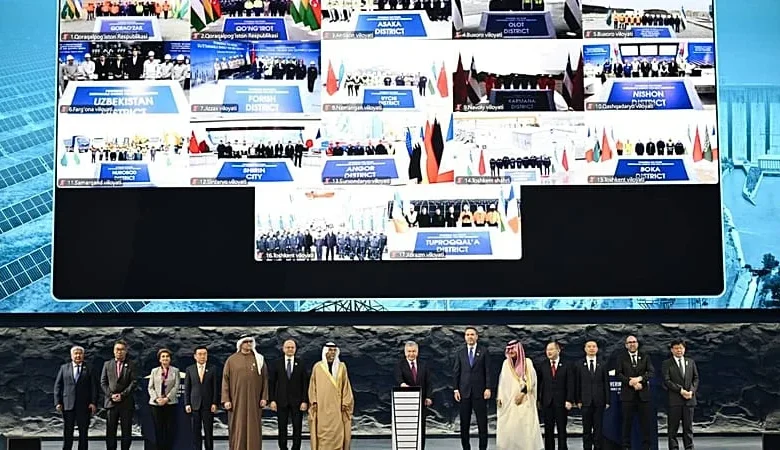
A presentation at the “Powering the Future” forum outlines $11 billion in energy projects across Uzbekistan – Courtesy of the Press Service of the President of Uzbekistan
To support the new infrastructure, Uzbekistan is also commissioning 11 substations and building 420 kilometres of high-voltage transmission lines.
“We have set two major objectives as our main priorities in this direction. The first is to ensure a reliable and uninterrupted energy supply for all sectors and regions. The second is to achieve this goal through modern, environmentally friendly, and renewable alternative energy sources,” explained Mirziyoyev.
The forum brought together government officials, international companies and financial institutions. Over recent years, Uzbekistan attracted approximately €30 billion to the sector. As a result, it has added 9,000 megawatts of new capacity since 2017, with total electricity generation rising from 60 billion kilowatt-hours to 85 billion in 2024.
Many of the new projects involve international companies from Saudi Arabia, Turkiye, the UAE, China, France and Qatar.
Saudi Arabia’s ACWA Power remains one of the most active investors. “Uzbekistan’s energy mix is becoming greener every year,” said Jon Zaidi, the company’s Country Head. “This year alone we added more than 2,500 megawatts to the grid, and the Vision 2030 target of reaching 54% renewables is very important for us.”
Story Continues
Related
Another contributor is Voltalia from France, which recently signed an investment agreement for a 200-megawatt hybrid project combining wind generation and storage. According to Deputy CEO Yoni Ammar, “We are also developing a 500-megawatt storage project called Turan, and expect construction to begin in 2026.”
European companies are also supporting more conventional energy projects. Pierre- Paul Antheunissens, General Director of Electicite de France (EDF) Central Asia said: “In Uzbekistan we are building two major gas-fired power plants together with partners from Japan, Qatar and Germany, with the first turbine tests set to take place this week.”
Uzbekistan’s minister of Energy, Jurabek Mirzamakhmudov, stressed that the expansion of renewable energy will reduce natural gas consumption by nearly 7 billion cubic meters, while preventing 11 million tons of harmful emissions.
By 2030, the government plans to add more than 17,000 megawatts of renewable-energy capacity, increasing the share of green energy in overall generation to 54%. Achieving this target will require the construction of 6,000 kilometres of high-voltage networks, including 1,000 kilometres scheduled for next year.
Delegates gather in Tashkent for the “Powering the Future” forum on Uzbekistan’s new energy projects – Courtesy of the Press Service of the President of Uzbekistan
At this year’s COP-30 climate conference in Brazil, Uzbekistan reported progress on the iCraft initiative, designed with the World Bank. The project accounts for 23 million tons of verified greenhouse-gas reductions and has enabled the country to launch a carbon-credit trading system. Seventeen domestic industrial companies have already adopted international green-energy certification, with the government aiming to increase this number to 100 within two years.
The country is now extending public–private partnerships to energy distribution. Earlier this year, the Samarkand regional grid was transferred to private management under an agreement with Turkiye’s Aksa Elektrik. The company will oversee operational management, invest in modernisation and reduce losses expected to save around €17.2 million annually.
The government says several more regional grids will be offered to investors in the coming years as part of a strategy to improve efficiency and introduce new management practices.
Uzbekistan is also promoting small-scale renewable initiatives. A new programme will install 107 megawatts of rooftop and micro-solar plants across 300 mahallas, or neighbourhoods. The initiative aims to supply green energy to 30,000 low-income families, who will also be able to sell excess electricity to the grid.
President Mirziyoyev and foreign delegates at the “Powering the Future” energy forum in Tashkent – Courtesy of the Press Service of the President of Uzbekistan
Entrepreneurs are increasingly investing in small hydropower as well. This year, 40 micro-hydro plants with a total capacity of 40 megawatts generated 120 million kilowatt-hours of electricity. Another 65 megawatts of micro-hydropower capacity is planned for next year, which officials say will improve electricity supply for 80,000 households.
Uzbekistan has also stepped up energy cooperation with neighbouring countries. Next year, the country plans to begin financing the Kambarata-1 hydropower project together with Kyrgyzstan and Kazakhstan, aimed at strengthening the region’s shared water-energy system.
At the same time, work continues on the Green Energy Corridor, a project involving Azerbaijan and Kazakhstan that aims to facilitate the export of Central Asian electricity to Europe.