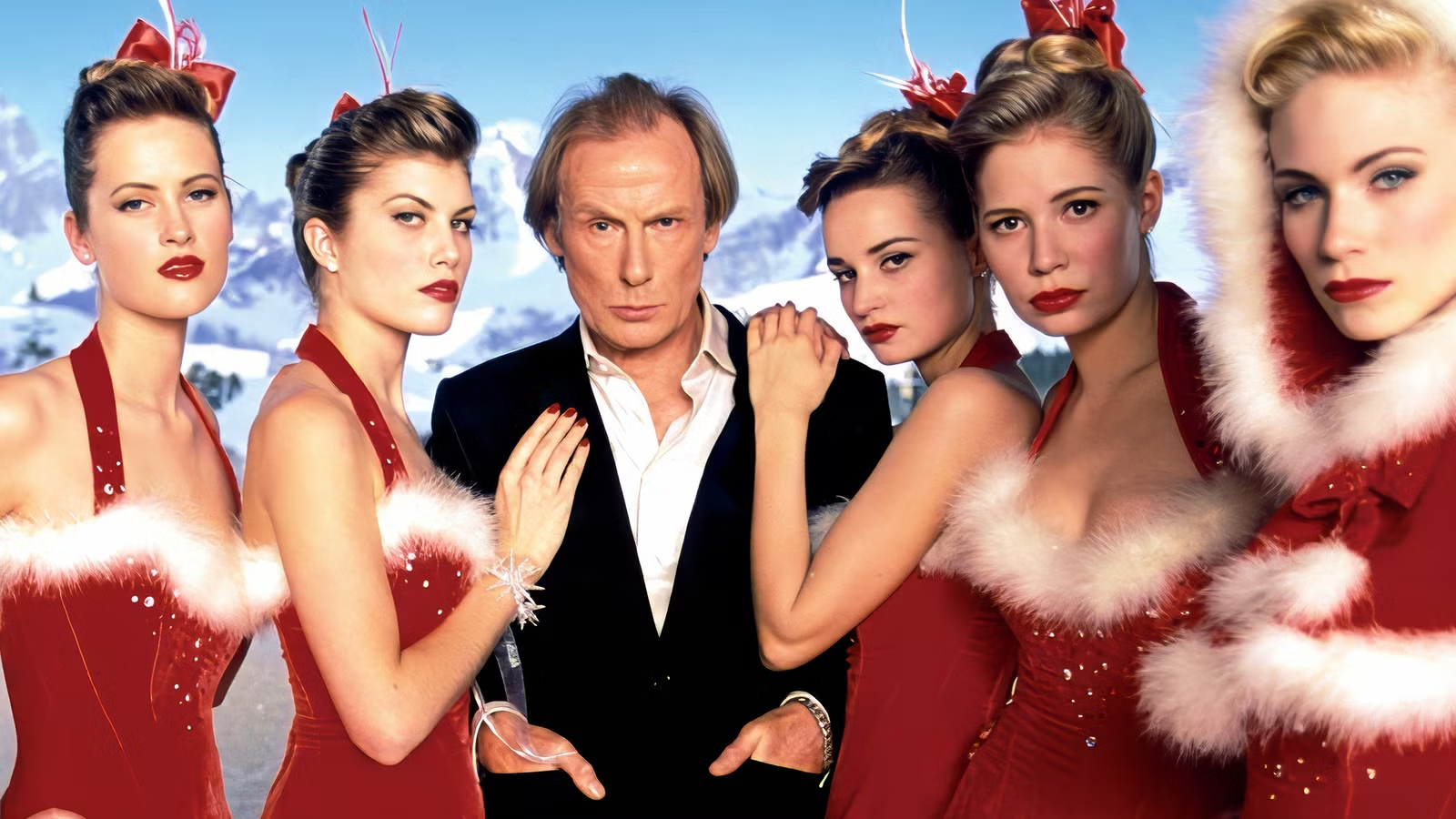
Richard Curtis’s 2003 Love Actually remains a Christmas movie staple more than twenty years after its release, and yes, it’s really been that long. The endurance of the festive classic shows just how much the movie’s multiple storylines, sharing many forms of love, resonate with audiences. In its storylines, Love Actually leans pretty heavily into tropes and archetypes, like the hopeless romantic (inappropriate cue card alert) and a husband with a wandering eye (midlife crisis cheater). But the best, and funniest, character is Billy Mack (Bill Nighy) as the ultimate exaggerated rock star figure. The aging rock star records a hollow Christmas single to top the charts, but this ambition is his label’s, not his. Mack’s attitude is shameless, witty, rebellious, and always charming, channeling the all-time golden personas of rock like David Bowie, Mick Jagger, and the Sex Pistols.
Billy Mack Is the Most Rock-Star Character in ‘Love Actually’
David BowieImage via BURIEZ/DALLE/startraksphoto.com
Bill Nighy’s performance in Love Actually truly embodied what, by the early 2000s, had become a dramatized caricature of the 20th-century rock star. The character of Billy Mack is an aging musician rather quickly losing his cool edge, and in search of a comeback at any cost. This results in the recording of a cheesy Christmas song, “Christmas Is All Around,” aimed to make it to number one on the charts. But Billy Mack is much cooler than that. Right off the bat, he is dressed in a flamboyant open shirt, tight trousers, and rocks a long haircut. The wardrobe alone is enough to draw parallels to the biggest rockers and glam rockers of the ‘70s, with Bowie never being one to hold back on visual aesthetics, and Jagger never failing to rock an XS jean, even now.
More than just aesthetics, Mack brought a rock star presence in his outrageous personality, particularly in promotional appearances for his single throughout Love Actually. In a TV appearance, hoping to boost the cheesy “Christmas Is All Around,” he uses a marker pen to draw rude images and messages on the posters of younger musicians, and gives some advice down the lens to children watching: “Here’s an important message from your uncle Bill: don’t buy drugs. Become a pop star, and they give you them for free.” It really is hilarious and shows his rebellious streak. The disregard of public palatability resembles the shambolic TV appearances of the Sex Pistols, and the open implication of personal drug use feels rather similar to David Bowie’s widely documented cocaine use in the Station to Station era. If he weren’t so charming, it would almost be irritating and obnoxious, but Mack’s coolly casual, cheeky nature alleviates any potential malice.
Related
22 Years Later and I Still Can’t Wrap My Head Around Keira Knightley’s Age Gap With This ‘Love Actually’ Co-Star
One age decade, two very different storylines.
Mack was also a shameless total womanizer, overtly discussing pretty explicit and private experiences with a myriad of women, even needlessly taking a jab at Britney Spears. I kind of hate the film for doing that, but it does echo the bravado of Gene Simmons claiming to have slept with thousands of women, making both a mockery and a critique of such behavior. But the conclusion of Mack’s story was that he was ultimately lonely, feeling a hollowness as a result of his hedonistic ways. He found comfort in admitting that his manager, Joe (Gregor Fisher), was as close to being a life partner as he’d get, as they had shared so much together. It breaks down this idea of the super-macho yet glamorous rock star, and this surprisingly human side of such a character shows how objectified and extremely idolized stars like Bowie and Jagger actually were through the ‘60s, ‘70s, and ‘80s.
From the beginning of Love Actually, it’s clear that Billy Mack is a musician past the peak of his career. The opening scene of the movie shows the recording of a Christmas single, where he quickly comments that “This is s**t, isn’t it?” But he needed an income as we all do, and was past the point of caring too much about artistic integrity. However, Mack’s openness through Love Actually, acknowledging that his song wasn’t amazing, reinforces his integrity as a person who could appreciate his music that came before.
Billy Mack’s “Christmas Is All Around” is actually based on the 1967 hit “Love Is All Around,” by The Troggs, which is acknowledged in Love Actually as being the original version by Mack. “Christmas Is All Around” is currently available to stream on Spotify, which adds a nice break of the fourth wall. This novelty really connects audiences to the truly human touch of Love Actually, where each character’s story really does feel real, and welcomes viewers and listeners to be part of that world, blurring the boundaries. This just shows how well Love Actually captured the essence of real love and real lives.
Related
15 Essential Christmas Movies You Must Watch This Holiday Season
“You see, George, you’ve really had a wonderful life.”
The festive rewrite in the film is a somewhat cynical parody of the over-commercialization of both Christmas and the music industry, but is, ironically a well-loved hit in the movie. What elevates this is that the song only starts to perform well after Mack’s radio appearance in which he appealed to listeners for the song to reach number one simply to take the spot away from younger artists, brilliantly campaigning: “Wouldn’t it be great if number one this Christmas wasn’t some smug teenager, but an old ex-heroin addict searching for a comeback at any price?” This honesty, cynicism, and British dry humor are exactly what transforms “Christmas Is All Around” from a cheap track to an iconic anthem. Mack’s nonchalant, openly loathing attitude towards the song gives loud echoes of a rebellious youth and a disregard for the attitude of others, much like Bowie’s dismissive stance toward record-label expectations in the 1970s. Ultimately, Billy Mack is so well-loved because he captures the absurdity and lack of humanity behind the myth of the rock star. Through cynicism, crudeness, and chart-chasing, he shows us that love, actually, is all around.