Vivek Ramaswamy’s Strive Sends Out A Warning Letter To MSCI Over Its Proposal To Shun Bitcoin Treasuries From Indexes

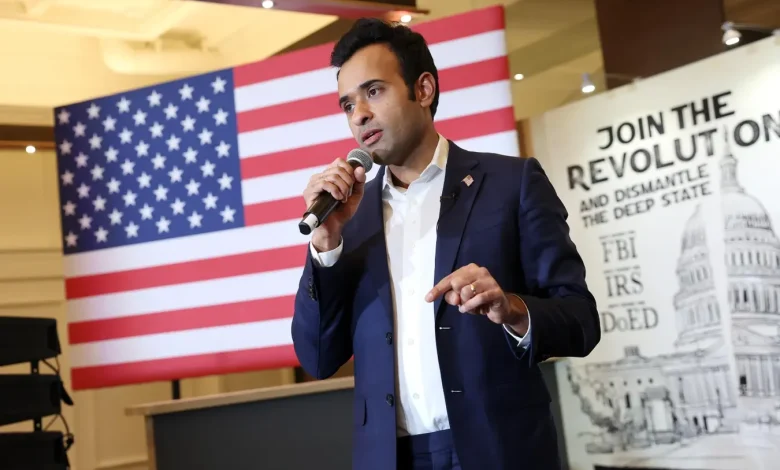
Former U.S. presidential candidate Vivek Ramaswamy cofounded Strive with Anson Frericks in 2022
Getty Images
On October 10, MSCI, the world’s second-largest index provider, floated a proposal that immediately dealt a sharp blow to a small but fast-growing corporate category: digital asset treasury firms.
MSCI suggested reclassifying these unique public companies, whose primary business activity is holding bitcoin or other digital assets, as “funds” rather than operating companies. Under the draft, if a firm’s digital asset holdings exceed 50% of its total assets, it could be removed from its benchmarks. Hundreds of public companies holding over $180 billion in crypto now consider themselves digital asset treasuries, so it’s no wonder that the news sent jitters across the market.
For the biggest bitcoin treasury, Michael Saylor’s Strategy, the news was like a gut punch. Its shares fell about 20% after the announcement’s release. Funds tracking MSCI’s or similar products, including the Nasdaq-100, hold about $9 billion of the company’s $54 billion market cap. Of that, roughly $2.8 billion sits in MSCI-linked funds that could be forced to sell if the index provider ultimately removes the stock.
MSCI’s latest proposal revolves around an important question: is a company whose main function is acquiring and holding a digital asset like bitcoin, and using assorted financing techniques to support it, an operating business or a fund?
Saylor, whose company still operates a $500 million software division, has used his bitcoin hoard to engineer an entire catalog of publicly traded structured notes and preferred equity instruments. He insists that financial engineering is his operating business. He’s not alone in pushing back.
Strive Asset Management, the investment firm cofounded by Vivek Ramaswamy and now the fourteenth-largest corporate bitcoin holder with $704 million worth of it on its balance sheet, has just submitted a seven-page letter to MSCI chairman and CEO Henry Fernandez, shared with Forbes, urging his firm to withdraw the proposal.
The letter argues MSCI risks abandoning the core principle of passive investing: neutrality. “An index provider’s purpose is not to take a view,” it says, “but to accurately reflect the equity universe so investors need not judge the wisdom of individual business strategies.” If specific investors want to exclude bitcoin-heavy firms, Strive argues, MSCI already sells the tools: custom indexes, overlays, asset class screens.
Strive believes that MSCI is applying a blunt definition to a rapidly evolving business model. Miners such as MARA Holdings, Riot Platforms and Hut 8—three of the largest corporate bitcoin holders—are now morphing into AI infrastructure companies. These miners “are rapidly diversifying their data centers to provide power and infrastructure for AI computing,” the letter notes, and several have signed multibillion-dollar deals with Big Tech.
At the same time, bitcoin-backed structured finance has taken off. JPMorgan, Morgan Stanley, Goldman Sachs and Citigroup have all filed prospectuses for structured notes tied to bitcoin’s returns—some with downside buffers, others with high coupon payments. New Hampshire launched the first bitcoin-backed municipal bond. Strategy, Metaplanet and Strive each issued their own structured instruments this year. “Bitcoin structured finance is as real a business for us as it is for JPMorgan,” the letter states.
So worried is Strive about MSCI’s bitcoin treasury kibosh that it rolled out a host of its top executives to make its case. Ben Werkman, Strive’s chief investment officer, argues index committees may be rushing to define a category before it has even taken shape. “You’ve got to remember that this sector is largely seven or eight months old, outside of Strategy, Metaplanet and Semler,” he says. “This decision takes away future flows.”
Werkman also points out that bitcoin is no longer an exotic fringe asset. “You’ve got a supportive administration around this. You have banks issuing structured bitcoin finance products. Vanguard is now offering the ETFs to their customers. It’s the most profitable product that BlackRock has. You’ve seen central banks now put it on the balance sheet.”
Jeff Walton, Strive’s chief risk officer who also runs a popular bitcoin-focused podcast True North, adds that MSCI’s logic is inconsistent. Insurance companies are structured finance businesses, he notes, yet no index provider questions their operating company status. “54% percent of MSCI’s assets on their balance sheet are goodwill,” he says. “Then you start to ask: Where do you draw the line? What is capital, what is an asset?”
Dave Weisberger, a portfolio trading veteran and cofounder of institutional algorithmic trading platform CoinRoutes, says MSCI’s move may have less to do with philosophy and more to do with competitive pressure. “They have a pretty good stranglehold on the international indexes,” he says, “but their U.S. and world indexes face strong competition from S&P, Russell etc. The last thing you want, if you’re an index provider,—in fact, it’s disastrous for you— is for your benchmark to underperform your competitors over a long period of time.” Bitcoin’s wild volatility including long-term run ups, followed by sharp drawdowns like the recent one, makes it a “double-edged sword.” “If you look back even the last five years, having Strategy in the indexes (MSCI USA and MSCI World) was tremendously beneficial,” he says. “But over the last year, it might have actually been helpful to not have it.”
Strive’s letter also warns that MSCI’s 50% threshold may be impossible to enforce. Bitcoin’s volatility alone could push companies in and out of index eligibility quarter to quarter, creating churn for fund managers and higher tracking error for institutional allocators.
But the bigger issue is accounting. If a company shifts exposure from spot bitcoin into derivatives, ETFs or structured notes, its balance sheet may appear to dip below the 50% line even though its economic exposure remains the same. Strive notes that Trump Media & Technology Group escaped MSCI’s preliminary exclusion list because its spot holdings sat just under the threshold, but including its derivatives exposure would push it above 60%.
Then there is the U.S. versus international divide. Under newly updated GAAP rules, U.S. companies must mark digital assets to fair value. Under IFRS, common in Europe and parts of Asia, companies can often keep crypto at cost. So two firms with identical bitcoin positions could be classified differently simply based on jurisdiction.
Werkman warns this dynamic could push innovation overseas. “You’re going to penalize the U.S. markets and the products launched here in favor of the international markets that have the more favorable treatment that bypasses these types of mandates,” he says. And even if MSCI finalizes the rule, he argues, companies could engineer around it. “If I was at 49% spot and the rest of my exposure I take in derivatives, do I now count? Is it exposure-based? How are you going to manage that?”’
Not everyone is buying Strive’s arguments. “If these were operating companies in the sense of being originators and charging fees, the feedback would make sense,” says Austin Campbell, an adjunct professor at NYU Stern and former banker. “But they are not. They are much more just owning the products or the issuers of the products. Should mortgage-backed securities be in the index? If not, why should a company just tranching itself be “operating”? The act of issuing debt does not change your operations.”
Steven Schoenfeld, CEO of MarketVector Indexes, echoes that view. DATs, he says, “are structured in a similar way as investment trusts/closed-end funds with some elements of financial engineering,” and index providers globally exclude such vehicles to avoid “double-counting or circular exposure.” MSCI, he adds, is now trying to standardize how that rule should apply to “digital asset treasury firms structured as funds,” and MarketVector’s own advisory committee is reviewing similar questions.
MSCI is set to issue its decision on January 15. A reversal would give bitcoin bulls another tailwind. A removal would likely dampen demand for these new publicly traded crypto creations, and hit the Wall Street banks that have been eagerly financing them.