The Prime Minister needs to ‘stop the boats’ but also faces a threat from the Greens on his left flank
The migration special edition of Question Time on Thursday night is a recognition of what is becoming increasingly clear: dealing with immigration is crucial to Labour’s chances of staying in power.
Some believe that the BBC, and other parts of the media, pay too much attention to this issue. But the facts are stark – public concern about the level of migration, and the Government’s failure to control it, has risen enormously in recent years.
A poll for The i Paper by BMG Research carried out last week found that a majority of people consider immigration one of the most important issues facing Britain today, with 21 per cent naming it as the number one issue – beaten only by the cost of living.
New Feature
In Short
Quick Stories. Same trusted journalism.
One reason for this rising level of public concern is simple, the sheer increase in net migration numbers which has taken hold since Brexit and the pandemic. Boris Johnson promised to cut net migration, as had David Cameron and Theresa May. But on his watch it hit more than 900,000.
If this were the only factor, however, things might be looking up for Labour: after all, the latest batch of statistics showed that net migration has fallen back to 200,000. Experts expect that figure to come down further in the next year or two, possibly reaching negative territory – which would mean more people leaving the UK than arriving.
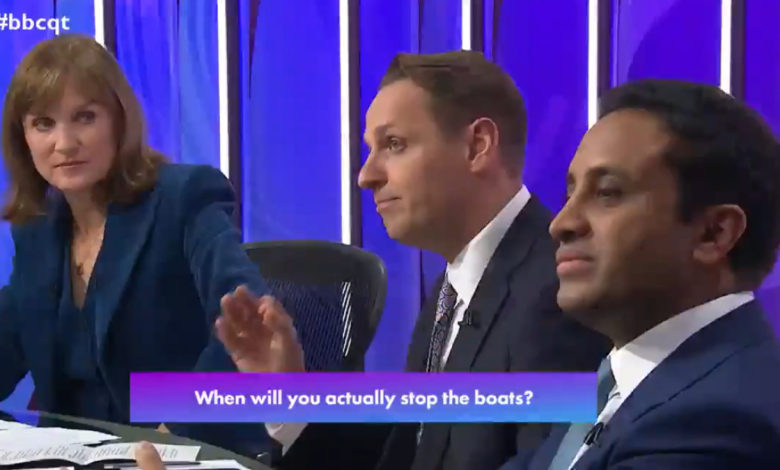
A clue to what Sir Keir Starmer’s real goal must be is provided by the location for the Question Time special: it was in Dover, the channel port which is on the front line of the ongoing “small boats” crisis.
Every month, hundreds of asylum seekers land in Dover – entering the country illegally – after making the dangerous journey across the English Channel in a flimsy craft.
And without stopping the boats, Labour will not quell the public anger about immigration. It is the perception of uncontrolled borders above all that has propelled the rise of Reform UK, whose policy chief Zia Yusuf is the loudest voice on the Question Time panel.
Speaking on the programme, he said: “Britain is a soft touch and what Labour has done is pour gasoline on a fire the Tories created,” and accused the Government of “gaslighting people” on deportation numbers.
Yusuf later criticised the BBC for allowing several refugees who had arrived from small boats to appear in the audience.
The Dover MP Mike Tapp, another member of the panel, has been made a Home Office minister precisely to try and deal with this anger. He talks tough on small boats, one of a number of Labour MPs who believe the problem is existential for their party.
He responded to Yusuf saying he was “splitting hairs” over the numbers, but also told the audience his party had to “go further” in addressing the issue.
“We’re making it less attractive to for people to come here, easier to deport people, we’re bringing in counter-terror powers to take on the smuggling gangs… and we’re looking at all solutions, to ensure that as a compassionate country we are providing that help to people who are fleeing war and persecution,” he said.
“For me we have to deal with this issue because we have to unite… around this so that as a country we can move on.”
But, moving to the right on immigration comes with risks too. Yusuf is not the only populist represented on Question Time; there is also Zack Polanski, who has taken the Greens to new heights since becoming their leader in September.
He told the programme that “fair and managed” immigration is “a positive thing for the country”.
There are, of course, many voters who are stridently pro-migration and unconcerned about the number of new arrivals. This group’s views are not represented by most parties – even the Liberal Democrats want to cut net migration – and so the Greens have deftly filled this vacuum.
Labour’s most loyal voting bloc over the past 20 years has been liberal-minded urban types, and it is they who are being pulled away by Polanski. The risk for Starmer is that the more he goes for the centre ground on immigration, the more he alienates his own core vote.
The good news for the Prime Minister is that the Conservatives have yet to regain their credibility on this issue.
The home secretary who oversaw the liberalisation of migration laws, Dame Priti Patel, is now in the Tories’ shadow Cabinet; the current shadow Home Secretary, Chris Philp, was one of her deputies in the Home Office.
Kieran Mullan, the junior frontbencher sent to represent the party on Question Time, does at least represent a seat on the south coast but is less of a heavyweight than the rest of the panel.
Labour is being squeezed on both sides. In the worst-case scenario, a tough policy that proves ineffective could scare off the left without winning back the right. But if Starmer does stop the boats, a huge political reward may await.