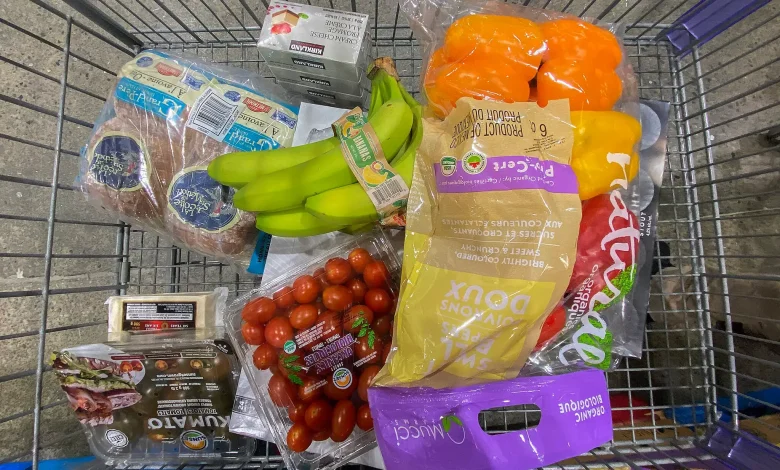
Anti-poverty advocates fear more Manitoba families will be pushed into hunger after a national study predicted some Canadian households’ annual food bill will jump by nearly $1,000 in 2026.
There will be hardship even though Canada’s Food Price Report, released Thursday, expects Manitoba’s increase to be below the national average of four to six per cent, or $994, for the average family of four compared with 2025, groups said.
“There will be a breaking point for a lot of these folks,” said Shawna Bell, executive director of the Christmas Cheer Board. “There are some impossible decisions being made by these families to ensure they do have something on the table.”
RUTH BONNEVILLE / FREE PRESS FILES
Shawna Bell, head of the Christmas Cheer Board, expects to receive up to 22,000 applications for hampers this season.
One-quarter of Canadian households are considered food insecure, with prices 27 per cent higher than five years ago, said the report, which was produced by several universities.
The average family of four is expected to spend $17,571.79 on food next year. Prices will climb even though inflation will drop to about two per cent and some tariffs have been rolled back in the U.S.-Canada trade dispute.
Meat prices are predicted to jump by five to seven per cent, after the 7.2 per cent rise in 2025 was largely driven by the cost of beef amid a downturn in cattle numbers and higher costs for the industry.
Higher beef prices boosted demand for chicken, but chicken prices are expected to rise substantially in 2026 due to underproduction.
Price hikes are projected in other food categories, including vegetables (three to five per cent), dairy, eggs and baked goods (two to four per cent), fruit (one to three per cent) and seafood (up to two per cent).
The report predicted restaurant prices will rise by four to six per cent. It warned severe weather, drought and potential labour shortages could result in price swings. (Read the full report.)
Food prices have jumped alongside the cost of housing, transportation and other essentials. Big grocery chains that control a majority of the market have posted record or higher profits.
A recent report by Canada’s Competition Bureau concluded the country needs more grocery store competition. It remains to be seen if a new federal grocery code of conduct will help lower prices.
In last month’s throne speech, Premier Wab Kinew announced a study to find ways to cut grocery costs.
Recent Statistics Canada data found Manitoba has the highest rates of deep poverty and child poverty among all provinces. Other studies have pointed to rising levels of household debt.
GRAHAM HUGHES / THE CANADIAN PRESS FILES
The average family of four is expected to spend $17,571.79 on food next year.
Manitoba food banks are reporting record or higher numbers of families and single people seeking hampers.
Harvest Manitoba’s annual report, released this week, said 60,000 people per month use food banks in the province, an increase of 150 per cent in five years.
The organization surveyed clients, with 62 per cent of families reporting that they go hungry at least once a month. It is providing food to more people who work or have some form of post-secondary education.
Bell said Christmas Cheer Board expects to receive up to 22,000 applications this season, which would top the record 21,000 hampers last year.
Some donors have had to scale back the amount of money they give while being squeezed by the rising cost of living. Some past donors are now in need of help, Bell said.
“My fear is at some point, we’re not going to be able to support everybody who needs us,” she said.
“Poverty is not a moral failing of an individual, but a condition we have allowed to fester in our communities for decades through ‘poor’ policy choices.”
Harvest Manitoba’s annual report called on governments to provide more income, housing and child-care support.
Kate Kehler, executive director of the Social Planning Council of Winnipeg, said governments have prioritized other matters and failed to do enough to reduce poverty.
“We keep spending our money on what doesn’t work rather than on what does,” she said.
She said she hopes the province’s poverty-reduction strategy, to be released in January, is as comprehensive and efficient as possible.
“I would love to hear a commitment to, and understanding of, that poverty is not a moral failing of an individual, but a condition we have allowed to fester in our communities for decades through ‘poor’ policy choices,” Kehler said.
She said rising costs could lead to shoplifting, with retailers passing security-related costs to customers.
“The other cost, of course, will be that more desperate people will be criminalized or, they will just go hungry,” Kehler said.
CHRIS YOUNG / THE CANADIAN PRESS FILES
A recent report by Canada’s Competition Bureau concluded the country needs more grocery store competition.
Progressive Conservative Leader Obby Khan and Kinew sparred over food prices during question period Thursday.
Khan said NDP measures to reduce grocery bills have failed.
“Under this NDP government, more Manitobans are using food banks than ever before,” he said.
Kinew said his government reversed cuts brought in by the Tories and passed a law intended to stop grocery stores from preventing competitors from opening nearby.
He said 46 property controls that prevent competition still exist, down from 66, after Monday’s registration deadline.
“That means, just by passing a law, we scared 20 grocery locations into having more competition in the market,” Kinew said.
He said the province will challenge the remaining 46 property controls.
chris.kitching@freepress.mb.ca
2026 Food Cost Estimator
Add the members of your family to see your household’s estimated 2026 food bill, based on Canada’s Food Price Report.
Person type
Add family member
Family members
Cost
Subtotal
Actions
Estimated annual household food cost in 2026:
$0.00
Chris Kitching
Reporter
Chris Kitching is a general assignment reporter at the Free Press. He began his newspaper career in 2001, with stops in Winnipeg, Toronto and London, England, along the way. After returning to Winnipeg, he joined the Free Press in 2021, and now covers a little bit of everything for the newspaper. Read more about Chris.
Every piece of reporting Chris produces is reviewed by an editing team before it is posted online or published in print — part of the Free Press‘s tradition, since 1872, of producing reliable independent journalism. Read more about Free Press’s history and mandate, and learn how our newsroom operates.
Our newsroom depends on a growing audience of readers to power our journalism. If you are not a paid reader, please consider becoming a subscriber.
Our newsroom depends on its audience of readers to power our journalism. Thank you for your support.