3I/ATLAS: ALMA Detects Most Enriched Concentration Of Methanol And Hydrogen Cyanide Observed In Any Comet Ever

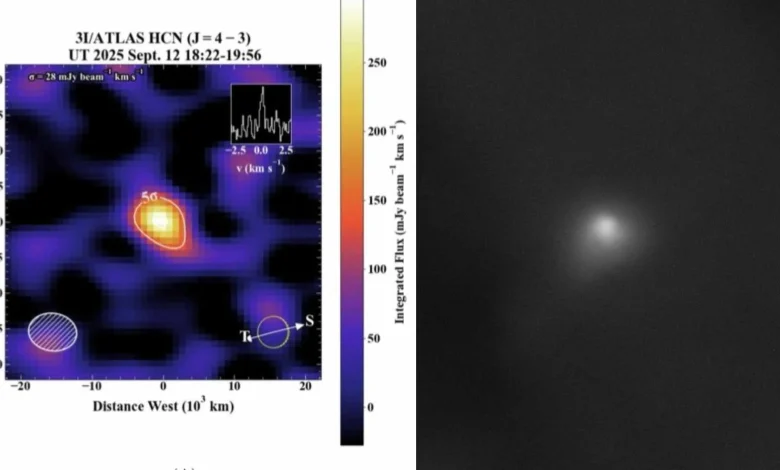
In its study of the third interstellar object ever recorded in the solar system, 3I/ATLAS, the ALMA observatory detected the most enriched concentrations of CH₃OH (methanol) and HCN (hydrogen cyanide) of any comet, second only to C/2016 R2 (PanSTARRS). Another anomaly to add to Harvard astrophysicist Avi Loeb’s list on the exocomet?
The ALMA’s observation led by Nathan X. Roth etal, on 3I/ATLAS released states the following on the detection of methanol (CH₃OH) toward interstellar comet 3I/ATLAS using the Atacama Compact Array of the Atacama Large Millimeter/Submillimeter Array (ALMA) on UT 2025 August 28, September 18 and 22, and October 1, and of hydrogen cyanide (HCN) on September 12 and 15.
The CH3OH production rate increased sharply from August through October, including an uptick near the inner edge of the H2O sublimation zone at rH = 2 au.
Compared to comets measured to date at radio wavelengths, the derived CH3OH/HCN rartios in 3I/ATLAS of 124 +30 _34 AND 79 +11 -14 on September 12 and 15, respectively, are among the most enriched values measured in any comet, surpassed only by anomalous solar system comet C/2016 R2 (PanSTARRS).
☄️Interstellar comet 3I/ATLAS! We found in it the most enriched concentrations of CH3OH (methanol) and HCN (hydrogen cyanide) of any comet, second only to C/2016 R2 (PanSTARRS).
➡️ Open review for all in the following paper https://t.co/sz2CFXjODw pic.twitter.com/OxjdlGro9S
— ALMA Observatory📡 (@almaobs) November 28, 2025
Before you go bonkers, methanol is not a definitive biomarker to confirm signs of extraterrestrial life, as it can be a byproduct of abiotic or non-biological processes as well. Jingcheng Huang, Sara Seager, Janusz J. Petkowski, Zhuchang Zhan, and Sukrit Ranjan, in their 2022 paper published by the American Astronomical Society, state in the title itself, Methanol—A Poor Biosignature Gas in Exoplanet Atmospheres.
In the paper they remark
life on Earth produces CH₃OH in large quantities. However, despite CH₃OH’s advantages, we consider it a poor biosignature gas in the atmospheres of terrestrial exoplanets due to the enormous production flux required to reach its detection limit.
An enormous flux of CH₃OH is essentially a massive waste of organic carbon—a major building block of life, we think this flux, while mathematically possible, is likely biologically unattainable.
Atacama Large Millimeter/submillimeter Array or ALMA
The Atacama Large Millimeter/submillimeter Array (ALMA) is an array of 66 radio telescopes in northern Chile’s Atacama desert set up by the European Southern Observatory (ESO), the National Institutes of Natural Science, Japan (NINS), and the National Science Foundation, USA (NSF). Besides the US, Europe, and Japan, other collaborators in the ALMA project are Canada, South Korea, Taiwan, and host nation Chile.
Image: ALMA by Y. Beletsky (LCO)/ESO
ALMA first released its studies of the comets on 11 August 2014, detailing the distribution of HCN, HNC, H₂CO, and the dust encompassing the comae of the following comets: C/2012 F6 (Lemmon) and C/2012 S1 (ISON).
ALMA also detected phosphine, a biomarker in the atmosphere of Venus, indicating the presence of biological organisms. The controversial study dating back to 2020, still awaits additional measurements to confirm the results.
Image: Venus / NASA
See Also: 3I/ATLAS: Harvard Professor Avi Loeb Reveals Six Major Anomalies In The Exocomet With No Simple Explanation
See Also: 3I/ATLAS: Harvard Astrophysicist Avi Loeb Shares New Update On Excomet’s Non-Gravitational Acceleration
See Also: 3I/ATLAS: Canadian Astrophotographer Clicks Clearest-Ever Picture Of Interstellar Visitor