The Eurovision Song Contest slogan is “United By Music,” but the music competition’s organizers are seeing some cracks in that unity.
A discordant note has been struck in that unity over Israel’s participation in the contest over the war between Israel and Hamas and the humanitarian crisis it precipitated.
Four European nations say they will not take part in the popular international song competition next year after Israel was cleared to participate. State broadcasters in the Netherlands, Ireland, Spain and Slovenia cited the ongoing war in Gaza as their reason for withdrawing.
The war started after Hamas launched a surprise terrorist attack in Israel on Oct. 7, 2023, that killed roughly 1,200 Israelis and took about 251 people hostage. Israel responded by declaring war, vowing to eradicate Hamas, the organization that has been de facto governing Gaza and has been designated by the U.S. as a terrorist group. The death toll in Gaza had surpassed 70,000 as of Wednesday, according to the Hamas-run Gaza health ministry.
Both sides agreed to a ceasefire, which has broadly held, this October.
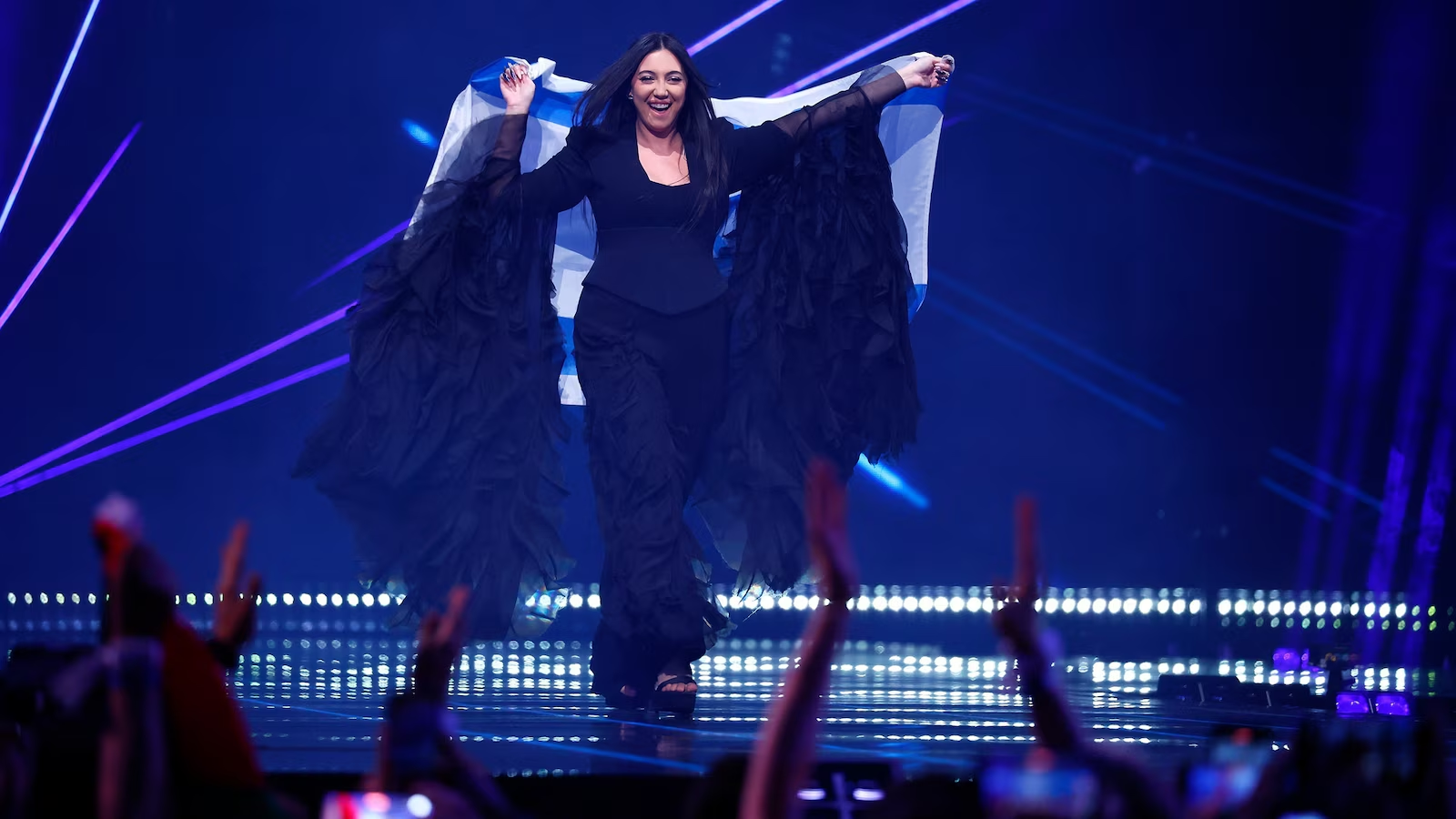
Yuval Raphael representing Israel walks on stage during the Grand Final of the 69th Eurovision Song Contest Opening Ceremony at St. Jakobshalle, May 17, 2025 in Basel, Switzerland.
Sebastian Reuter/Getty Images
“Culture unites, but not at any price. What has happened over the past year has tested the limits of what we can uphold,” Taco Zimmerman, head of the Dutch broadcaster AVROTROS, said in a statement. “Universal values such as humanity and press freedom have been seriously compromised, and for us, these values are non-negotiable.”
Ireland’s broadcaster RTÉ directly cited the war in its statement.
“RTÉ feels that Ireland’s participation remains unconscionable given the appalling loss of lives in Gaza and the humanitarian crisis there which continues to put the lives of so many civilians at risk,” it wrote.
Ireland has won the Eurovision Song Contest seven times, and is tied with Sweden for the most wins ever. The Swedish group ABBA famously got a boost into worldwide stardom from its Eurovision win for “Waterloo.”
“The situation in Gaza, despite the ceasefire and the approval of the peace process, and Israel’s use of the contest for political purposes, make it increasingly difficult to maintain Eurovision as a neutral cultural event,” Alfonso Morales, secretary general of Spain’s broadcaster RTVE, said in part in a statement.
JJ representing Austria celebrates after winning the Grand Final of the 69th Eurovision Song Contest Opening Ceremony at St. Jakobshalle, May 17, 2025 in Basel, Switzerland.
Harold Cunningham/Getty Images
Spain is part of what’s known as the Eurovision’s “Big 5” — the participants whose broadcasters provide the most, financially, to the contest and have the biggest viewership. The UK, France, Germany and Italy are the other members of this group, and performers representing these countries get automatic entry into the Eurovision final.
A representative for Slovenia’s broadcaster also cited the war in Gaza, and said the Israeli government had been using the contest for political gain.
During this year’s Eurovision, Yuval Raphael’s song “New Day Will Rise” reached second place — it was beaten by Austrian singer JJ’s “Wasted Love.”
The Israeli government was accused by other countries’ broadcasters of manipulating the voting system during this year’s Eurovision. Amid the controversy, the EBU announced new changes to tighten voting rules, but Eurovison Song Contest Director Martin Green told the BBC that Israel did not break the rules.
At a meeting in Geneva on Thursday, the European Broadcasting Union — the organizing body of the contest — and member broadcasters from participating nations gathered to discuss new voting guidelines and contest rules. They did not take a vote on Israel’s participation, which cleared the way for the country to compete.
Delegates leave the headquarters of the European Broadcasting Union after the first day of a two-day general assembly of the EBU, which organises the Eurovision Song Contest, in Geneva, December 4, 2025.
Fabrice Coffrini/AFP via Getty Images
Four European nations say they will not take part in the popular international song competition next year after Israel was cleared to participate. State broadcasters in the Netherlands, Ireland, Spain and Slovenia cited the ongoing war in Gaza as their reason for withdrawing.
“I am pleased that Israel will once again participate in the Eurovision Song Contest, and I hope that the competition will remain one that champions culture, music, friendship between nations, and cross-border cultural understanding,” Israeli President Isaac Herzog wrote, in part, in a post on X after the Geneva meeting.
Israeli broadcaster KAN was critical of the backlash
“The attempt to remove KAN from the contest can only be understood as a cultural boycott,” one representative said during the meeting.
But some broadcasters — like Britain’s BBC — expressed support for Israel to compete.
Opposition to Israel’s participation had been brewing since 2024, when protesters demonstrated outside the arena in Malmo, Sweden.
Israel first joined the Eurovision Song Contest in 1973. Four Israeli acts have taken home the Eurovision trophy since, most recently in 2018.
The final of the 2026 Eurovision Song Contest will take place in Vienna, Austria, on May 16.