The Athletic has live coverage of the 2025 MLS Cup final between Inter Miami and Vancouver Whitecaps.
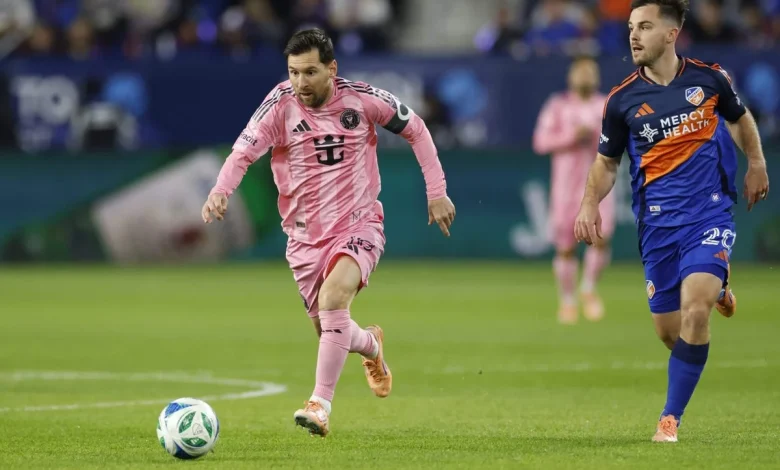
Lionel Messi is again at the centre of the MLS play-offs, this time driving Inter Miami into the cup final and boosting the league’s viewership figures.
At 38, he has 13 goal contributions (six goals, seven assists), the most in a MLS Cup campaign, as Miami have outscored opponents 17-4 on the way to the side’s first championship final, where they will face Vancouver Whitecaps.
This has come in a season of uneven form under head coach Javier Mascherano, whose credentials were questioned when he was appointed 12 months ago. Now, the side looks more balanced, the system is clearer, and the players around Messi feel chosen to fit one another and the side’s requirements.
Mascherano, Messi’s former club and Argentina team-mate, has been the most effusive about his countryman’s performances. After the 4-0 first-round win against Nashville on November 8, Mascherano highlighted Messi’s pressing and defensive work.
“I want to congratulate Leo for the game he played,” Mascherano told reporters after the game. “Leo was the first who guided us on that high pressure. Seeing him press like he pressed today, at 38, it’s something crazy. Leo on the ball, we all know. Leo off the ball today was impressive.”
It was the same story after the 4-0 quarter-final win over Cincinnati, with Mascherano noting how Messi led the team’s defensive approach.
Messi’s head coach focused more on what he did without the ball than with it, but he is a player associated with energy conservation and long spells of walking. The idea that he is “pressing more” sounds unlikely.
In possession, Inter Miami are patient when building from the back but very vertical once the ball leaves their defensive third. The plan is to circulate it safely through the back line and midfield, then funnel it into Messi between the lines so the attack can run through him.
Without the ball, the picture is far more aggressive. Miami are one of the league’s heaviest-tackling teams, often matching up man to man. In Mascherano’s mid-block, players jump out of the line to press on triggers, with the rest of the unit shuffling across to cover the space left behind.
Looking at the passes per defensive action (PPDA) metric — which measures how many passes a team allows before making, you guessed it, a defensive action — the trend line shows a clear shift. Across their play-off campaign, the numbers sit lower and, just as importantly, fluctuate less, pointing to a more assertive and consistent press than in previous years.
The difference with and without Luis Suarez is stark. In the three play-off games he has not started, Miami’s PPDA drops noticeably, indicating a tighter, steadier and more intense press. Suarez’s suspension in the decisive Nashville game opened the door for 19-year-old Mateo Silvetti, who then kept his place for the wins over Cincinnati and New York City. With Silvetti and other younger runners around Messi, the team can cover more ground and win more balls. Messi can then pick his moments rather than chase constantly.
After last season’s play-off exit to Atlanta and Tata Martino’s departure, Mascherano took charge as one of the league’s youngest coaches of its oldest squad. The obvious question is whether Messi’s defensive game has changed under him.
On the surface, the answer is no. His defensive actions per 90 minutes are down, with fewer tackles and interceptions than in 2024.
What has changed is where and how those actions happen. In 2024, most of his tackles came in the attacking third. This season, a much smaller share is that high up, with more work in deeper zones, including defensive-third tackles, where he previously had none. His recoveries are up as well, and no player in MLS has produced more shot-creating actions from defensive plays.
While Luis Suarez has been out of the team, Inter Miami have pressed more aggressively (Sam Navarro-Imagn Images)
Messi’s off-ball approach mirrors how he plays with the ball. He often walks into pockets, scans the pitch and stores information before deciding when to accelerate. The same spatial intelligence is now shaping his and his team’s defending, with Messi choosing when and where to engage rather than simply doing more of it.
Among MLS forwards this season, Messi ranks 10th for possessions won in the final third per 90, a counter-pressing metric that supports Mascherano’s view. Rather than covering every lane, he is often the one setting the first line of pressure, showing he understands his defensive brief in this league. With fresher legs around him, the benefits of that positioning multiply.
So what does Messi actually do without the ball? The answer changes depending on the opponent and who he plays with.
Against NYCFC in the Eastern Conference final, the clearest example came around the 74th minute. Miami lost the ball on their left and immediately crowded the area to slow the attack, then slid across as NYCFC switched play to the right. When NYCFC tried to play through the middle third, Messi had already stationed himself there. He jumped to press, Rodrigo De Paul followed, and won the ball, drawing a foul. It neatly shows how Mascherano uses younger runners to do the heavy shifting so Messi can press from the zones that matter most.
There are also times when he does the chasing himself. Against Cincinnati, after losing possession around the 30-minute mark, he immediately tracked the ball and opposition player to try and win it, and later in the game, he recovered possession 25-30 yards from his own goal (see below) before sliding the pass that led to Tadeo Allende’s finish.
Against Nashville, he anticipated a loose ball high up the pitch, stepped in to win it and scored the opener (see below), finishing with four tackles plus two goals and an assist in the game where Mascherano first highlighted his pressing.
In that light, Mascherano’s words carry more weight: Messi is not leading the press through sheer volume, but by deciding when and where it snaps into gear, and that selective work without the ball is raising the collective level of Miami’s performances.
Messi leads Inter Miami — and sits near the top of the league — for most major attacking metrics, from goals and assists to progressive passes and touches in the final third. Most of his work with the ball now happens high up the pitch, where he is asked to simply decide games.
That is where the defensive picture fits in. Messi conserves energy without the ball so he can spend it when he has the ball. His numbers will never look like those of a true presser, even as his defensive impact has increased in key moments.
With the younger legs of Silvetti, Allende and Telasco Segovia running around him, he does not need to defend like a midfielder for 90 minutes. The system does most of the running, so he can decide when to raise the temperature. At 38, the pressing isn’t in his legs as much as in his timing, and Miami have been built to give his timing all the legs it needs.


![2025 Rolex Paris Masters: Sonego [45th] vs. Korda [54th] Prediction, Odds and Match Preview](https://cdn1.emegypt.net/wp-content/uploads/2025/10/2025-Rolex-Paris-Masters-Sonego-45th-vs-Korda-54th-Prediction-390x220.webp)