In a recent interview, Ken Burns said that the American Revolution was the most important human event since the birth of Christ. While historians (and theologians) may debate this claim, what cannot be contested is how this conviction has helped to shape his latest documentary, “The American Revolution,” which also carries a warmth and familiarity that will remind viewers of many of his more than 30 earlier documentaries (with two more currently in production).
Like many of Burns’s earlier works, this one has been made possible by PBS, an institution Burns regards as essential, because neither streaming platforms nor cable outlets would support the years of production his films demand. He started this project (in collaboration with Sarah Botstein and David P. Schmidt) in 2015, and the years of careful work are unmistakable.
Through steady narration and a thoughtful blend of images, historic maps, music, re-enactments and computer-generated imagery (a first for Burns, as the American Revolution came well before the invention of photography), this latest creation achieves a tone that is unmistakably Burns: measured, atmospheric, at times elegiac and always attentive to nuance. (In his editing room hangs a neon sign saying “It’s complicated.”) The overall effect arises not simply from the wealth of historical detail but from the way the visuals, pacing and narrative flow guide viewers on a sacred journey of sorts through 12 hours of national myth and historical complexity.
The documentary’s richness also owes much to the voices and viewpoints of eminent historians like Bernard Bailyn, Joseph Ellis and Gordon S. Wood, along with younger scholars whose perspectives broaden the interpretive frame. For those who have been fans of Burns for more than four decades, the return of familiar narrators, like Peter Coyote, Morgan Freeman and Paul Giamatti (brilliantly voicing John Adams once again), along with new voices, like Claire Danes and Laura Linney, can bring an unexpected thrill, their cadences giving the series much of its power and gravity.
The series opens by reminding viewers that long before the English and other Europeans settled in North America, these lands were home to Indigenous peoples, and it is against this backdrop that the colonists, benefiting for more than a century and a half from “salutary neglect,” pushed steadily westward, displacing Native communities. But London’s decision to curtail that expansion after what was known in the colonies as the French and Indian War became one of the most consequential sparks of colonial unrest.
A Catholic delegation
Among the other European powers that had shaped the region were the French, whose defeat in 1763 and the subsequent British annexation of Quebec set the stage for the Continental Army’s first major initiative—to conquer the territory—under Major General Benedict Arnold 12 years later. Although that campaign failed, the documentary does not address a diplomatic attempt to draw French Canada into the colonies’ rebellion, which had a decidedly Catholic connection.
A 1775 draft of the Articles of Confederation invited every British colony—from Bermuda to Quebec and even Ireland—to join this new “Association.” Hoping to win over Canada, that November, Washington forbade Continental troops to observe the usual Guy Fawkes (Pope’s) Day festivities, mindful that gestures hostile to Catholicism would hinder that effort.
Then, in 1776, Congress sent a four man delegation, including Benjamin Franklin and the Rev. John Carroll of Maryland (technically no longer a Jesuit because the Society of Jesus had been suppressed three years earlier), chosen both for his fluency in French and his Catholicism, to Montreal to encourage the Canadians to, in the words of Washington, “unite with us in an indissoluble union.”
Although the mission to Canada, like Arnold’s invasion, ultimately failed, it nonetheless helped shape the course of Carroll’s later life. Prior to meeting him, Franklin harbored the general anti-Catholic sentiments of Protestants of his day. However, Carroll’s learning and his kindness toward Franklin likely softened Franklin’s view of Catholicism, a point underscored by Carroll’s decision to accompany him from Montreal to Philadelphia when he became ill.
That kindness would have unexpected consequences for Carroll’s future. When Rome began planning a leadership structure for the church in the new republic, Franklin recommended Carroll to the papal nuncio in Paris, which ultimately resulted in Carroll being named “Superior of the Missions” in 1784 and the nation’s first bishop in 1789.
However, not all of the founding fathers were as open-minded to Catholics as Franklin eventually was. Two years before this failed mission, in the fall of 1774, John Adams was in Philadelphia as a delegate from Massachusetts to the Continental Congress. Feeling “wearied to death” by the strain of his official duties, he and Washington began visiting churches around the city, including St. Mary’s, which had been founded about a decade earlier as the second Catholic church in the city. Writing to his wife Abigail, Adams referred to it as the “mother church, or rather grandmother church. I mean the Romish chapel.”
Although he began by praising the priest’s sermon, his compliments ended there. He then described the scene as he perceived it: “The afternoon’s entertainment was to me most awful and affecting; the poor wretches fingering their beads, chanting Latin, not a word of it they understood…their crossing themselves perpetually…. Here is everything which…can charm and bewitch the simple and ignorant.” His closing remark to Abigail carried the sharpest sting: “It is a wonder Luther could ever break the spell.”
While noting that most of the revolutionaries were Protestant, the documentary still acknowledges the presence of Catholics and Jews among them, as well as a small number of Muslims who, despite the trauma of the Middle Passage, preserved their faith and quietly passed it on to their children. Many architects of the new republic were more deist than Christian, believing in God as a disconnected “clockmaker” rather than as intervening in the world, yet they believed that religion was necessary to sustain the citizenry’s moral life. In a monarchy, virtue radiates from the sovereign, but in a republic, it must take root in the people, with religion serving as a chief instrument for forming that moral character. They believed that only a citizenry so formed could sustain the fragile political experiment they were establishing.
At the time of the American Revolution, several colonies still maintained established churches, including Anglicans (who became known as Episcopalians in the United States in 1789) in Virginia and Congregationalists in Massachusetts. Catholics, by contrast, not only lacked any form of state support, but in some colonies it was even illegal for a priest to enter. Yet the penal laws that had so sharply restricted Catholic practice in England were on the whole, by the 18th century, less rigorously enforced on this side of the Atlantic.
In fact, owing to the generally liberal attitude toward the free exercise of religion fostered by the Quakers in Pennsylvania, the establishment of St. Joseph’s Church in Philadelphia by the Jesuits in 1733 created the only place in the English-speaking world where it was legal to celebrate Mass publicly.
From such modest beginnings, the Catholic community would slowly expand, and by the eve of the Revolution, through natural population growth and immigration, Catholics made up roughly 1 percent of the population of the 13 colonies.
Broadening the lens
While ‘The American Revolution’ devotes a good deal of time to troop movements, strategies and the ebb and flow of military fortunes, Burns resists letting the story become only a chronicle of war. For viewers who may find that level of military detail less compelling, he weaves into the larger story a rich array of social history that broadens the lens through which the Revolution can be understood.
In doing so, he reminds us that the struggle for independence unfolded not only in the councils of war but in the daily lives, aspirations and anxieties of the diverse peoples who inhabited the 13 colonies. The cases he brings forward, whether long familiar or recently rediscovered, enrich and complicate the customary narrative of the Revolution. Part of Episode 4, for instance, traces the deliberations of the Haudenosaunee (also known as the Iroquois Confederacy of the Six Nations) as they weighed which side to support in the conflict.
Because contemporaneous written sources by or about the Indigenous peoples of North America are relatively scarce, figures like the Mohawk Thayendanegea (Joseph Brant) stand out. No Haudenosaunee leader identified more closely with the British. He had fought with them in the French and Indian War, traveled to London in 1776 to meet King George III and later worked to rally support for the Crown among the Six Nations. He even ensured that portraits were made of him, raising his public profile.
Although the Haudenosaunee Confederacy first sought to remain neutral, mounting pressure from both sides soon made that impossible. Longstanding ties to Britain, fears over land loss and growing internal divisions fractured the confederacy: Most nations aligned with the British, while the Oneida and Tuscarora supported the Americans. What began as an attempt to stay out of a colonial quarrel ultimately pulled the Six Nations into a civil war of their own, bringing immense pain, death and destruction to their communities. These stories of fractured Native communities are every bit as essential to the story as any account of troop movements or battlefield tactics.
The Revolution also had far-reaching and often conflicting consequences for enslaved persons. Britain, the largest slave trading power in the world, was hardly motivated by abolitionist ideals, yet it quickly recognized the strategic value of offering freedom to enslaved men owned by rebels who would take up arms to help suppress the uprising. Such proclamations, most famously Lord Dunmore’s in 1775, issued even as he himself owned more than 50 slaves, were deeply opportunistic, but they nonetheless terrified slaveholders and pushed many firmly into the Patriot camp.
Later, in the summer of 1779, General Henry Clinton issued his own proclamation promising refuge to any Black person who was the property of a rebel, even though Clinton made clear that any Black man captured while serving with the American forces was to be sold as a slave.
A path to liberty?
For many Black Americans, the war was above all a fight for individual freedom and even the possibility of ending slavery itself. With these hopes in mind, roughly 15,000 served with the British and about 5,000 with the Patriots. Their decisions unfolded within a stark regional contrast: The South was a slave society, while in the North, it was a society with slaves, a difference that shaped both opportunity and peril.
In many ways the British offered a clearer, if imperfect, path to liberty than the Americans did, a truth that one historian in the documentary notes has often been hard for Americans to hear.
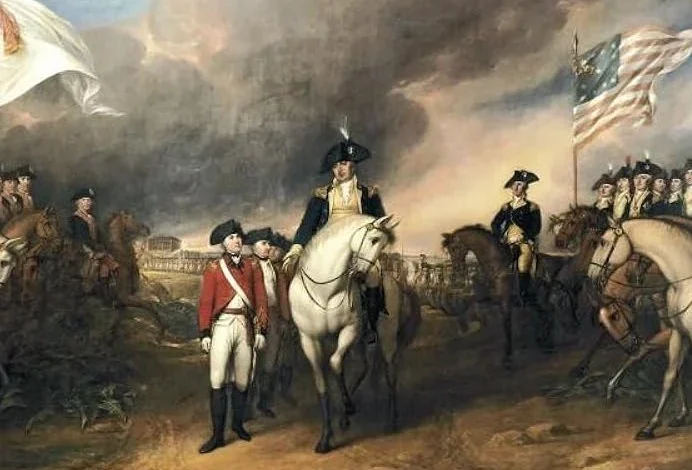
Given the overwhelming might of the British Empire, what had seemed unthinkable only a few years earlier finally came to pass in October 1781; at Yorktown in Virginia, the combined forces of George Washington and the Comte de Rochambeau, aided by the French fleet, which sealed off the Chesapeake, forced Lord Cornwallis to surrender his army. This decisive capitulation effectively ended major hostilities in the American Revolution and opened the way for negotiations that would recognize American independence.
The series closes with a brief look at the unsettled years after the Revolution: the failure of the Articles of Confederation to sustain an effective national government, the debates that produced the Constitution in the late 1780s and the inauguration of George Washington in 1789 as the nation’s first president.
When Washington voluntarily stepped down from office in 1797, King George III famously observed that by relinquishing first his military authority and then his political power, Washington had made himself “the greatest character of the age.” Drawing on images from decades and even centuries after the Revolutionary era, the series then concludes by underscoring how the nation has struggled (and continues to do so) to live up to the ideals for which the Revolution was fought.
There is a story, often repeated, that upon leaving the Constitutional Convention in 1787, Benjamin Franklin was asked what form of government the delegates had produced. His reply was succinct, sobering, if not haunting: “A republic, if you can keep it.”
In light of recent tests to our constitutional order, this latest masterpiece from Ken Burns reminds us that Franklin’s warning was never meant for an age long past, but for moments, our own among them, when the durability of the republic may feel uncertain and the work of keeping it remains an unfinished task for every generation.
Related