According to the initial iteration of the United States’ 28-point plan for ending the war in Ukraine, Kyiv would be required to completely relinquish Donbas, comprised of the regions of Donetsk and Luhansk, to de-facto Russian control. This would include those parts of the region not currently occupied by Russia, which would be designated a “demilitarized zone” and would also effectively come under Russian control.
After fierce criticism from Kyiv and Europe, the proposals are now being revised and talks between US and Ukrainian officials are currently underway in Florida. The talks follow President Donald Trump’s special envoy, Steve Witkoff, meeting with Russian President Vladimir Putin in Moscow earlier this week.
Ukraine currently controls around a quarter of the Donetsk region. According to the regional military administration, around 200,000 people still live there despite regular shelling.
More and more evacuations
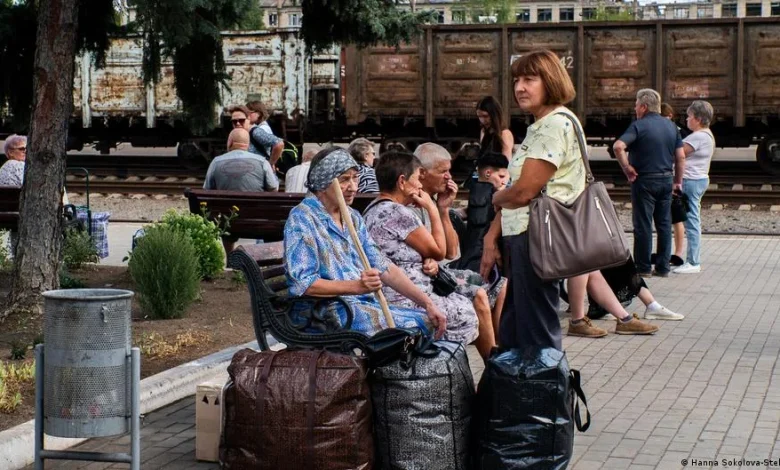
Anastasia Machnyk, who volunteers as a hotline dispatcher run by the Ukrainian Road of Life aid project, told DW that so far there had not been much talk about the peace proposal among the residents of Donbas, but that over the past weeks, more and more people had asked to be evacuated from the cities of Kramatorsk and Sloviansk.
She said that most of the people who had contacted the project were families with children or others who needed help, many of whom had held out till the last minute in the hope that the situation would improve. She said that life had been relatively calm for them, at least compared to other places closer to the front. “But they see that their hopes are not being fulfilled. Perhaps they are also being influenced by the news.”
Machnyk added that she had the impression from her conversations with people that most could not imagine that the Ukrainian government would give up areas where so many people still live. “They think that as long as there are still many people, they will not be abandoned. But a certain distrust of the authorities can also be felt.”
Many buildings in Kramatorsk in the Donetsk region have been completely destroyed Image: REUTERS
Fear of Russian occupation as well as war and winter
Machnyk continued by explaining that most seemed to doubt that Russia would stop fighting, even if there were a compromise and it gave guarantees. But she said the reason for the evacuations now also had to do with the fact that the frontline was getting closer, more and more buildings were being destroyed and winter was approaching.
Oleksiy K. (name changed), the co-founder of an aid organization that evacuates people from the Donetsk region, said people in relatively safe parts were leaving their homes for fear of a Russian occupation.
“Some are getting ready to leave because they are scared that at some point they will be told: ‘You have two days left, and then the area will fall to Russia,'” he told DW.
But those in the frontline areas of the Donetsk region, such as Kostiantynivka or Pokrovsk, were leaving mainly because their homes had been destroyed and there was a shortage of food supplies, he said — as well as the fact that communication lines were down because of shelling — not because of the current news.
“Those who are afraid of Russian occupation left these areas long ago,” he said. “Those who remain are mainly desperate people who don’t know where to go and pensioners who are worried about looting. They will hold out until the end, as long as their homes remain intact.”
He also said that there were people without principles who claimed they had “nothing to do” with politics, as well as a number of conscientious objectors for whom a ceasefire would make sense as they would not be drafted into the army.
Of those who have chosen to remain is Maksym Lysenko, the founder of a clothing brand who in June even opened a showroom with a cafe in Kramatorsk. But given the situation, he told DW that he was considering relocating his business to Kyiv. “When we opened we were a little apprehensive, but we hoped that everything would turn out well.”
But then the front line got increasingly close. “We are now thinking more about moving than about expanding,” he said, adding that nothing had been decided just yet. He said sales had risen again slightly in the past two weeks, after a sharp decline when the rail connection to Kramatorsk was interrupted, but had not yet returned to their previous level.
‘Anything is possible’
According to a survey conducted by the Kyiv International Institute of Sociology at the end of September and beginning of October, 71% of Ukrainians are against ceding Kyiv-controlled territories to Russia. But in the east of the country, only 47% of respondents are against this, while 24% would accept a loss of territory for the sake of peace and 29% are still undecided.
Lysenko, who is from Pokrovsk, said the idea of ceding Donbas to Russia was “absurd and unimaginable,” but conceded that it could happen. “Given the realities of the world and those in power in the US, I think anything is possible.”
He added that he did not think that handing over the entire Donbas region to Russia would lead to peace. He said it would instead enable the Russian army to regroup, bypass Ukrainian fortifications in the Donetsk region, and continue its advance. That would be a “defeat for the whole world.”
“We’ve saved Kyiv, our sovereignty, and our freedom. But we’ve lost a lot of territory because of the inaction of the international community,” he continued. “Instead of pressure being put on the aggressor, it is being put on the weaker party, and the world is standing by and watching this absurdity. It’s like rewarding a murderer just because he is stronger.”
Evacuation units have been helping people leave their homes in Kostiantynivka Image: Anatolii Stepanov/REUTERS
Concession of territories would be ‘capitulation’
Kateryna Koval is originally from Druzhkivka, near the frontline, but she currently lives with her family near the Ukrainian capital Kyiv. She also thinks it would be “completely absurd” to give up the whole region to Russia.
“This is not about an empty field, but about human lives. How can entire cities be abandoned? And the people who remain in them?” She pointed out that these did not all support Russia but had held on to their homes because they could not afford to move or were afraid of ending up on the streets. “Older people in particular who would not find another way of making a living.”
Conceding territories would be like capitulating, Koval said. And she also doubted that Russia would stop at Donbas but that, on the contrary, the threat to the Kharkiv and Dnipropetrovsk regions would only increase. But she feared that the US would force Ukraine into surrendering, adding that it would be a hard sell to the population.
She said that she had not heard of any internally displaced person who did not want to go home. “Even if their homes have been destroyed. It’s not just about the walls but about the feeling of home. And about the graves of loved ones, which would no longer be accessible.”
“If it’s Ukraine, and there is peace, we will go back because it’s our home.”
This article was originally written in Ukrainian.
Inside Ukraine’s front-line evacuations as Russia advances
To view this video please enable JavaScript, and consider upgrading to a web browser that supports HTML5 video