One of Slovenia’s most important post-war developments was Murgle, overseen by architects France and Marta Ivanšek and built from 1965 to 1982 on the outskirts of Ljubljana. Featuring groupings of low-built houses separated by pedestrian pathways, with cars excluded from all but the main thoroughfares, Murgle is a planned community that started out with simple, low-cost, small, prefabricated houses – many, bungalows.
An archive image of the original Murgle settlement
(Image credit: France and Marta Ivanšek Foundation)
Explore this newly designed bungalow in Slovenia
Although later buildings were more conventionally sized, the development still stands as an example of human-centric design long before debates about community and sustainability reached the mainstream. This renovation project from Slovenian firm OFIS arhitekti explores the ‘Murgle Archetype’, creating a more refined and elegant architectural expression without compromising what the studio calls the ‘collective low-tech intelligence’ of the overall development.
The original house before demolition and reconstruction
(Image credit: Tomaz Gregoric)
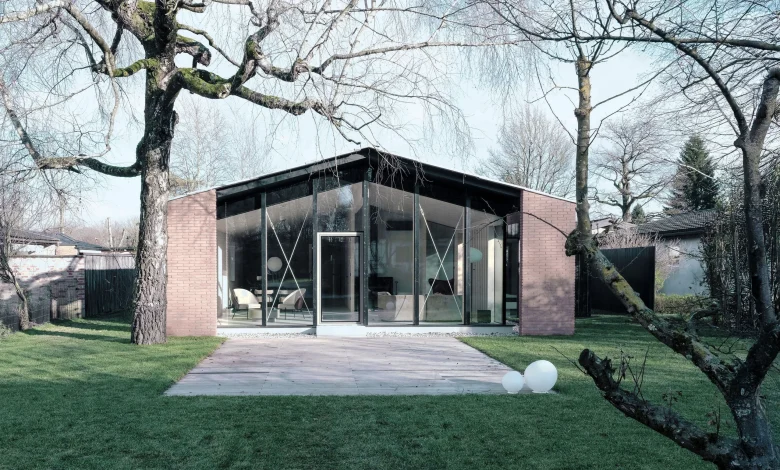
House under the Poplars, Murgle, Slovenia, by OFIS arhitekti
(Image credit: Tomaz Gregoric)
There’s a distinctly Scandinavian character to the Murgle Settlement, inspired in part by the Ivanšeks time in Sweden. As the architects note, ‘Murgle’s greatest challenge is its greatest value: how to renovate a settlement built by private owners, each constructing their own house from uniform urbanistic plans, without erasing the ecological and social DNA that made it exceptional?’
The view from the living room
(Image credit: Tomaz Gregoric)
House under the Poplars is the result, a structure that respects the simple archetypes of the original development. The original house was completely unsalvageable due to the presence of asbestos and the degraded timber frame. Nevertheless, the location was excellent, on the edge of a row of houses, offering a rare opportunity to extend the floorplan, albeit only by a small percentage.
The brick piers recall the location of the original house
(Image credit: Tomaz Gregoric)
The new house preserves the proportions of the 1980s original, only with cross-laminated timber structure and modern insulation and environmental performance. ‘The aim was not to redesign Murgle, but to repair a fragment of it without visually disturbing the whole,’ say the team at OFIS, led by principals Rok Oman and Špela Videčnik.
The main living space in the House under the Poplars
(Image credit: Tomaz Gregoric)
Although the exterior footprint is little altered, the interior volume makes for a radical departure. The original cellular plan is opened up, with a living room and kitchen area taking up around half the floor area, with ceiling heights raised up to the apex of the roof.
Inspired by greenhouses and pavilion design, one gable end is entirely glazed, with the roof structure supported on two brick columns, designed to be replica slices of the original façade, keeping the house rooted in local tradition.
Vertical slats provide privacy to the main living space
(Image credit: Tomaz Gregoric)
The new glazed façade looks out to the garden and a mature birch tree, with the side glazing partially obscured by vertical slats for privacy. The extension houses the primary bedroom, with an adjoining ensuite bathroom and covered atrium.
House under the Poplars, Murgle, Slovenia, by OFIS arhitekti
(Image credit: Tomaz Gregoric)
The house contains just one more bedroom suite, as well as a modest study, while a wine cellar is set beneath a glass floor in the living room. Timber cladding is used extensively on the walls and ceiling, unifying the interior and creating a feeling of warmth. Unpretentious in scale and programme, the House under the Poplars is a true successor to the spirit of the Murgle Settlement.
House under the Poplars, Murgle, Slovenia, by OFIS arhitekti
(Image credit: Tomaz Gregoric)
OFIS.si