This story contains major spoilers for It: Welcome to Derry episode seven, “The Black Spot.”
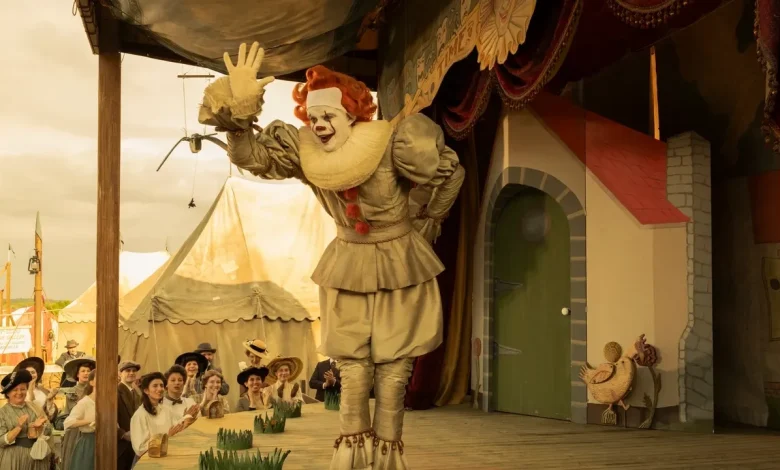
HBO’s It: Welcome to Derry has taken Stephen King’s lore into its own hands. Sunday night’s explosive penultimate episode “The Black Spot” finally executed the long-teased adaptation of the 1986 novel’s most devastating historical interlude. It also gave us the first-ever direct look at Bob Gray, the actual human who went by Pennywise onstage before It stole his whole schtick. Bill Skarsgård’s take on the man is as magnetic as his instantly famous rendition of the monster.
Welcome to Derry was announced almost four years ago, when Argentine director Andy Muschietti and his producer sister Barbara—whose It films earned nearly $1.2 billion worldwide in 2017 and ’19—teamed with actor-turned-writer Jason Fuchs to create a prequel series. Fuchs, who serves as co-showrunner with Brad Caleb Kane, jumped on Zoom from London to tell GQ about introducing Bob Gray, next Sunday’s finale, and the “risky gambit” of developing a project that didn’t have Bill Skarsgård—the face of the franchise—attached yet.
“The central mystery that a lot of us have talked about being one of the animating things that made us wanna tell the story was, ‘Why Pennywise?’” Fuchs recalled. He talked to us about how they ended up with a show that illuminates so much more.
GQ: This is probably the scariest Pennywise stuff we’ve ever seen. You did at least one brand new horror thing here: Humongous cleaver, head chopped in half, clown chomps into it like a melon. How’d that feel?
Jason Fuchs: It’s what my mom always dreamed of me doing with my life. [laughs] When you’re doing something like Welcome to Derry, we know we are wading into, to some extent, well-trod territory. We’ve made two movies, there’s a book—how do you approach this in a way that still feels like it’s an organic extension of the material, but also find fresh notes in it? That goes from the character stuff to the plotting to the time period, but also to the gore. What are the things we haven’t seen? We’re always looking for new horrors and new things that will generate a visceral reaction for the audience and elicit the kind of horrified reaction that the characters are experiencing.
The novel is over 1,100 pages, but Bob Gray remains a total enigma. We know It was never human, but it seems like Gray’s more than just an alias. In this episode, we meet Bob in 1908, as a carny—who’s also Ingrid Kersh’s dad—and get to see his Pennywise the Dancing Clown act. What was it like to take ownership of that lore?
The mystery around Pennywise, of Bob Gray—who he is, what that means—it’s one of the great mysteries of the novel. If we’re going to provide answers for it, those answers have to be at least as good as the mystery itself. I read It when I was 11. I’ve been, as you have been, sitting with these stories a very long time. I’ve thought about Bob Gray and who he was, and what’s real and what isn’t, since I was 11. I’m 39. So you feel a great sense of pressure as a Stephen King fan to deliver, if you’re gonna tackle one of those mysteries. It was one of the first questions we tackled: Why is It drawn to this form of Pennywise the Dancing Clown, and what is the real story of Bob Gray? Once we felt like we had answers that were tantalizing, and once we knew that the master himself, Stephen King, was feeling good about our answers, we felt really excited about where that might lead in the context of the season. And of course that dovetailed with the other key imperative, which was that we had to convince Bill Skarsgård to do it.
How did you get him onboard?
This was a really risky gambit. I don’t know if I’ve talked about it in this way with anyone yet, but we start breaking the season, we know that Pennywise has to be in this show. We also know that Bill Skarsgård has yet to say yes to this show, because there are no scripts. The network is going, “So what happens if Bill Skarsgård doesn’t say yes?” And you sort of bluff, you go, “Eh, it’ll be fine, don’t worry about it.” But there was no backup plan. Had we gotten to a point where Bill Skarsgård read the scripts and said no thanks—which was a possibility, given that he played this role twice and had sort of done what he expected to do with it—we didn’t know where we were going.
We projected great confidence, like, “Oh yeah, if Bill doesn’t do it, it’s fine, there’s a way.” There was no will, there was no way. Without Bill Skarsgård there’s no Pennywise; without Pennywise there’s no Welcome to Derry. So it’s one of the scariest risks that I’ve taken in my career. But Bob Gray was the key to getting Bill to come back, because Bill was looking for something new to do with the role. Of course he can come back and play the greatest hits; that’s not what he wanted. He wanted to come back and find fresh textures, fresh tones, something that dramatically was interesting and worthy of him taking on a role that takes him to a dark place. He invests his whole self into that performance, and Bob Gray was the key to that. Because he really is playing two characters in the context of the show, and it’s a very different character, when it comes to the human Bob Gray.
Bill’s so mesmerizing in both parts. What can you tell me about how he works?
He and Andy [Muschietti] have a really remarkable, unique collaborative relationship. They are very close friends in addition to being repeat collaborators, and they have a second hand with each other that I have not often seen between filmmaker and star. Watching Andy craft those performances with Bill is really special. You see Andy almost performing it, like a stage mom, at the monitors, reacting and doing Pennywise, it’s really funny. And you feel Andy’s energy through Bill, and it’s extraordinary to watch that symbiotic relationship. Bill is pretty remarkable in that he is, in between takes, kind of just a chill, great guy. When I saw him take on the Bob Gray stuff, I saw him lock in in a different way. You could see him figuring it out in real time. Bob Gray is in many ways as interesting a character as the It manifestation of Pennywise. Watching Bill portray him got me very excited not just for this season, but if we’re lucky enough to make more of these, I would be so curious to see what a season three looks like in 1908 with Bill as Bob Gray. There are a lot of possibilities there, if we’re lucky enough to get to see that.
I was rocked by the sight of kids loving his Pennywise act.
We all think of Pennywise as really scary. But you wouldn’t necessarily pick a scary creature if your goal was to lure kids in. Yes, people like me find clowns very scary, but that couldn’t have been the initial thing. Because there’s an infinite number of scary options, so you’d only be a clown, if you’re It, in order to terrify people who specifically have a fear of clowns. There had to be something more broadly applicable, and that’s what you see It seeing in the form of a little urchin boy in episode seven, seeing the way kids react. They’re captivated—Pennywise is hypnotizing, he draws them in, and then they go mad, they go nuts, they storm the stage. That moment of realization was really exciting, because it unlocked something for me as a fan: Oh, this is why It was so drawn to this form. He’s the Pied Piper of 1908.
What do you want us to take away from It inhabiting that child form, after two brief glimpses and only a few words?
That is the tip of the iceberg of a larger story that takes place in 1908. It is in that form for a reason. It uses that form to lure Bob Gray to his demise, but It doesn’t take that form just to do that. It was already up to something.
The plan the team’s been talking up is that season one takes place in 1962, season two will cover It’s previous cycle, 1935, and you wrap up with a third season in 1908. Was there a model for this, anything that inspired it?
No. I think that’s part of what’s fun about it. It wasn’t inspired by any other show or structure we’d seen. It felt necessitated by canon. We’re looking at the larger story map of this universe and going, okay, almost all the blanks are filled in in terms of 2016 [and 1989]. But we have this big territory that precedes 1989, and 1962, that hasn’t been as filled in. You have little pieces filled in, the hints that you get from the Mike Hanlon interludes. So by definition, we knew we had to move backwards in time. It also felt like there may not be a complete story to be told in between It’s appearances, but there might be pieces of the story that occur during It’s hibernations that are worth exploring. Is there a story or a character engine that justifies why we’ve moving backwards? Yes, and although I can’t tell you what that engine is, you will get a hint of it in episode eight. Andy keeps teasing, “There’s a reason we’re telling this story in reverse, I can’t tell you, it’s the big secret, it’s the mystery.” There’s one moment in that finale that speaks directly to that central mystery, which I’m excited to see how people react to.
Are we going to visit 1989 or 2016? Is anyone from the films banging on your door wanting to be on the show?
I would say stay tuned. Maybe you will or won’t see something that comes into play between It’s cycles before the end of the season.
What actually happened between Mrs. Kersh (Madeleine Stowe) and Hank Grogan (Stephen Rider)? Ingrid’s the one who informs the white mob he’s hiding at the Black Spot. Was that a genuine relationship or was it just a long con?
No, no, not at all. No one’s asked me about that—that relationship was completely genuine. Ingrid is in an abusive relationship, Stan Kersh is a bad dude, he’s a horrible husband. And she found refuge, as so many of us do, at the movies. One of the things we sacrificed was, I’d actually written a little bit of a backstory for them that we never got to film, where you saw her going to the movies. Sitting there in the theater alone, and Hank noticing her, and noticing she always comes in at the same time. And they bonded over film. They had a shared love of movies, and it was her refuge from the abusive household that she lives in.