New Report Highlights FedEx Economic Impact in Asia Pacific Region as Company Drives Connectivity and Innovation

December 7, 2025 09:30 PM
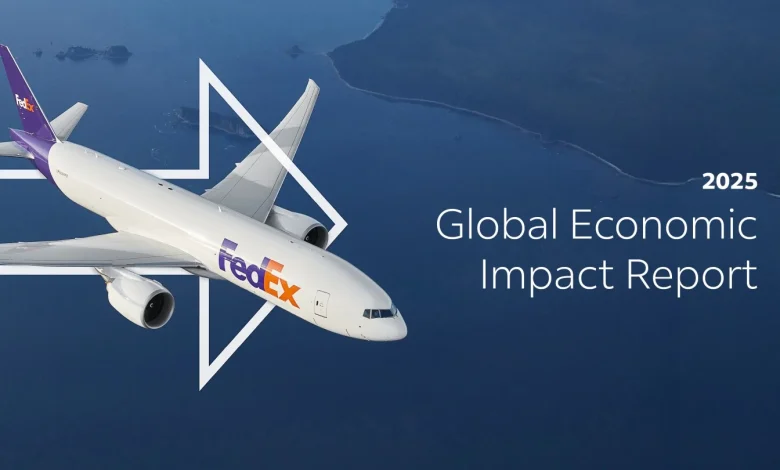
Singapore, December 8, 2025 – FedEx Corp. (NYSE: FDX) released its annual Global Economic Impact Report, highlighting the company’s worldwide network and role in fueling innovation during its 2025 fiscal year (FY25).Produced in consultation with Dun & Bradstreet (NYSE: DNB), a leading provider of business decisioning data and analytics, the study demonstrates the positive impact FedEx has on individuals, businesses, and communities around the world — otherwise known as the FedEx Effect.
“For more than 50 years, FedEx has shaped global commerce by offering innovative shipping services that bring communities closer together,” said Raj Subramaniam, president and CEO, FedEx Corporation. “Our culture of innovation, paired with our team’s steadfast commitment to outstanding service and bold ideas, enabled the FedEx network to continue fueling worldwide progress this past year through a rapidly evolving trade landscape and shifts in supply chains.”
The report reveals that FedEx contributed $126 billion in direct and indirect impact to the global economy in FY25. FedEx direct impact alone is 1.6 times greater than the average direct impact of companies with more than 100,000 employees in the Dun and Bradstreet Data Cloud.[1]This reflects the scale of the FedEx network and the company’s ongoing efforts to enhance its services and optimize its operations as one FedEx.
APAC impact
FedEx has continually expanded and transformed its network to support Asia Pacific’s growing role within the global economy since beginning operations in the region more than 40 years ago. The company employs tens of thousands of team members across 43 APAC countries and territories, linking those markets to the rest of the world. In FY25, FedEx directly contributed 0.1% to net economic impact in APAC’s Transportation, Storage, and Communications sector[2] and indirectly contributed $1.6 billion to the region’s overall economy — including $510 million to its Transportation, Storage, and Communications sector and $484 million to its Manufacturing sector. Together, the combined direct and indirect contributions from FedEx to APAC’s economy totaled approximately $5.7 billion.
“Asia Pacific is one of the most dynamic and diverse markets in the world,” said Salil Chari, senior vice president, marketing and customer experience, FedEx Asia Pacific. “It holds 60%[4] of the world’s population and is an increasingly important driver of the global economy. That means the FedEx Effect has a particularly significant impact here and will continue to do so into the future. Our customers span small e-commerce entrepreneurs to global manufacturers. We continue to invest in the region to enhance our network and operations and introduce new digital innovations to make supply chains smarter, faster, and more sustainable so our customers can compete and thrive in an evolving global economy.”
Global impact
FedEx operates the world’s largest express transportation company, serving more than 220 countries and territories and employing more than 500,000 people across 5,000 facilities. The company transports approximately 17 million packages per day and more than $2 trillion worth of goods every year. The scale of this network drives the magnitude of the company’s global impact.
Notable results from the Asia Pacific region highlighted in the FY25 FedEx Global Economic Impact Report include:
- Trade: Leveraging the company’s long history of connecting businesses around the world, deep understanding of the complexities of global supply chains, and expertise in customs brokerage services positions, FedEx continues to be a valuable trade partner and help customers navigate and optimize their supply chains. By analyzing changing regulations and trade patterns, FedEx has been able to adjust capacity across its network to meet customers’ evolving needs.
- Operational enhancements: FedEx continued to strengthen its network in FY25 with several new flight routes across the region — including a direct round-trip between Singapore and the U.S. to support growing Southeast Asia trade, and a new route linking the Asia Pacific hub in Guangzhou to Bangalore, the UAE, Liège, and Paris to enhance intra-Asia and Asia-Europe connectivity. The company also increased the frequency of two China–U.S. routes: Qingdao–Memphis (via Osaka) and Xiamen–Anchorage–Memphis (via Incheon). In Southeast Asia, FedEx invested in new facilities to serve the region’s expanding economy. It opened a gateway facility in Denpasar, Bali, providing faster, more reliable export connections through Singapore, and a new parcel and freight facility in Laem Chabang, Thailand’s Eastern Economic Corridor (EEC), to meet rising regional demand.
- Supply chain: In calendar year 2024, 90% of the 100,000 suppliers FedEx contracted with were small- and medium-sized businesses (SAMs), supporting hundreds of thousands of jobs. FedEx also spent $1.9 billion with suppliers in APAC during calendar year 2024 (CY24), 73% of which went to small businesses. Across the region, 88% of FedEx suppliers are small enterprises, underscoring the company’s commitment to supporting local entrepreneurship and supply chain resilience.
- Intelligent innovation: FedEx is leveraging its industrial network and the data it captures to develop digital, AI-driven tools and solutions — modernizing operations to create smarter, more flexible supply chains, and streamlining the international shipping process. FedEx expanded its AI-driven digital brokerage solutions that improve the customs clearance experience, reduce delays, and help customers adapt to evolving regulatory requirements across regions.
- Small businesses: FedEx offers a portfolio of solutions and programs that are designed to help SAMs accelerate their growth and extend their global reach.In FY25, the company expanded the availability of several digital innovations designed to streamline international trade and global supply chain management, including launching FedEx Import tool, and the Collaborative Shipping Tool to all FedEx import customers across APAC markets.And through its annual Small Business Grant Contest™ FedEx recognized four companies in Asia Pacific from Singapore, Indonesia, and India by awarding them a combined prize pool of US $69,000. Winning companies are not only tackling today’s pressing challenges but also shaping a more connected and resilient future, with solutions focused on battery recycling, carbon tracking, satellite propulsion, and space safety.
- Sustainability: The company advanced toward its goal to achieve carbon-neutral operations by 2040 through continued investments in renewable energy to power its facilities, fleet electrification, alternative fuels, and air fleet modernization. In Asia Pacific, the company added EVs to its fleet in Japan, Korea, New Zealand, Singapore, and Thailand, while expanding charging infrastructure in Malaysia and Japan. In January 2025, the FedEx South Pacific Regional Hub in Singapore began using solar panels that now supply over half of the facility’s total electricity needs. In FY25, FedEx also began its first major U.S. deployment of sustainable aviation fuel (SAF), securing more than 3 million gallons of blended SAF for use at Los Angeles International Airport (LAX) over the course of a year.
- Giving: FedEx Cares is committed to strengthening communities worldwide through charitable giving, employee volunteerism, and in-kind shipping support. In FY25, FedEx contributed $55.5 million to nonprofit initiatives, dedicated more than 81,000 volunteer hours among team members, and harnessed its global network to deliver critical disaster relief to communities in need, quickly and reliably. The annual FedEx Cares Purple Tote Campaign saw 800 team members contribute 1,000 volunteer hours, donating 3,600 kilograms of essentials through 20 non-profit partners, benefiting more than 1,600 people. The company also supported youth entrepreneurship through its regional FedEx JA International Trade Challenge and expanded the Library Program to 40 schools and communities in China, providing educational resources for 9,000 students and teachers.
Read the full FY25 FedEx Global Economic Impact Report and explore the FedEx Effect in communities and regions around the world at Home | Economic Impact Report | FedEx.