Can Eagles’ alarmingly inefficient offense change as Nick Sirianni sticks with Kevin Patullo? – The Athletic

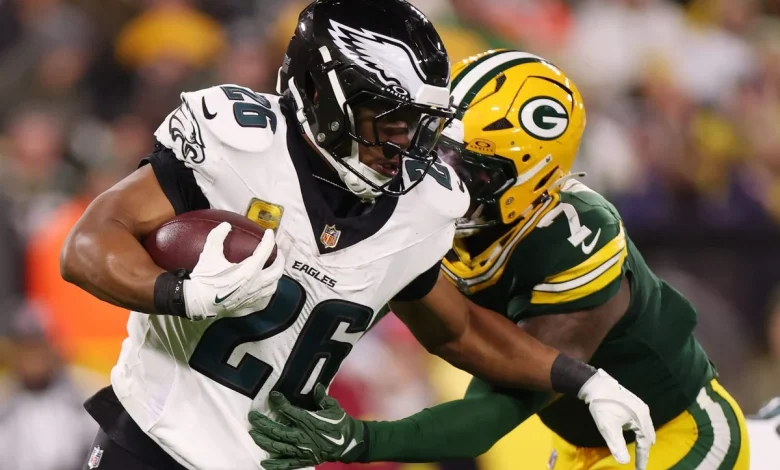
The creators, stewards and members of the Philadelphia Eagles offense know their production is insufficient. They know their system has bugs that need fixing. They insist they are taking actions to do so. They just have no interest in discussing how that is being done — even to the vaguest degree.
At the gates of The House of Silence is Nick Sirianni. The head coach began the 14th week of his fifth season by telling reporters “everything” was evaluated over the team’s mini-bye weekend after getting bullied in its Black Friday home loss to the Chicago Bears. Going forward, Sirianni said “we will think about some different things that we want to do all over the place,” which involves “everything,” he repeated.
What exactly is everything?
“I don’t think it benefits us for me to share in particular what that is,” Sirianni said. “Just know this: We want to get this thing fixed more than anybody. We live it, breathe it, and are involved in it every waking second of our lives. That’s what we’re working on right now.”
Everything can be convenient framing. It evokes the holistic idea of every inch of The House of Silence being supervised without having to address the wiring issue that’s mucking up the wall sockets. Or more. That’s the flip side: How many problems are there in everything? When Sirianni says, “obviously, we’re evaluating everything,” that invites the alarming possibility that there are problems with, well, everything. And Sirianni’s silence leans on both organizational and public trust that his process can fix whatever everything is.
Sirianni is certainly operating the 2025 season with organizational trust. Owner Jeffrey Lurie extended Sirianni’s contract after the Eagles won Super Bowl LIX. They’d reached the Super Bowl twice in three years. Sirianni’s career win percentage (.700) remains higher than anyone who’s coached the Eagles. And Sirianni exercised that organizational trust by promoting his long-time assistant, Kevin Patullo, to replace New Orleans Saints-bound Kellen Moore as his offensive coordinator.
That decision drew scrutiny before it was officially made. Scrutiny has intensified as its surface-level concern was realized: The Eagles are once again stagnating offensively after another internal hire.
The Eagles offense’s season-total -5.22 EPA ranks 16th in the NFL. In a more alarming view, the Sirianni-era Eagles had never owned a negative total offensive EPA beyond Week 11 until this season. Despite returning all but one starter from their Super Bowl LIX lineup, despite Jalen Hurts and Saquon Barkley playing in every game, despite deploying A.J. Brown and DeVonta Smith together in all but one game, despite fielding at least four of their usual starting five offensive linemen all season, Sirianni and Patullo’s system is on pace to be the team’s least efficient offense since Sirianni was hired.
Sirianni-era Offensive EPA Totals
SeasonOCThrough Week 13Full Regular Season
2021
Shane Steichen
38.92
59.36
2022
Shane Steichen
69.13
72.91
2023
Brian Johnson
57.89
47.19
2024
Kellen Moore
60.23
93.58
2025
Kevin Patullo
-5.22
???
The stagnation threatens Patullo’s job security and could force Sirianni to adapt yet again during the offseason. An aggravated Eagles fanbase has increasingly hollered boos and curses and “Fire Kevin” chants from their seats. An extreme and reckless contingent hurled eggs at Patullo’s home after the Bears game and is being investigated by local law enforcement.
“It’s perfectly acceptable to sit up here and talk about what’s going on, how to fix it, what we’re going to do going forward, and we know that,” Patullo said. “But when it involves your family, obviously it crosses the line. That happened, and at this point, we’ve just got to move on. We’re trying to win.”
Sirianni and Patullo’s rallying cries for their on-field product echo those in 2023. Former OC Brian Johnson was trying to win, too. But the details within that season’s dysfunction were indeed different. Sirianni later admitted to being too involved in the day-to-day oversight of that offense. Patullo leads the 2025 offensive game-planning and calls plays, an adapted framework Moore operated within last season. Still, Sirianni and Patullo’s long-shared history somewhat devalued the relevance of any autonomy Patullo held, and moreso launched the ultimate test of the offensive principles they’d formed together.
This is reinforced by Sirianni’s constant defense of Patullo as the offense’s play-caller. That steadfastness underlines the unique predicament this year’s Eagles are in.
Sirianni has twice changed play-callers midseason. He called offensive plays to begin his inaugural 2021 season, but delegated the job to former OC Shane Steichen. In 2023, Sirianni stripped defensive play-calling from former DC Sean Desai before their Week 15 loss to the Seattle Seahawks and gave those duties to former senior defensive assistant Matt Patricia. Steichen, who’d called plays for the Los Angeles Chargers, galvanized the Eagles in two straight playoff runs before the Indianapolis Colts hired him as their head coach in 2023. Patricia, a long-time New England Patriots DC and former Detroit Lions head coach, did not improve a defense that required the personnel overhaul it received during the subsequent offseason.
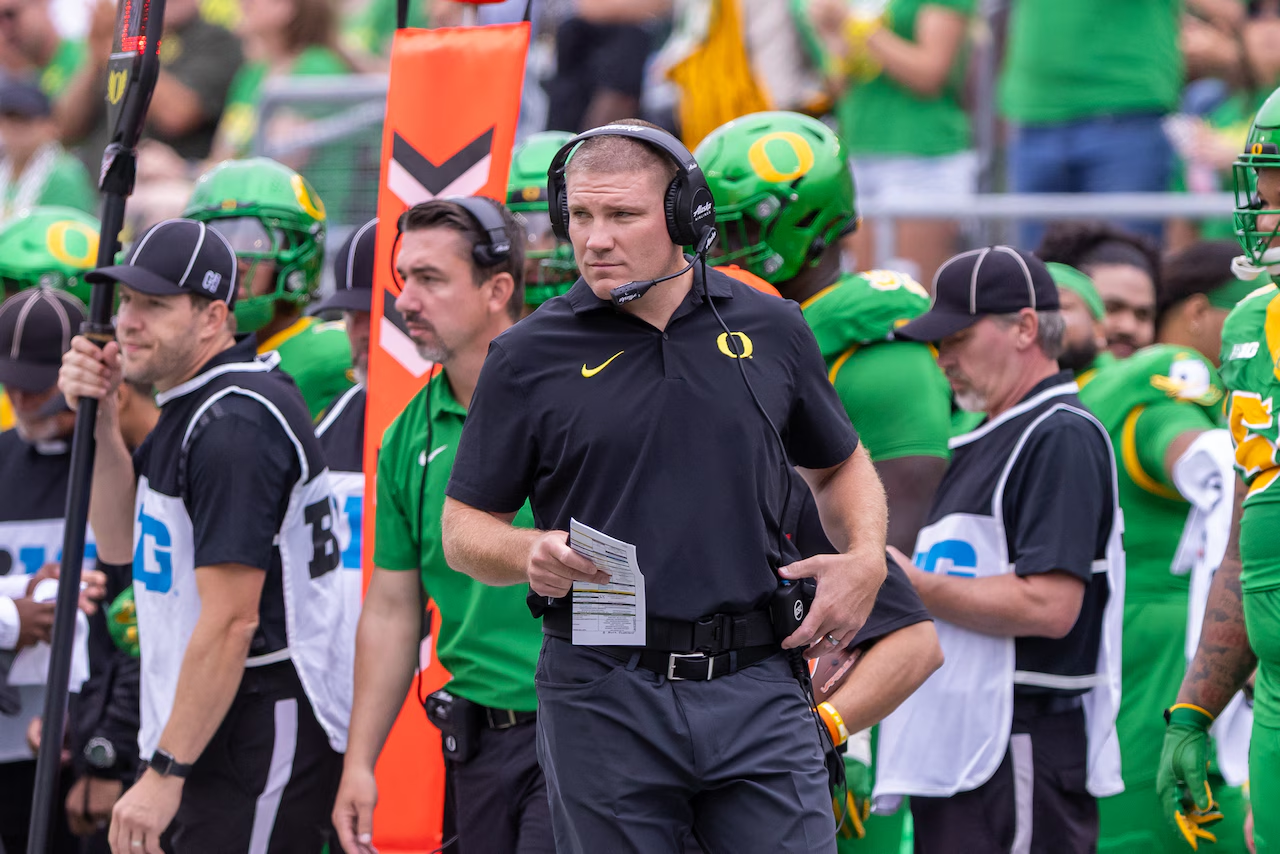
Head coach Nick Sirianni and the Eagles have been vague about what their problems are and what they’re looking to fix. (Kevin Jairaj / Imagn Images)
This year, Sirianni has stuck by Patullo while offering repeated variations of, “It’s not about one person.” Asked why this year is different from 2021 and 2023, Sirianni called them “different scenarios” without saying why he believed they were. As for the 2023 season, which contained the biggest blot on Sirianni’s otherwise exemplary record, he said “the lessons we learned” resulted in their Super Bowl LIX championship.
“I have very specific thoughts and have written down exactly what we learned and how we learned it and what we did for that,” Sirianni said. “Obviously, those lumps that you take, if you allow them to, can knock you down and keep you down, or those lumps that you take can let you rise up above everything.”
Sirianni is once again leaning on those notes to combat an offensive lull few NFL head coaches have conquered by standing pat with their staff. In 2003, Mike Tice stuck with his Minnesota Vikings coordinators through a 6-0 start that devolved into a 9-7 finish. (Tice fired DC George O’Leary that offseason.) In 2008, Eric Mangini stood by OC Brian Schottenheimer despite the New York Jets’ backslide from 8-3 to 9-7. (The Jets fired Mangini afterward.) In 2014, Chip Kelly’s Eagles started 9-3 and missed the playoffs at 10-6. (Kelly fired DC Bill Davis afterward and was fired himself in 2015.)
Onlookers can point to past head coaches who executed midseason firings and believe it’d also yield the Eagles dream results. In 2012, John Harbaugh famously fired OC Cam Cameron in Week 14, promoted former Colts head coach Jim Caldwell, who was on the Baltimore Ravens’ staff as their quarterback’s coach, and the Ravens eventually won Super Bowl XLVII with record-setting games by quarterback Joe Flacco. In 2015, Mike McCarthy took back play-calling from OC Tom Clements in Week 14, which boosted the play of Aaron Rodgers and carried the Green Bay Packers through a two-game playoff run.
Unlike Harbaugh, Sirianni does not employ a former offensive-minded NFL head coach. And unlike McCarthy, Sirianni did not climb the coaching ranks because of his proficiency as a play-caller. The former of those two factors reinforces Sirianni’s belief that Patullo, himself and his staff of subordinates will succeed. The latter reinforces the organization’s belief in Sirianni’s process. Both are facing major tests.
The framework of Sirianni’s offensive staffing is noteworthy. He has never hired someone with experience as a full-time NFL offensive play-caller for a position at a lower rank than offensive coordinator. (Passing game coordinator Parks Frazier and tight ends coach Jason Michael both previously called plays on an interim basis.) This inherently creates a natural pecking order that was jostled on the defensive side when Sirianni added Patricia to the 2023 staff behind Desai. Given that Sirianni did not employ a former DC behind Jonathan Gannon in 2021 or 2022, Sirianni effectively used Patricia as a break-the-glass option for Desai, whom Sirianni hired because his preferred option, Vic Fangio, was not yet available.
The only shadow looming over Patullo is Sirianni, who is most comfortable not calling plays. Instead, Sirianni oversees the collective work of a coaching staff that he often calls a “collaboration.” One could argue that first-year quarterbacks coach Scot Loeffler, a four-time collegiate OC and former Bowling Green head coach, is qualified to call NFL plays. (Johnson was a three-time collegiate OC.) But Sirianni hired Loeffler because of his expertise as a quarterbacks coach and the distinct portfolio of offensive systems and concepts he’d contribute to the collaboration.
Loeffler and Frazier were Sirianni’s two external hires in the offseason. Their collective history contributed to Sirianni’s belief that his staff contained enough fresh ideas to prevent the long-term stagnation that doomed the 2023 season. Asked how Loeffler and Frazier have specifically been involved in the staff’s recent system evaluation, Sirianni instead spoke the name of every offensive staff member and talked about them in general terms.
“Everyone’s in there talking through everything and that’s what you do,” Sirianni said. “You have to have a guy that’s leading the charge, but those coaches meetings are so valuable of how you kind of go through that because you want everybody on the same page. You go through it with everybody together, and, naturally, everyone’s looking at it as a slightly different vantage point. And so everybody helps in those processes.”
No team is quite alike, but Sirianni’s commitment to his offensive staff amidst considerable snags contains similarities to a 2015 Atlanta Falcons team in which their coach, Dan Quinn, stood by then first-year OC Kyle Shanahan through a 6-1 start that gave way to a six-game losing streak. Quarterback Matt Ryan’s career-low struggles confounded the fanbase considering the enviable talent he had around him in All-Pro wideout Julio Jones and Pro Bowl running back Devonta Freeman.
The defensive-minded Quinn still held strong confidence about the direction of their offensive system, like Sirianni. Quinn told reporters during their bye week that they’d made only “subtle” changes to their offense. After Atlanta’s fifth straight loss, Quinn doubled down by saying, “We have a core philosophy that we absolutely, 100 percent believe in and won’t back off from.” The Falcons still tumbled, lost two of their next four games, and missed the playoffs at 8-8. Quinn retained Shanahan, and, in 2016, the Falcons reached Super Bowl LI and Ryan won league MVP.
“Oddly enough, I think one of the things that was interesting is while we finished that season 8-8… I actually felt like we were making strides as an offense and getting better and moving in the right direction,” Ryan, now an NFL analyst for CBS Sports, told The Athletic. “And I think that’s one of the hardest things in sports is to feel like you’re living in this area where your process is really good, your preparation is really good, but you’re not seeing the outcomes that you want. Because that inherently makes you question whether you’re doing it.”
Play-callers and players are graded on results. Wins and losses. Points and yards. Efficiency and consistency. Absent of those things, how did Ryan feel like the Falcons were making progress? He said when the process they had during the week started showing up on tape — success even in small sample sizes. Not fluke plays. Not improvisation. When a play or concept they’d installed for that week’s game plan — a blitz protection, a route dependent on adjusted timing, et. al — made it to the field and worked.
“In a lot of ways, it is a result,” Ryan said. “It’s a result on a specific play or a specific protection or a run scheme of a back trusting his reads, his keys, those things, and you see a positive gain. And it might be followed by one that’s not there, but we’re having more positive results than we are negative.”
Indeed, the 2015 Falcons recorded a net-positive total offensive EPA in four of their final five games, per TruMedia. Conversely, the 2025 Eagles haven’t played a game with a net-positive total offensive EPA since their Week 8 win over the New York Giants. Within that four-game stretch, 188 of Philadelphia’s 238 offensive plays (79 percent) carried a negative EPA. They include 49 incomplete passes, 21 penalties and 11 negative runs. Hurts’ 0.01 EPA per dropback in that span ranks 18th among league quarterbacks. Barkley’s -28.65 total rush EPA in that span ranks last among running backs.
Hurts and Barkley have both held themselves accountable publicly. So have a number of other offensive players. But there is also little evidence to suggest that an offensive staff with Sirianni at the helm and Patullo spearheading game plans and play calls is affording a talent-laden roster a schematic advantage.
“Of course none of us are doing a good enough job right now,” Sirianni said. “We all have to look internally and get better.”
Sirianni’s evaluation of “everything” operates within a workflow process he still holds confidence in. The framework of the team’s day-to-day schedule has remained unchanged in the Sirianni era, although it truncates on short weeks and shifts over for Monday night games:
- Monday: Review the previous game, then take a big-picture look at the next opponent
- Tuesday: NFL-mandated off day for players
- Wednesday: Early-down play installation
- Thursday: Third-down play installation
- Friday: Red-zone play installation
- Saturday: Four-minute and two-minute situation installation
- Sunday: Game day
Several players said they appreciate the consistency. The items within the days have changed over the years (for example, the Eagles close their days with practice this year when they practiced earlier in previous seasons), but the subject matter stays the same. For comparison, Ryan said he had to adapt to different installation schedules while playing for five offensive coordinators with the Falcons. Sirianni’s daily framework allows the players to work ahead on their own time while knowing when they’ll meet with coaches over specific plays.
“It’s good that way because you know what you’re getting yourself into,” wide receiver Jahan Dotson said. “You know how to attack your weeks, how to attack your day, and how to use your time most efficiently.”
The Eagles’ coaching staff molds their preparation around that framework. Sirianni has balked when asked what responsibilities each assistant holds. But in terms of their day-to-day approach, Sirianni said “the guts” of his process “stay pretty similar, but there are constant tweaks.”
“There are definitely days that you go in and say, ‘Okay, I’m devoting eight hours to red zone,’ and then that day it takes eight and a half or nine or 10 or five,” Sirianni said. “It just depends. Your schedule may be this, but we have the ability as coaches to stay later. We don’t have to punch a clock; we don’t get overtime for anything. Although, I did get overtime when I was at (Indiana University of Pennsylvania) as a (wide receivers) coach. That was nice.”
It is clear Sirianni and his coaching staff are working overtime. Left guard Landon Dickerson said he often receives 10 p.m. text messages with addendums to the game plan ahead of the next day’s installations.
“You just kind of look over those at night or when you wake up in the morning,” Dickerson said. “You don’t have a ton of time here together in this building. So, you got to get the information out somehow. So a lot of times it’s you send stuff out, pictures and texts and videos and all that stuff just so you can get it hammered out and kind of put this day in and make sure you get all the information you need before you get to the next day.”
By sticking with the framework of his staff, Sirianni is placing belief in his process with Patullo as his play-caller. By committing to a workflow that every play-caller has operated within under Sirianni, the Eagles at the very least have an established constant for how they managed their time.
And they will know which variables contributed to this offense’s problems — or its solutions.