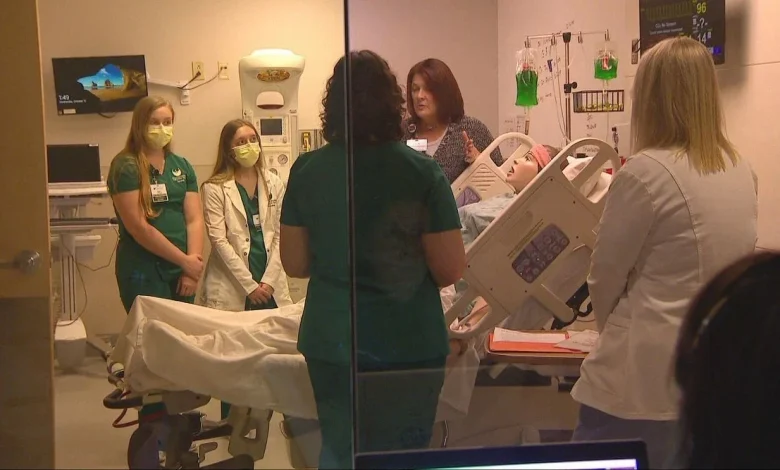
(WLUK) — Changes at the Department of Education are being met with concern and confusion by many — especially those in the field of nursing.
The department announced last month that it would be removing nursing from its internal list of professional degrees to lower federal borrowing limits for students.
The Department of Education announced last month that it would be removing nursing from its internal list of professional degrees to lower federal borrowing limits for students. (WLUK)
In Wisconsin, there are more than 93,000 registered nurses.
“They are the largest health care profession in Wisconsin,” says Gina Dennik-Champion, who heads the Wisconsin Nurses Association and has 40 years of nursing experience.
It was a shock to many in the nursing field when the Trump administration announced the Department of Education would be excluding nursing from its list of professional degrees.
“I guess appalled would be a good word, given what’s going on in health care these days and the important role that nurses play,” Dennik-Champion adds. “It has become an emotional issue for all nurses to be labeled or to think that [they’re] being perceived as not a professional. Which, when you look at the work that is done day in, day out, you know — who’s in our health care facilities 24 hours a day? It’s the presence of a nurse.”
But on its new “Myth vs. Fact” page online, the Department of Education debunks the idea that it doesn’t believe nurses are professionals. It reads:
The definition of a “professional degree” is an internal definition used by the Department to distinguish among programs that qualify for higher loan limits, not a value judgement about the importance of programs. It has no bearing on whether a program is professional in nature or not.
The Department of Education’s list of “professional” degrees, which are granted higher federal borrowing limits. (WLUK)
Still, the new classification lowers federal borrowing limits for nurses who are seeking advanced degrees — a master’s or a doctorate. Students getting a “professional” graduate degree are eligible to borrow $50,000 yearly, with a lifetime limit of $200,000.
Those graduate programs not under the “professional” designation, like nursing soon will be, can only borrow $20,500 yearly, with a lifetime limit of $100,000.
According to the National Center for Education Statistics, the average cost of an advanced nursing program sits at $30,000 per year. Wisconsin Department of Workforce Development data shows that just over 8% of Wisconsin’s registered nurses have advanced degrees.
Federal borrowing limit differences between “professional’ degrees and those not included on the “professional” list. (WLUK)
Dennik-Champion says she believes this could make some students think twice about pursuing a higher degree. That’s a problem, she says, because advanced-practice nurses are filling holes left by the state and nationwide physician shortage.
Wisconsin is also already preparing for a 20,000-deficit in nurses by the year 2040, too.
Dennik-Champion says the change could potentially impact health care in the years to come.
“Patients will probably have to travel further right to get to a health care system or clinic where I can at least see and get care. In that way, we also have in our emergency rooms, you have a number of nurse practitioners who are working in the emergency room. If they’re gone and the physicians are gone, you know, what will the impact of that care be? Delay, delay, delay,” she says.
But Jessica Leiberg, the dean of the nursing school at Concordia University Wisconsin, says she believes those who are called to be nurses will still pursue those higher roles.
“It takes a special person to be a nurse,” says Leiberg. “I don’t think there’s going to be a decreased interest. I think what we’re really going to have to rally our troops is in education of these additional funding mechanisms.”
She does have concerns, however, about future nurse educators who could be hit hard by aid caps.
“Statistically speaking, there were over 60,000 nursing students who were turned away — qualified nursing students with interest to be a nurse — that were turned away because there were not enough nurse educators to teach them,” Leiberg says, referring to a 2023-24 statistic from the American Association of Colleges of Nursing.
But even so, leaders at Concordia University Wisconsin say they feel confident that — thanks to its financial aid office, strong donors and university partnerships — they can help mitigate the impact of the new borrowing limits for those incoming nursing students who may be affected.
The school does plan to start its classes a week early next year, just before the new borrowing limits take effect July 1.
“I think when you have legislation come down like this in such a short timeframe, the more students you can grandfather into the old limits allows us, and any school, more time to come out with a plan that’s best for students moving forward,” says Concordia University Wisconsin Assistant Vice President of Financial Aid and Student Accounts Kevin Sheridan.
Overall, Sheridan says the funding changes will have the biggest impact on first-generation college students and will put more work on admissions and financial aid teams.
“The change to the graduate plus loan is honestly going backwards in time, before 2008, when it didn’t exist,” he says.
The Department of Education says the decision to make the change came from “data [indicating] that 95% of nursing students borrow below the annual loan limit and therefore are not affected by the new caps.”
Sheridan indicates that statistic does ring true of Concordia University Wisconsin’s advanced-degree nursing students. After polling them, he says the average loan debt for those students at CUW is under $20,000.
But, that may not be the case everywhere.
“We have been hearing already that, ‘I can’t get any more loans,’ says Dennik-Champion of the Wisconsin Nurses Association. “You know, the Department of Education loan program was certainly tapped into by a number of these graduate-level nursing students.”
The Department of Education also made the decision as a way to encourage universities to lower their overall tuition rates.
“Since 2007, graduate and professional students have been able to borrow up to the full cost of attendance. This has allowed colleges and universities to dramatically increase tuition rates, even for credentials with modest earnings potential, which has saddled too many borrowers with debts they find difficult to repay,” the department’s ‘Myth vs. Fact’ page reads. “The Act’s annual federal loan caps are already reining in inflated prices at graduate programs across the country.”
“They are hoping that by reducing the amount of dollars available to pay for tuition, that the cost of tuition will go down,” Dennik-Champion says.
Sheridan says it doesn’t work that way.
“I can say this from Concordia’s perspective. There isn’t a lot of gap between the cost of the program and what we’re charging students. We’re not making hand-over-fist in terms of revenue from these programs. To have great faculty, to have experienced faculty, to have great facilities and to continue to improve the technology students want, the facilities they want, it all costs money,” he says.
Personally, I don’t think it’s going to lead to a decrease in tuition because I don’t think there’s that much of a gap in some of these programs to lower tuition before schools will consider getting out of them.
When it comes to financial aid, Sheridan says literacy is vital. If he could give advice to incoming students who may rely on federal aid, it’s this:
“I think it’s important for students to know not to overborrow. I think where this stems from is, not all students, but there was a population of students that might have been taking advantage of the federal loan program,” he says. “Like any federal or state program, it’s never going to be perfect, but to be very conscious about only borrowing what they need, because those limits will run out, and not to take excess upfront because it could cause problems later on.”
But most importantly, he hopes students will keep this in mind moving forward:
“Schools are still fighting for students. Accrediting agencies are still fighting for students. We’re going to walk with students, meet them where they’re at and walk hand-in-hand trying to help them afford their education,” he says.
The Wisconsin Nurses Association, in partnership with the American Nurses Association, has started a petition in hopes of sharing their concerns about the borrowing limit changes with the Department of Education. Those interested in signing the petition can click here.