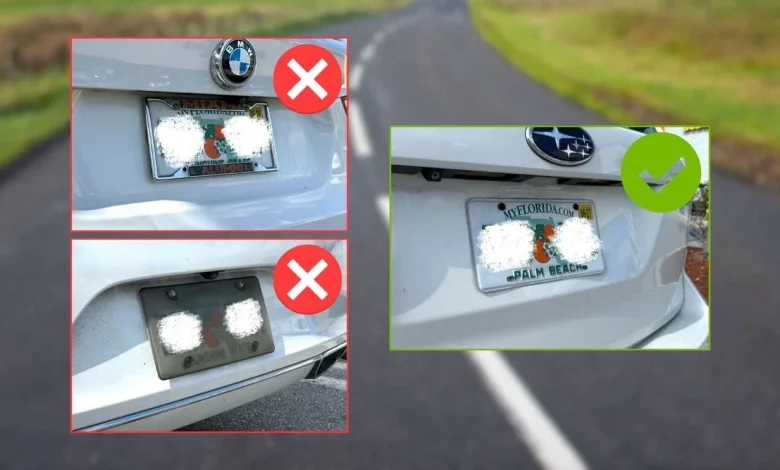
WEST PALM BEACH, Fla. (CBS12) — A new Florida law already on the books is catching drivers off guard — not because they’re speeding or running red lights, but because of what’s on their license plates.
Since Oct. 1, 2025, anything that blocks, covers, distorts, or even slightly obscures a Florida license plate is illegal under changes to state statute 320.061, part of House Bill 253.
What used to be a harmless cosmetic accessory — a tinted shield, a dealership frame, a glossy “protective” cover — is now grounds for a criminal charge.
What drivers need to know
The law makes it a second-degree misdemeanor to obscure a license plate in any way. That includes:
- Tinted, smoked or “clear” plastic plate covers
- Decorative frames that hide even a small part of the numbers, letters, or the word “Florida”
- Reflective sprays, films or coatings
- LED lights or attachments that distort visibility
- Mechanical “flippers” or any device that hides or retracts the plate
Even dealership-installed frames can violate the law if they cover any portion of the plate’s border or state name.
Penalties now in effect
The consequences are much steeper than many drivers realize.
Knowingly driving with an obscured plate is a second-degree misdemeanor, punishable by up to 60 days in jail or a $500 fine.
Manufacturing or selling plate-blocking devices carries a first-degree misdemeanor, which can mean up to one year in jail.
Using any plate-obscuring device while committing a crime — or fleeing from one — escalates the offense to a third-degree felony, carrying up to five years in prison.
Since Oct. 1, 2025, anything that blocks, covers, distorts or even slightly obscures a Florida license plate is illegal under changes to state statute 320.061, part of House Bill 253.
Click here to view the PDF file
With these penalties, Florida now ranks among the strictest states in the nation for license-plate visibility.
Why now?
Lawmakers pushed the measure after years of complaints from law enforcement and tolling agencies who said obscured tags were making it harder to identify vehicles — in criminal investigations and in everyday enforcement.
Supporters say the law creates statewide consistency and cracks down on devices specifically marketed to evade tolls, red-light cameras or detection during a crime.
See also: Martin Co. sheriff: Wawa Red Bull stop helped identify suspects in $1M sneaker heist ring
What’s still allowed
Plain plates — fully visible, uncoated, unobstructed are still allowed.
Plain plates — fully visible, uncoated, unobstructed are still allowed. (WPEC)
Standard thin frames are allowed only if they do not cover:
- The numbers or letters
- The registration decal
- The word “Florida”
- Any part of the plate border
If a frame overlaps even a sliver of the plate’s design, it’s likely illegal.
What drivers should do now
The safest move: strip the tag bare. No covers, no coatings, no tinted shields — and only minimalist frames that leave every word, number and border fully exposed.