Julian O’NeillBBC News NI crime and justice correspondent
IMAGES4MEDIA.COM
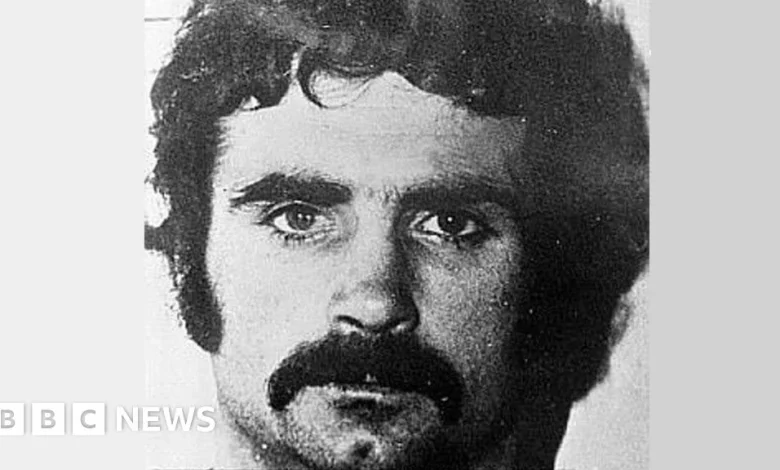
Stakeknife was west Belfast man Freddie Scappaticci, who died in 2023
MI5 had a bigger role in the handling of a spy who murdered at least 14 people while working at the heart of the IRA during the Troubles in Northern Ireland than it had previously claimed.
The findings were revealed in the final report of Operation Kenova, a £40m police investigation into the Army agent known as Stakeknife.
The 160-page report stated MI5 was “closely involved”, was regularly briefed and had sight of all Stakeknife intelligence. The security service had previously said its role was “peripheral”.
MI5 director general Sir Ken McCallum has offered sympathies “to the victims and families of those who were tortured or killed by the Provisional IRA’s internal security unit during the Troubles”.
The report, authored by former Police Scotland chief constable Sir Iain Livingstone, found: “MI5 was involved in briefing and tasking Stakeknife via the (Army) throughout his operation as an agent.”
It said the belated discovery and disclosure of documents by MI5 to the investigation last year was “a serious organisational failure”.
The MI5 director general said an independent review had found no material was deliberately withheld.
Stakeknife was west Belfast man Freddie Scappaticci, who died in 2023.
He operated as a British agent from the late 1970s until the 1990s, and has been linked to 14 murders and 15 abductions.
He operated within the IRA’s ruthless internal security unit throughout the 1980s. Known as the “nutting squad” the unit was responsible for torturing and killing people it accused of being informers.
However, he is not identified as Stakeknife in the Operation Kenova report because of the existing government and security policy of not naming agents.
The report states MI5 had “automatic sight” of Stakeknife’s intelligence and “was aware of his involvement in serious criminality”.
The details emerged in hundreds of documents MI5 discovered in April 2024.
They were found after the Public Prosecution Service (PPS) for Northern Ireland decided not to charge any ex-IRA members or security forces personnel.
The report states: “The revelation of the MI5 material was the culmination of several incidents capable of being negatively construed as attempts by MI5 to restrict the investigation, run down the clock, avoid any prosecutions relating to Stakeknife and conceal the truth.”
It adds the PPS’s view is that the material “would not have altered prosecution decisions”, but “investigative opportunities were undoubtedly lost”.
The documents reveal Stakeknife’s army handlers twice took him out of Northern Ireland for a holiday “when they knew he was wanted by the [police] for conspiracy to murder and false imprisonment”.
The agent was flown out by military aircraft and given military identification.
MI5 was aware at the time.
Had Operation Kenova investigators known about this earlier, it could have been raised with relevant army personnel during interviews.
The report goes on: “The previous unavailability of this material is deeply regrettable because it contains information that could have been put to witnesses, generated new lines of inquiry and enriched Kenova’s understanding of the factual background.
“Accordingly, the unavailability of this material to Kenova represents a lost opportunity whose impact can never be fully known.”
‘Stakeknife should be named’
In the report’s preface, Sir Iain states Stakeknife should be named “in the public interest”.
It is generally routine practice not to identify agents, a principle known as NCND, an acronym for Neither Confirm Nor Deny.
Speaking in the House of Commons, Northern Ireland Secretary Hilary Benn said due to ongoing litigation surrounding NCND, it was not possible to name Stakeknife at this time.
However, he added: “The government’s first duty is to protect national security and identifying agents risks jeopardising this.”
Police Service of Northern Ireland (PSNI) Chief Constable Jon Boutcher, who led Kenova until his appointment in 2023, said naming Stakeknife “would not put anyone at risk, affect the recruitment or retention of agents or the flow of secret intelligence or damage national security”.
“I believe the government’s claims to the contrary are untenable and bordering on farce,” Boutcher added.
Pacemaker
Scappaticci (left of picture) pictured at the 1988 funeral of IRA man Brendan Davison
KRW Law, which represents families of some of those murdered by the IRA, said it was “insulting to the families” that Stakeknife had not been named in the Kenova report.
“It’s a slap in the face by the state at a time when their ought to be the most fulsome of apologies over what was a state-sponsored murder operation lasting from 1979 to 1994,” it said.
Paul Wilson, whose father Thomas Emmanuel Wilson was killed by the IRA in 1987, said failing to name Stakeknife goes against the objective of the report.
“How can you say we are getting any truth if that key detail is missing?” he told reporters.
Stakeknife ‘well rewarded financially’
An interim report published last year said Stakeknife had probably cost more lives than he saved.
Kenova discovered 3,517 intelligence reports from Stakeknife.
“However, it found that ‘time and again’ the reports were not acted upon, with the protection of the agent apparently more important that protecting those who could and should have been saved.”
Pacemaker
Sir Iain Livingston and PSNI Chief Constable Jon Boutcher speaking to reporters after report was published
Investigators found that a special Army unit known as the “Rat Hole” was set up solely to assist the management of Stakeknife.
The agent was given a dedicated phone line he could call at any time.
The report also reveals how he came to be recruited by the Army in the late 1970s.
“The motivation for him first wanting to become an agent appears to have been linked either to a risk that he was facing criminal prosecution or a desire for financial gain,” it added.
Operation Kenova was “unable to ascertain” how much money he was paid in total.
It adds the Army “was willing to ensure he was very well rewarded financially”.
The report goes on: “Kenova understands a number of financial incentives were offered both during and beyond the period of time Stakeknife was operationally active.
“These ranged in value from roughly the equivalent of an average wage to lump sums of tens of thousands of pounds, including to assist with the purchase of property.”
MI5 director apologises
In a statement, the MI5 director said the organisation retrieved and provided a “very large volume of historical records” to the Kenova investigation.
“Regrettably, after this extensive disclosure process was complete, we discovered additional relevant information,” Sir Ken said.
“MI5 informed Kenova and shared the material without delay.
He said he apologised to Sir Iain, and that an independent review conducted by a former assistant commissioner of the Metropolitan Police Helen Ball found no material was deliberately withheld.
“MI5 is now implementing all of ex-AC Ball’s recommendations,” he added: “I repeat today my apology for the late discoveries.”
1972 killing investigated
Family
Jean Smyth-Campbell was fatally wounded in 1972
The report also covers a re-investigation of the killing of Jean Smyth-Campbell, a 24-year-old woman who was shot as she sat in a parked car on the Glen Road in west Belfast in 1972.
There were shooting incidents involving the Army and the IRA around the time.
The investigation, which involved new ballistic tests, found she was “most likely” killed by “an unknown member” of the IRA.
Ms Campbell-Smyth’s family do not accept the conclusions.
“Jean’s family believe that the evidence supports the theory that it is more likely to have been a member of the British Army who killed Jean, rather than a member of (P)IRA.”
PA Media
The Taoiseach said the report details the “very sordid story” of the top British agent in the Provisional IRA
The Taoiseach (Irish Prime Minister), Micheál Martin, said the final report of Operation Kenova details the “very sordid story” of the top British agent in the Provisional IRA.
Martin said Stakeknife was “responsible for the deaths of so many people,” as the Taoiseach supported calls for his identity to be revealed by the UK Government.
He told reporters in Dublin: “The report is very clear about unacceptable nature of state involvement and utilisation of this agent which led to so many deaths and it is also very clear about the campaign of terror that Provisional IRA waged within their own communities.”
The Taoiseach added: “The agent should be named, everybody knows who the agent is.”