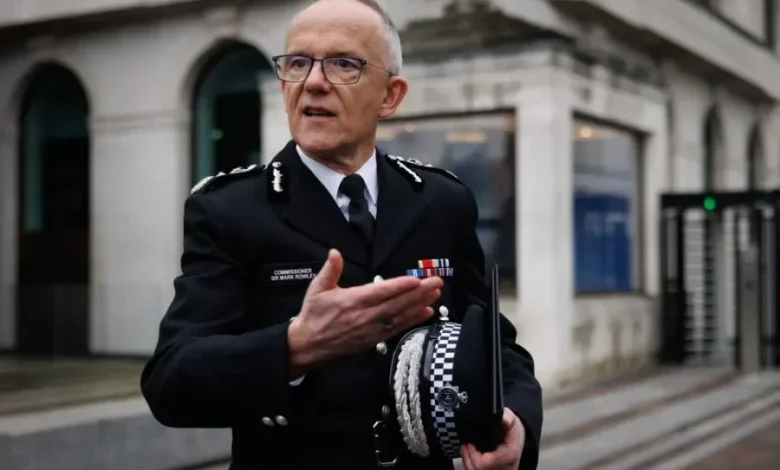
When the history books reflect on the commissionership of the Metropolitan Police Chief Sir Mark Rowley, there is a risk – with less than two years of his five-year term to go – that the headline will be ‘an opportunity wasted’.
Appointed in the midst of too many crises to recount, late 2022 was the chance for the force’s new leadership team to turn the Met into a genuinely effective crime-fighting machine. But this isn’t what happened. Despite falls in knife crime offences this year compared to last, in the last full financial year the Met recorded far higher rates (per 100,000 of the population) of knife crime compared to other areas: 17.8 per cent higher than the West Midlands, 36.8 per cent higher than Greater Manchester, 44.6 per cent higher than South Yorkshire and 46.9 per cent higher than West Yorkshire.
Analysis by Policy Exchange shows that the force only solves a tiny fraction of reported theft offences: 1 in 13 shoplifting offences, 1 in 20 robberies and burglaries, 1 in 76 bicycle thefts and 1 in 179 theft person offences such as pickpocketing. The reality is that, when it comes to the force’s core mission of fighting crime – certainly high-volume street crime – the Met’s performance is inadequate.
Rowley has also not always been helped by his political masters
Looking back over the last three years, the seeds of this inadequacy are clear for those who choose to see. Far too much time has been spent placating the various ‘stakeholder’ groups and their sectional interests which populate the fringes of policing. Many of these – usually progressivist or explicitly left-wing – groups have no actual interest in seeing the police operate as effective crime fighters. Instead, their unspoken political agenda is to neuter policing to a point of ineffectiveness. And yet huge amounts of the Met’s time is wasted on these groups – partly because, as one insider said to me recently, many of policing’s senior leaders are just ‘shockingly politically naive’.
Too much leeway has been given to those inside the force who are just not very good at their jobs. So many of the force’s problems come down to poor recruitment, training and vetting procedures – yet how many of those with oversight of those areas over the last decade have been held to account? How many – or more likely, how few – have actually been shown the door due to their failings?
When it comes to poor performance in the fight against crime, it is not entirely unheard of for local police commanders to be removed from their posts. The reality, however, is that these individuals are merely moved to a new, entirely non-frontline, sinecure. There they can continue to draw their six-figure salary; but without the trouble of working nights or weekends, no public meetings, and no dealing with local councillors or MPs. As a reward for failure, it is a very comfortable berth to be shunted into.
Rowley’s three years as commissioner have been far from a complete failure. Steps have been taken to remove officers whose conduct does not meet the necessary standards. The force increasingly looks towards how technology can be more effectively used in the fight against crime: the use of live facial recognition technology, the use of data analytics to identify high-harm predators and the use of drone technology to respond to incidents have all been ramped up under Rowley’s watch. This year the number of homicides in the capital is way down on previous years and the Met continues to solve 95 per cent of all murders in the capital. For each of these things, the Commissioner deserves recognition.
Rowley has also not always been helped by his political masters. The Mayor’s appointment last year of Kaya Comer-Schwartz as the deputy mayor for policing and crime was an incredibly a low-wattage choice. Comer-Schwartz was on record as the leader of Islington Council for being a sceptic of live facial recognition technology, in the same way that Sir Sadiq Khan is on record as wanting to reduce the use of stop and search. With friends like these who needs enemies?
The paucity of the Comer-Schwartz appointment is particularly obvious to observers given her predecessor, Sophie Linden, was – even for those who disagree with aspects of her politics – undeniably impressive. Linden is now operating behind the scenes as a special adviser in Shabana Mahmood’s Home Office.
It is the Home Secretary who should now step in across a series of areas to get the Met in the right place for the next commissioner when Rowley steps down in two years’ time. For a time-limited period, the Mayor of London should be stripped of the powers of oversight – with the Home Secretary becoming the ‘police authority’ for London, as was the case pre-2000. This would enable central government and parliament to exercise far greater scrutiny and influence over the Met’s performance.
It is also time to recognise that the Met’s national responsibilities for leading the police counter-terrorism network are a distraction from their principal role as local crime-fighters. A separate body, led by a chief constable, should be created to take over this national leadership function.
As for the Commissioner himself, he has one essential task if the Metropolitan Police is to be effective – and seen to be effective – at fighting crime on behalf of the law-abiding majority. Those at the very top must be willing to demonstrate the iron will and grit to properly hold senior and mid-level police leaders to account for crime-fighting performance – with consequences for both success and failure. So far, there has been insufficient evidence to show that such an iron will exists. Making this correction will be central to any reckoning of Sir Mark Rowley’s term – indeed, his entire legacy as Commissioner depends upon it.