László Krasznahorkai, 2025 Nobel Laureate in Literature: “Human beings remain the same, dangerous to themselves”

“Night had fallen when K. arrived. The village was shrouded in snow. Nothing could be seen of the castle hill; it was surrounded by fog and darkness, and not even the faintest light hinted at the great castle. K. stood for a long time on the wooden bridge that led from the road to the village, gazing into the apparent emptiness above. Then…”.
These were the first words that, at the age of twelve, sealed the fate of László Krasznahorkai (Hungary, 1954), winner of the 2025 Nobel Prize in Literature. They are the words of Franz Kafka at the beginning of his novel The Castle. What began for that boy as a game to be accepted into the circle of friends of his brother, six years his senior, ended up becoming the motive and passion of his life: literature; reading and writing; a way of observing and feeling the world and of perceiving and intuiting the course of life.
After Kafka came his guardian deities: Fyodor Dostoevsky and Leo Tolstoy. And, surrounding them, the retinue of Russian writers like Nikolai Gogol and Ivan Turgenev. Authors whom Krasznahorkai read in Hungarian translations because he didn’t read Russian very well, even though, since his country was under the rule of the former Union of Soviet Socialist Republics (USSR), they were forced to learn the language.
Literary masters to whom he is eternally grateful. He expressed this in September 2024, in Marrakech, Morocco, when he received the Formentor Prize for Literature. He did so through a moving, beautiful, and profound literary self-portrait of his life, a tribute to his childhood memories and the friends who helped him become a great writer. In that small list of acknowledgments were names that help us understand his literary origins and evolution:
“Ernő Szabó and Imre Simonyi, unknown poets from Gyula, whom I admired and who bor my admiration with dignity and courage,
Péter Hajnóczy, the most haunting Hungarian storyteller, who succumbed to his terrifying visions and is therefore no longer among the living,
thanks to the art of classical Greece,
to the Italian Renaissance,
to Attila József, the Hungarian poet who showed me the magical power of words”.
Nobel laureate László Krasznahorkai in Marrakech, Morocco, upon receiving the 2024 Formentor Prize for Literature. /WMagazín
“These wonderful results are thanks to the Enlightenment”
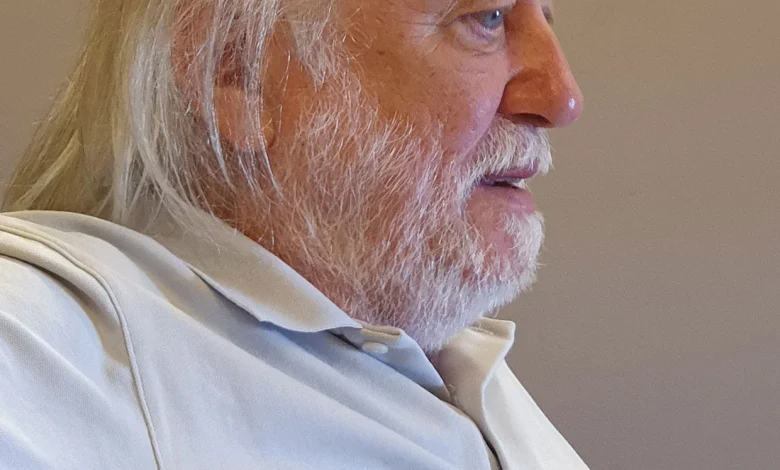
The next day, Lásló Krasznahorkai, like a Caribbean man in the Mediterranean, with a leisurely gait and calm manner, dressed in black trousers and a white polo shirt and wearing a felt hat, whose shadow on his face, with its white mustache and beard, intensified the blue of his eyes, sat down in a hotel lounge. He smiled and spoke with three of the journalists who had been invited by the Formentor Foundation to the award ceremony and the Literary Conversations. He is the author of several titles, all published by Acantilado, including Melancholy of Resistance (2001)—his debut novel for Spanish-speaking readers—North the Mountain, South the Lake, West the Road, East the River (2005), War and War (2009), Isaiah Has Arrived (2009), And Seiobo Descended to Earth (2015), Satanic Tango (2017), Merciful Relations (2023), and Baron Wenckheim Returns Home (2024).
After discussing his favorite authors and Hungarian literature, I wanted to know his opinion on two events that are disrupting the present and seem poised to alter the course of history. One he experienced during his first three decades, but now on a global scale, and the other is a revolution that connects humanity to its future: the attacks on Enlightenment values and human relationships in the digital age.
“The Enlightenment was an incredible thing, excellent in its time, in the history of humanity and in the development of human knowledge. This has been an inevitable process, but at that moment of the Enlightenment, one era ended and a new one began, one that had to happen. Today we have a completely different view of the history of knowledge, since the Enlightenment, the rational and causal thinking that has led us to marvelous results in the 21st century, which are thanks to that Enlightenment. All philosophical revolutions aim to change human beings, but human beings cannot be changed.
Technological and technical circumstances change. The strength of civilization for our era, for the 20th and 21st centuries, has been greatly reinforced, and this hasn’t even been four hundred years ago. If we think about daily life at the end of the 18th and beginning of the 19th centuries, and then take a great leap to our time in the 21st century, we will see that technological advances have extremely strengthened current civilization.
The problem is that the digital revolution changed humankind either, even though it was The goal. We have this extraordinary, incredible digital civilization on the one hand, and on the other hand, we have the users. Human beings, in the end, remain the same: dangerous to themselves. The only remaining hope is that humanity, fate will not be decided by humankind. Survival, truly, is not decided by us, but by the survival instinct that resides within us”.
In this metamorphosis and shift of civilization toward the digital realm, emotions and concepts like friendship are at stake, risking distortion or reinterpretation. To answer, László Krasznahorkai recalls his days in the Extremadura region of western Spain:
“In Extremadura, friendship is not in danger. When I was there, I drove along those excellent roads, but there was so little traffic that when two drivers saw each other, they would stop their cars and start talking. At first, I thought these two people knew each other, but no, they were from different farms. I spent some time traveling all over Extremadura and never made so many new friends; I am still in touch with many of them. So, I say that friendship depends on where we are, right? When friendship changes, it really disappears or ceases to exist; that what changes in friendship. But, it must also be said, when theres a problem, new friendships always emerge very quickly, even outside of Extremadura.
As for the digital world, when we are in front of the computer and we strike up a virtual friendship with someone, and we have been in contact for a while, and suddenly one of us says: ‘Hey, why Why don’t we meet in person?’ When the meeting finally happens, the person who appears as a woman in the virtual world turns out to be a man, or vice versa. A beautiful friendship can then blossom from that. But it’s also true that we tend to exaggerate this virtual interaction, like everything else. I think some people exaggerate the dangers of it. We all need personal contact; we need friendships. Don’t forget what I said about humans being animals, after all, and needing friends.
So, selfishness also has its limits. But human beings need to be in contact with others. Civilization doesn’t exempt you from the disappearance of that selfishness. This individualism we have isn’t good business. We’re not just animals, we’re also businesspeople; we have to survive, we don’t know why, we don’t know, but we have to survive”.
László Krasznahorkai, The 2025 Nobel Prizes for Literature. / Niklas Elmehed © Nobel Prize Outreach
The guardian gods
Soviet rule over countries like Hungary, for much of the 20th century, left its population the gift of the discovery of 19th-century Russian masters. The other two journalists asked Krasznahorkai about those first steps in literature:
“Russian literature had an enormous impact on me, especially when I was a teenager. I practically liked each author much more than they liked each other; I couldn’t compare the relationship between Dostoevsky and Turgenev. I read all their works in a rather poor translation during my adolescence because at that time I had only been studying Russian for seven years. As you may recall, we were in the territory occupied by the former Soviet Union, and studying Russian was compulsory. We spent forty years under the Russian regime. We were in a state of passive resistance, and that passive resistance encompassed everything. The two most important authors for me were Dostoevsky and Tolstoy, the two geniuses who had the greatest impact on me. To this day, I respect them like saints. Although their influence isn’t reflected in my own work.
When I was a teenager, my family, being a bourgeois family, idolized Sándor Márai. I, on the other hand, found his writing rather irritating; I was irritated by his use of grand words and hyperbole. I think His diaries, which will keep him among literary greats, are excellent. I’m not a huge fan of Márai, but I strongly agree with and identify with his moral values, because that European bourgeois attitude he clung to, which he maintained until the very end, I think will be an example for Southern Europe for a very long time; the North is already lost.
The poet Attila József was a unique genius. I feel very sorry for all the Spaniards who don’t have the opportunity to read him in a good translation or who stop reading him because they find the existing translations inadequate; they are missing out on a unique, extraordinary poet. During his lifetime, he wasn’t held in very high regard in Hungary as a poet, but after his death, practically everyone has found parts of his work that they could use. I would very much like literature to finally discover the genius that Attila József was.
What connects me to these writers is that we all use the Hungarian language, which is common to us. We live in that environment. Linguistics are infinite, because it’s the language we use to express ourselves and that helps us in our endeavors. It’s a very strong connection. But the Hungarian language is also cruel. It quickly reveals who’s who and condemns, condemns our quality. I’m not saying you should immediately go tothe bookstore and buy everything by a Hungarian writer, because I could just as easily say, do the same with all contemporary Italian or Greek writers.
Hungarian literature, as such, is only important to us because it has its own particular scale of values, just as Spanish literature does, and so it is with every literature.
A person who struggles with language is in a very advantageous position. A person who begins to write has problems with the world or with themselves. On the contrary, it’s not the problem that compels them to write, but rather the thought of prophetic literature, because they see something and say: I have to write this, it compels me to write what I have foreseen or seen”.
Art Against Apocalyptic Terror
László Krasznahorkai was awarded the 2025 Nobel Prize in Literature “for his compelling and visionary work that, amid apocalyptic terror, reaffirms the power of art”. László Krasznahorkai is a great epic writer in the Central European tradition, stretching from Kafka to Thomas Bernhard, and characterized by absurdity and grotesque excess. But he has more resources, and he also looks to the East, adopting a more contemplative and refined tone.
He is a short story writer, novelist, and essayist with a poetic eye, a seeker of the rawest, most authentic reality, a tracker of beauty in the ordinary and painful, a defender of the transmission of experience and traditions, and a reminder of the importance of a calm pace for living life.
Krasznahorkai was born in Gyula, Hungary, then part of the Soviet Union, on January 5, 1954. He lived and studied there until he was 20, then traveled to Budapest to study law and art. He first left Hungary in 1987, heading to West Berlin. After the fall of the Berlin Wall in 1989, he has lived in various countries, including France, Spain, the United States, England, the Netherlands, Italy, Greece, China, and Japan, but he frequently visits his homeland.
- With translation assistance from Robert Lienhard.
Other articles from our English edition that may interest you:
Complete series of Artificial intelligence in the world of books and literature:
- Artificial Intelligence in the World of Books and Literature (1): Authorship and the New Role of Humans in Creation. You can watch it HERE.
- Artificial Intelligence in the World of Books and Literature (2): Writing and creativity in the posthumanist era. You can read the article HERE.
- Artificial intelligence in the world of books and literature (3): Cultural revolution and paradigm shift. You can read the article HERE.
Subscribe to WMagazín’s free newsletter at this link.
We invite you to become a patron of WMagazín and support quality, independent cultural journalism. It’s easy; you can find the instructions at this link.
If you’d like to learn more about WMagazín and its special sections, CLICK HERE.
Visited 24.163 times, 959 visit(s) today