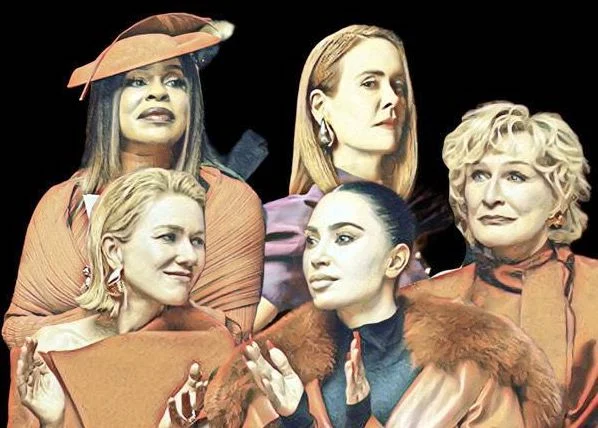
Slow down, this is not the end yet. After the emotional aftermath of Doug’s death, All’s Fair pulls us back to what truly matters: the “whodunit,” far more compelling than any moment of catharsis.
Detective Connie Morrow arrives armed with crime scene photos from Lloyd Walton’s death and asks to “talk” — meaning interrogate — Liberty and Emerald. The technical detail that dismantles the original investigation is decisive: the near-perfect shot to Lloyd’s right temple supported the suicide theory, but the extreme violence inflicted on his genitals before the gunshot makes it unmistakable. The scene was staged. This was murder.
Emerald and Liberty respond with the most logical defense: Lloyd had many potential victims beyond Emerald; the suspect pool should be wide. Still, for reasons that remain unclear, Morrow keeps her attention squarely on the lawyers.
Everyone’s alibi is examined, and Liberty’s is the weakest. She was alone, with a two-hour window in which she was unreachable and unseen. This is when Dina, my prime suspect since early in the season, jumps in once again with her favorite refrain: an interrogation without lawyers is harassment, there’s no legal footing, bring facts or bring a warrant. Morrow accepts the challenge.
To clear their heads — or flee — the trio boards a jet to New York for Fashion Week. Allura joins them, saying nothing about her night with Chase. Mid-flight, Emerald receives a massage that borders on delirium. Between drinks, the women take stock of the past month: divorce, abuse, death. A heavy accumulation.
The idea of officially making Dina the firm’s fourth partner comes up. Dina, however, suggests they consider Carr instead. Her reasoning is simple: she wants more time to live, to travel, to breathe. Liberty shuts the idea down violently. The tension escalates when Allura announces that Milan is coming back, she has forgiven him. Emerald tries to reorganize the board: she suggests Alberta for the team and makes it clear that if Carr joins, she leaves. For now, Alberta is the only name everyone can agree on.
Dina pushes Liberty to at least interview Carr. She reveals the trauma that binds them: she was the one who discovered her father’s body after his suicide. She feels responsible. Liberty reluctantly agrees.
Back in Los Angeles, Carr and Sebastian rewatch Postcards from the Edge. Carr recites lines with obsessive precision until Sebastian asks for a pause. He remarks that the two of them should probably be dating. He asks the question that matters: when was the last time she was genuinely attracted to someone? The answer is immediate: Chase Munrow. And the challenge is clear: do something about it.
Chase pressures Allura for reconciliation, but she refuses. She needs to break the cycle. With the field open, Carr makes her move. Chase resists even when she proposes a purely physical night — but eventually gives in. Guilt follows quickly: he truly wants to confront his sexual addiction. In one of the episode’s most vulnerable moments, Carr shows her scars and speaks about analysis, about being mid-process rather than healed. She doesn’t judge him. When Chase leaves, Carr knows exactly what she has done and how badly it could end. Still, she smiles.
Chase continues to hover around Allura until she realizes he has abandoned treatment. Casually, he mentions Carr. Jealousy explodes. Their conversation turns into a brutal exchange of long-avoided truths. Reconciliation is clearly off the table.
That opens the door for a relationship between Carr and Chase, built on the execution of sexual fantasies inside her office. Until the inevitable slip, he calls her Allura. The mood dies instantly. He apologizes. Carr pretends it’s fine, but the damage is done.
In the episode’s most delirious sequence, Carr hires a stylist with a disturbing goal: she wants everything Allura has. The result is unsettling. Carr appears transformed — hair, clothes, voice — identical to her rival. Milan is briefly confused when he sees her. The two women trade barbs.
“Everyone wants to be her,” Milan says. Do we? “The world only needs one Allura Grant,” Carr replies. “But it also needs a Carr Lane.”
It’s pure internal satire, Sarah Paulson openly mimicking Allura with gleeful exaggeration. Still, Allura draws a line: aligned now with Liberty, she refuses to accept Carr as a partner. Even so, they proceed with the interview.
Carr surprises them with radical honesty. She needs to resolve the existential wound of being rejected by them. She wants in. She is simply too brilliant to dismiss, and Dina asked for her. They agree to a “trial,” immediately tested in a divorce mediation.
Carr single-handedly accomplishes what the three partners could not. She is prepared. She is ruthless. She is, undeniably, the best divorce lawyer at the table. Sarah Paulson fully hijacks All’s Fair here, and that is the show’s real secret.
That evening, Carr burns dinner while cooking for Chase. They laugh. Briefly. He breaks up with her, trying — genuinely — to be a better man. Carr reacts with aggression, as always, but the defeat lingers.
Later, with Sebastian, she keeps her mask firmly in place. When he presses her again on why she wants to work with women she despises, the answer is stripped bare: it isn’t destiny, it’s revenge. She wants to destroy the firm. It’s the only thing they truly love.
The episode ends with the board fully arranged: a murder without a solution, fragile alliances, unresolved desires, and enemies preparing to work side by side. Nothing has been resolved — and that’s precisely what makes the final episode inevitable.
Related Posts
Descubra mais sobre
Assine para receber nossas notícias mais recentes por e-mail.