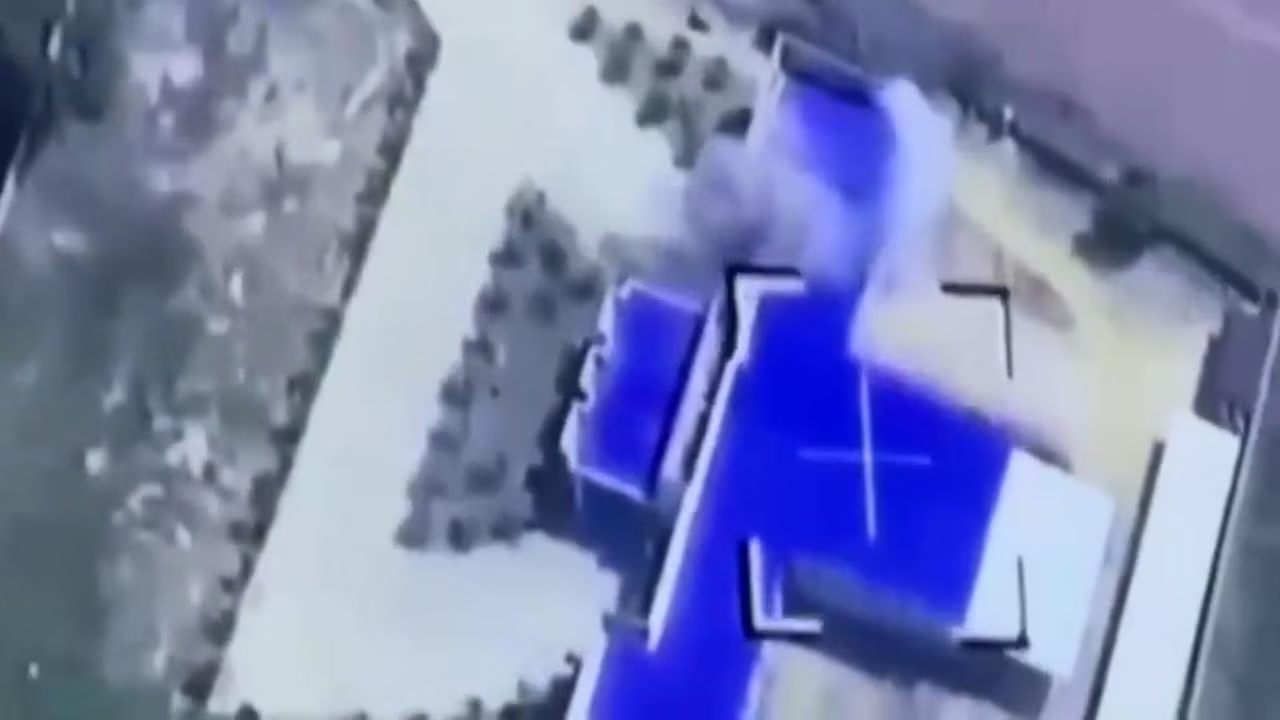
Shattered casinos. Rubble tumbling from ancient temples. Refugees streaming from the border.
Cambodia and Thailand are battling again.
Only last week, US President Donald Trump’s new National Security Strategy declared this to be one of the “eight raging conflicts” that he had personally “settled”.
But the ceasefire he had brokered barely survived a month.
Fighting flared on Sunday.
Troops on the border between Cambodia’s Preah Vihear province and Thailand’s Sisaket province exchanged sustained fire. This rapidly escalated along the whole border region.
More than 180,000 Thais have already been evacuated to safety.
Thailand accuses Cambodia of firing first.
Cambodia denies the charge.
Then, on Tuesday, Thailand launched F-16 Falcon and JAS-39 Gripen strike-fighter attacks in what it claims was a “search and destroy” mission to destroy Cambodian artillery. Among the targets hit were three casinos. This included the abandoned O’Smach Resort casino (now used as a call centre for online scam networks).
Also targeted were what Thailand called “anti-drone towers”. This appears to have included the 11th-century Ta Moan Thom temple within the disputed border region.
US Secretary of State Marco Rubio yesterday issued a short statement saying the Trump Administration is “concerned by continued fighting and casualties in multiple locations” and urged the “immediate cessation of hostilities”.
But Thai Prime Minister Anutin Charnvirakul said his patience for negotiations had run out.
“From now on, there will be no negotiations of any kind,” he asserted, saying he “will support all kinds of military operations”.
“The objective is to render Cambodia militarily ineffective for a long time – for the safety of our children and grandchildren,” added General Chaiyapruek Duangprapat.
The demise of the deal
Tensions between the two Southeast Asian nations spike in May after a clash between border troops.
Tit-for-tat retaliatory attacks steadily escalated until they became a full-blown war in July.
Five days of intense fighting killed at least 48 people and caused 300,000 to seek refuge.
The two nations met in Malaysia on October 26 to sign a peace deal brokered by Malaysian Prime Minister Anwar Ibrahim. And President Trump.
His administration had threatened to suspend trade talks with both nations if a peace deal wasn’t reached.
While China is a close neighbour of both combatants, the US is their largest export market.
And Trump was threatening debilitating tariffs.
The agreement called for the withdrawal of troops and equipment from the combat zone. And for cooperation in clearing the deadly minefields left behind.
The 47th US President was quick to claim victory.
But by November 11, the deal had fallen apart.
A landmine explosion injured four Thai soldiers patrolling the border.
Bangkok accused Cambodia of laying a new minefield.
Phnom Penh denied this.
“They’re doing great. I think they’re gonna be fine,” Trump insisted as the war of words flared yet again.
But Prime Minister Charnvirakul now says he “no longer cares’ about the threat of tariffs.
“If we can’t sell to this country, we’ll find others. How can we put our lives in the hands of one country?”
He states Trump has now backed down on the threat to link tariffs to the peace deal.
Chances of saving the deal are slim, says Council on Foreign Relations analyst Joshua Kurlantzick.
“While President Trump played a role in the initial peace deal, he is now grappling with issues ranging from inflation, divisions within his own party, and squabbles with Europe,” Kurlantzick writes.
“He also likes to broker deals with a clear win, which is not probable with Cambodia and Thailand now, given that the conflict is not going to end any time soon.”
Thailand and the New World Order
“All of this is a sign of the obvious reality that the Kuala Lumpur agreement was signed by the two nations to placate the Trump administration rather than out of a genuine commitment to rebuild trust,” argues Foreign Policy analyst Joseph Rachman.
The Royal Thai Army (RTA) insists Cambodian troops fired first, killing one soldier and injuring four others in a Ubon Ratchathani province clash.
It’s a border dispute that dates back more than a century.
Colonial France drew up a boundary separating Cambodia from neighbouring Thailand in 1904. And it only withdrew from Cambodia in 1953..
The neighbours have been struggling to sort out the mess ever since.
The Royal Thai Air Force insists it only deployed combat jets as “Cambodia had mobilised heavy weaponry, repositioned combat units and prepared fire support elements.”
But internal politics is also a likely cause.
“By continuing to bolster nationalism, the armed forces may hope that their actions boost support for pro-military parties in March, and prevent the progressive People’s Party (PP) from winning an absolute majority,” argues the CFR’s Kurlantzick.
The Thai Prime Minister’s political position is precarious.
His right-wing populist party governs based on a fragile coalition with the nation’s main left-wing party.
He had promised constitutional reform.
He had promised immediate fresh elections.
He’s delivered on neither.
“Anutin himself faces widespread allegations of corruption in his cabinet, including involving a leading global criminal ring based in Cambodia,” Kurlantzick states. “He has to look strong so as not to appear to be favouring graft related to Cambodia—and may hope the border conflict distracts from his cabinet woes.”
Cambodia and the New World Order
The Ministry of Information added Thailand’s air strikes were an escalation after days of “provocative attacks” including “residential villages … “causing many injuries to innocent civilians and destroying numerous homes.”
Cambodian Prime Minister Hun Manet states he is determined to “protect the people” and “protect Cambodia’s sovereign territory.”
He also urged “all ministries, institutions, local authorities, the armed forces of every branch, and citizens across the country to stand united in defending the nation during this difficult period.”
Former Prime Minister Hun Sen (father of Hun Manet) posted to social media that Cambodia “firmly adheres to resolving disputes through peaceful means in accordance with international law.”
But, like Thailand, internal politics are at play …
“Cambodia has little desire to withdraw either for fear of looking weak, given almost universal anger among the Cambodian population about the ceasefire failure, which most Cambodians blame on Thailand,” says Kurlantzick.
And the Phnom Penh government needs to secure its grip on power.
“Some analysts have suggested nationalism is being used by the Hun dynasty to secure its grip on power, with leadership formally passed from Hun Sen to his son Hun Manet in 2023,” argues Rachman.
“If Cambodia has planted new mines, that suggests recklessness. Though it came off worse in July, Cambodia seems keener on the peace deal and lavished praise on Trump for his interventions.”
But Trump’s influence appears less than desired.
“While (Malaysian President) Anwar will hope that his good offices can bring the two nations back to the table, both governments face significant domestic political incentives to maintain a hard line,” Rachman concludes. “Even if they agree to another ceasefire, the likelihood is that the conflict will drag on into 2026 – and beyond.”
Read related topics:Donald Trump