They say humans began with relationships interwoven through earth, nutrition, and shared cycles. Communities slowly emerged around the rhythms of agriculture, drawing meaning from the soil and from one another. Over time, these early achievements gave rise to houses, then towns, then roads that mapped their movement and longing. Kingdoms took shape, some out of protection, others out of dominion. Eventually, they reached outward to become empires—claiming land, clashing for sovereignty, and yearning to inscribe their will upon the world.
At their core, these empires were often less about governance than strength and domination: orchestrated myths of power. Their expansion was not just territorial but emblematic.
Throughout this history, woven into its brutality and its brilliance, humankind created art, music, rituals, literature, religions, laws, and institutions. These emerged not only as expressions of life but also as architectures of belief to dominate.
In every noble act, shadows lingered. And within every violence, echoes of ingenuity or unbidden beauty sometimes survived. Nothing, it seems, was wholly pure or wholly corrupt. What followed was the construction of systems of various scales and textures—designed to administer, remember, and perpetuate: cities, nations, global orders, tools of order, and languages of control.
Yet beneath it all, one persistent thread remains: the making of memory. Whether conscious or not, this collective pursuit never ceased—of defining who we were, who we are, and who we may yet become.
It is here, in the strata between what is remembered and what is buried, that I draw my thoughts in relation to the experience I had in 2023-2024. For it is not only what we build, but also how we remember that shapes the world, especially the present.
Hitherto, under the surface, rises another human construction: culture.
Culture is neither wholly good nor wholly bad; it holds both. For it is the good and the bad of mankind that shape culture. Therefore, culture is a reflection of, and a mirror for, the society that inherits it.
Cultural heritage and art
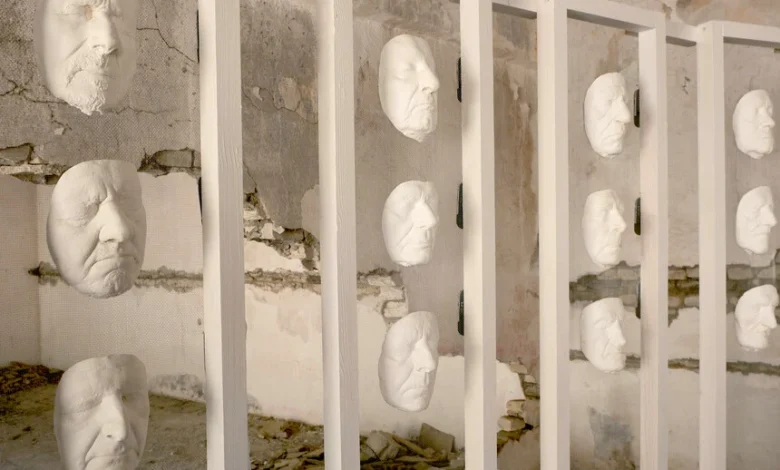
It is at this part of culture (in its universal notion) that I reflect my observation, emerging from an artwork I created in 2024—an altogether experience. This piece is a site-specific sculptural installation, titled The Present Past, which places Albania’s political past as a traumatic incarnation in our cultural heritage: the abolition of collectiveness, fearing others.
In this article, I am sharing a part of my observation about an inherited cultural element. Thoughts arising throughout, and beyond, the creation of the work conceived specifically for the former political prison of Spaç in Mirdita, Albania. Throughout the research process that led to the artwork, I encountered the writings of Jürgen Straub. According to Straub, the continuous improvement of collective memory must shed light on time and open pathways for the development of the future. At the very least, this process allows us to rediscover lost possibilities by stabilizing the power of human action.1 His work brought clarity and strength into my pursuit. Knowing how taut the Albanian political landscape is, one needs inspiration to oppose the present mindset.
In the movement of regaining what was lost, I found space to nurture the creation of the artwork — perceiving the artwork as an act of agency through visual art.
There are threads of the present in cultural heritage that can reveal the architecture of our collective striving. Cultural heritage functions as a laboratory of collective memory: eternalizing fragments of history, processing cultural nuances, and maintaining traces of the past. And yet, art—through culture—becomes a catalyst, an alchemical wave that energizes the processes of social treatment, healing, and deepening generational knowledge of what has come before.
Art as cultural action
What do I mean by art as cultural action? The artwork and the exhibition that took place in the former political prison arose from the necessity to undertake sincere steps in facing aspects of our traumatic past, existing, presently, in the collective unconscious, highlighting fear and mistrust between Albanian comrades. As a matter of fact, these two components have been an issue in fragmenting our collective progress, pushing the new generation to the edge of disinterest for the common living sphere.
If viewed otherwise, culture seems to grow alone in such a way as to have its own life detached from society but yet influenced by ego-individualistic constricted interest. What comes out of this phenomenon is an obscure political dominance layered onto societal decision-making. Eventually, the cultural landscape is fuelled with one-person command, giving birth to the cult of the individual, which takes us back to the imperialistic and dictatorial occurrence.
Regardless of the emotional association with culture, it eventually embodies this dark aspect, marking the progression of Albanian society, even after the fall of the dictatorship in 1991. In this regard, The Present Past is a cultural action because it embraces the processing of these painful marks left from the past. It creates opportunities to regain lost possibilities to center emotional and psychological reconciliation socially in the present.
The artwork is created by integrating four main areas – history, theory, psychology, and symbolism – aiming for conscious remembering of past happenings: (1) the existence of cultural heritage, (2) traces of the past, (3) intergenerational transmission, and (4) art in breaking the cult of the individual.
The existence of cultural heritage
Albanian history is deeply marked by the dictatorship regime that lasted from 1944 to 1991. Traces left from that system are spread all over our cultural sphere and constructed sites, describing what society had experienced. The real nature of the past system can be clearly uncovered through sincere analysis. One of these cultural heritage sites is the former prison of Spaç, built amidst high mountains in the region of Mirdita, in a place where the sun cannot be seen. In the beginning, Spaç was called an educational camp, namely 303. In contrast, Spaç turned out to be a political prison afterward.
Spaç Prison was officially designated as a second-category cultural monument in 2007. This classification was later expanded in 2015 to include the broader protected area encompassing not only the prison buildings but also the mine administration structures and the workers’ quarters. Despite its classification as a protected monument, Spaç has been left to the fate of time by all governments that came after 1991. Therefore, Spaç prison shows how intentionally it has been left to vanish. This place has been calling us for years to take serious action and face our past with courage. The entire social plague solidifies into this construction. Its existence made me understand the importance of being direct in uncovering the traces of the past rather than whitewashing political desires, pointing against the phenomenon of avoidance inherited in Albanian society for decades.
Traces of the past
We carry the memory of the past, a time lived within a wounded socio-political-cultural environment. The mindset formed during past political moments is inherited in the collective memory, determining the trajectory of the entire Albanian society. The persecution of individuals or groups during that time is regarded as one of the social traumas that later generates the cultural trauma of the next generation.2
Traces of the past are persistent within memories, emotions, inner states, and behaviors. Sometimes they appear in a settled mindset. Other times, they form a significant part of the living being. Eventually, I came to perceive 49 former political prisoners—currently alive—as substantial breathing traces of the past. My meeting with them was a living testimony. They made me meet with an unexplored aspect of my own being as well—my grandfather was one of the first prisoners imprisoned in Spaç. Throughout two months, I travelled around Albania to meet each of them and listen to them, and then create 49 face mask sculptures. In the entire process, a phase persisted:
“Justice has not been made,” said each of them.
On the one hand, their presence revealed how we are not educated to approach this matter, to understand why it exists, to accept the pain, and how to process it at all. On the other hand, I thought (I am still thinking) that our collective memory is shaped by this inherited social plague. As a result, it became obvious to me to understand what happens when justice shifts away from truth. Then, I could see that when society drives away from inner exploration and intentionally forgets its historical roots, mass irresponsibility will reflect on the present. This was my second ground from which the creation of the artwork could be informed as well.
Intergenerational transmission
Another aspect of the creative process involved a personal reflection on our intergenerational dialogue—a dialogue lacking honest and true connection between individualistic and collective life. In the exchange between Albanian generations, there is a tone built on fear and silence, manifested in a systematic drive to hide historical facts. This dialectical phenomenon creates a narrative that dismantles important evidence of the past.
Also, the social wound we inherit seems to have embedded within it the phenomenon of avoiding confrontation with political systems, thereby reinforcing the faculty of traumatic culture, inveigling the entire population, and prolonging it even after 1991.
Yet again, the experiences of the present show how substantial the work is that we must do in seriously decoding traces of the past—starting from our interpersonal communications.
Art in breaking the cult of the individual
The historical and empirical experience of other countries dealing with their own traumatic past teaches us that we, as well, must proceed along a similar trajectory in order to properly connect history with truth. Through art and creativity, we can stimulate processes of societal renewal or regeneration. Imagine it like a rebirth from ashes. By combining both art and culture, the creative act becomes the healthiest tool to internalize and develop inter-renewal processes—individually and collectively. In this way, society will begin to reflect responsibility, sooner or later.
Why does the artwork integrate the form of the face mask into its sculptural aspect?
For me, it was very clear—even though I had to explain it to the majority of people who engaged in the process. To point out: seeing a copy of a face solidified in plaster and with closed eyes may, for many, evoke fear. In contrast, I perceive it as a symbol of serenity. The concept of the mask — its symbol, form, and interpretation — has been used for centuries by humankind. The oldest recorded mask dates back 9,000 years. The mask is a universal spiritual and artistic expression, conveying multiple cultural aspects.
On one side, the mask has functioned as a symbolic tool: spiritual manifestation, emotional connection, representation of the supernatural or deity, hierarchical domination, etc. On the other side, in Aristotelian dramaturgy, the mask is not merely a theatrical prop — it’s a vessel of transformation, a medium through which character, action, and emotion are distilled into archetypes. Furthermore, the mask is also associated with the concept of persona: the concealment of the true self.
However, in this artwork, I perceived the mask as a symbol of psychological revelation. By indirectly realizing the mask of a person (a former political prisoner), rather than the mask of a political leader, it came to me as a process of dismantling the past belief linked to the live-casting of mask-making. A major part of our society holds a strong mindset around the live-casting of a mask. For years, it was believed that such a mask could be created only for Stalin and Enver Hoxha after their deaths. Therefore, the artwork also centers on the act of confronting both the established perception and the cult of the individual. One can clearly see how strongly the cult of the individual has been transmitted within our collective memory. This phenomenon has persisted for decades, dismantling institutions by passing power solely onto the leader, the individual.
My concluding statement
The artwork The Present Past and its entire process is a cultural act aiming to confront the phenomenon of the cult of the individual and its shadowy presence. This obscure phenomenon and political status have never—and will never—bring benefit to Albanian social development, nor to the entire Albanian socio-political-cultural landscape.
Notes from the author
-
This article is not a description of the artwork The Present Past; it is rather an extension of it. It is a reflective process after a year of its realization.
-
The artwork is donated to the public and Spaç, permanently installed in the former prison, and open to visitors.
-
Face masks are sculptures created through the live-casting method.
-
Enver Hoxha was an Albanian dictatorship that ruled for almost 50 years.
-
The outcome is a collaboration with the organization Tek Bunkeri that commissioned me to give form to the idea to create face masks of former political prisoners. The face masks were part of a larger project carried out by the organization and funded by the EU and the Ministry of Economics, Culture, and Innovation.
References
1 Straub, Jürgen. “Psychology, Narrative, and Cultural Memory: Past and Present.” In Cultural Memory Studies: An International and Interdisciplinary Handbook, edited by Astrid Erll and Ansgar Nünning, 215–28. Berlin and New York: De Gruyter, 2010.
2 Cabrera Sánchez, José. “Transgenerational Trauma and Post-memory among the Grandchildren of Victims of the Chilean Dictatorship.” Revista de Estudios Sociales, no. 84 (2023): 59–76.
3 Jung, Carl Gustav. Two Essays on Analytical Psychology. Translated by R.F.C. Hull. 2nd ed. Princeton, NJ: Princeton University Press, 1966.
4 Jung, Carl Gustav. The Archetypes and the Collective Unconscious. Translated by R.F.C. Hull. 2nd ed. Princeton, NJ: Princeton University Press, 1969.