It’s one of the ugliest chapters in Australia’s history.
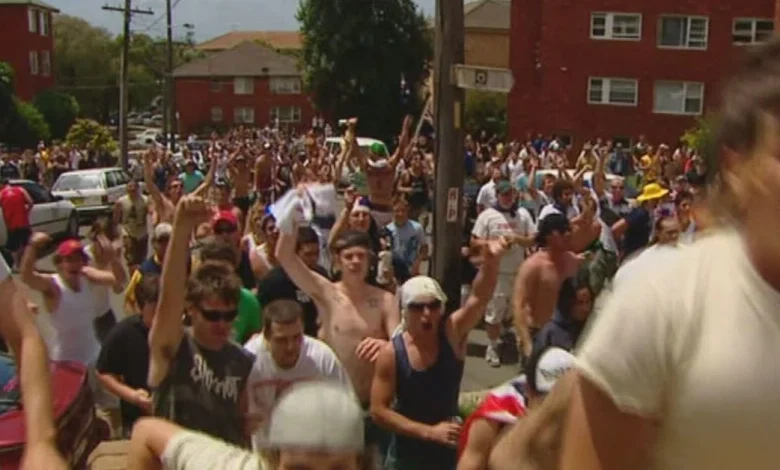
Sydney’s Cronulla Beach, December 11, 2005.
For then Assistant Commissioner Mark Goodwin, it was a day of shame.
READ MORE: DPP admits to errors in prosecuting young woman’s abuse case
It began as a day of protest but the hot weather, mixed with alcohol, was a cocktail for disaster. (Nine)
“Ever since that day, every time the word racism is mentioned in Australia, it raises its ugly head again,” Goodwin told me.
“It was probably the biggest police operation, as it turned out, not just the daytime events, but the revenge attacks that followed and the intensity of the political and media interest in it.”
Speaking on the eve of the 20th anniversary, Goodwin has revealed there was much about the riots and the subsequent revenge attacks that was never revealed.
“There were some fairly hardcore right-wing extremists in that crowd,” he says.
Tensions in the area had been simmering for months, with groups of young Middle Eastern men from Sydney’s southwest travelling to Cronulla Beach.
“We need to make a very strong point,” Goodwin stresses.
“The ones that were causing trouble down here were little gangsters that were well known by the police in their own area, who were escaping, probably, police attention on a weekend, coming to the Cronulla area because they were so well known in their own area, and they were coming out to Cronulla and (making) some very, very offensive comments to young women.”
For decades, Cronulla had been a favourite of gangs, it’s the only beach on a train line.
“However, this time, it became, instead of f off bankies or westies or sharpies or rockers or whatever it is, it was f-off Lebs.
“And instantly that became labelled and badged as racist.”
READ MORE: Professor Richard Scolyer opens up on his ‘good and bad days’
Speaking on the eve of the 20th anniversary, Goodwin has revealed there was much about the riots and the subsequent revenge attacks that was never revealed. (Nine)
When two Cronulla lifeguards were assaulted and hospitalised, locals were incensed.
“Like any riots around the world, there’s always a flash point, and that flash point was an assault on the lifeguards by some of these young Lebanese men from the western suburbs,” Goodwin says.
Cronulla Beach became global news.
Goodwin says the anger was fuelled by a media firestorm.
“It was literally blown out of proportion at that point,” he recalls.
“That’s when, you know, hundreds of thousands of texts started circulating about reclaiming the beach.”
It began as a day of protest but the hot weather, mixed with alcohol, was a cocktail for disaster.
“The thing that kicked a lot of people off was chanting in the crowd, but that was started by right wing patriots that had turned up.” Goodwin told me.
At Cronulla Train Station, the violence went to the next level.
“We very quickly found out that this rumour had gone around the crowd, that there was all this mob coming from the western suburbs,” Goodwin says.
The angry mob was baying for blood.
READ MORE: Council demands grandmother rip up beloved garden
By day’s end, the marauding crowds dispersed but it was far from the end of the story. (Nine)
It turned out there were only two young Middle Eastern men on the train.
“They were viciously, viciously set upon by a group on that train.”
By day’s end, the marauding crowds dispersed but it was far from the end of the story.
TV news bulletin footage inadvertently fuelled the fire.
“Made it look like a 5000-strong crowd had attacked the Lebanese community,” Goodwin recalls.
“I well knew the possible retaliatory attacks and what might occur.
“The revenge attacks started, and they built up to a point where we had… it went on for weeks.
“The violence that was exhibited and that the police dealt with was probably, I’d say, at least ten times, possibly up to a hundred times, worse than anything that occurred on the day at Cronulla.”
Goodwin describes it as mobile rioting.
“We had groups of up to 50 carloads of young men who were rampaging through the suburbs.
READ MORE: How a song written on a bus ticket became an Aussie Christmas classic
“We had roadblocks, and we had suburbs shut down, and we literally took off the street truckloads of weapons, you know, from cars and people, and we’re talking baseball bats, knives, guns.
“I remember seeing a picture that was shown by some of the operational police of a billiard leg table that would have had a hundred nails sticking out the end of it.”
Beachside suburbs were targeted.
“These were short, sharp, intense visits to suburbs and just trashing entire suburbs, smashing windows, stabbing people, and batting, baseball batting people, and then they’re out again.”
At the time I interviewed a victim of one of the attacks, Steve, who was set upon by up to 20 men.
“They were angry, very angry,” Steve told me.
“I can remember thinking – when I actually thought I was going to die – like I remember getting hit in the head about 20 times and just covering up, and I looked up and said, ‘stop, stop, please stop,’
“Just ultimate anger – just consumed by anger, and there was no way they were going to stop.”
Crates of Molotov cocktails were seized and police learned of plans for mass attacks at Sydney shopping centres.
“We had very strong information and intelligence that there was going to be a drive-by shooting and a hand grenade thrown into the beer garden the following weekend at Northies, which is the popular hotel at North Cronulla,” Goodwin recalls.
New emergency lockdown legislation and specialised rapid response teams of riot police and highway patrol eventually gained the upper hand.
But police were worried Christmas, New Year’s Eve, and Australia Day could become flashpoints.
“So, this operation went on virtually the whole of the summer,” Goodwin says.
“It’s remarkable that it didn’t escalate to even worse than what it was.”
Goodwin and then police minister Carl Scully have set the record straight in their book The Cronulla Riots.
“We’ve had even academics write it up, and it’s all in the school curriculum, and it’s everywhere, and it’s all the white, racist bogans of the Cronulla area,” Goodwin told me.
“There’s nothing to do with the revenge attacks.
“There’s nothing to do with the buildup to it, which is really the whole circumstances of the big picture.”
But Cronulla, Goodwin says, still wears the stigma.
“The issues that the police were dealing with were off the Richter scale, like I had never seen in my police career.”