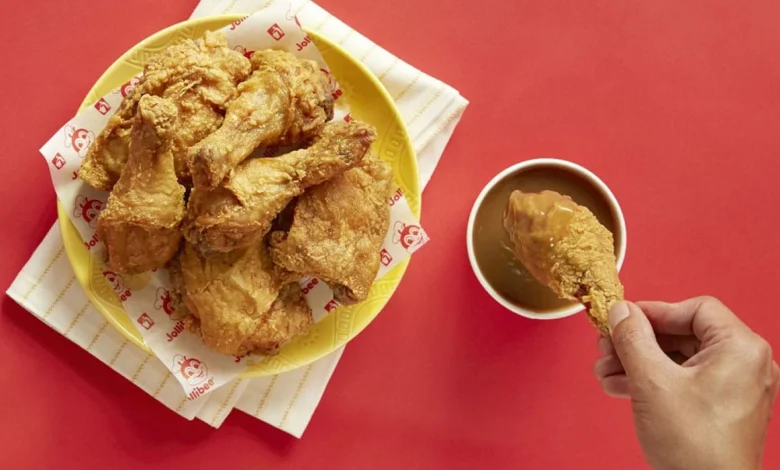
When Peter Wright walked into a Jollibee for the first time, he wasn’t thinking about taking a job there. He was doing what he’d always done whenever someone floated a new restaurant opportunity his way—he went straight to the food.
Wright had spent his career helping major brands grow, from Starbucks to Panera to McAlister’s. He knew what strong concepts looked like. And he knew the feeling he got when something had potential.
So he stopped at a Jollibee, ordered a meal, and immediately understood this wasn’t just another international brand trying to crack the American market.
“I was immediately impressed with the quality of the food and the taste,” says Wright, who now serves as Jollibee’s vice president of franchise development. “But equally so in terms of the customer experience, the warm welcome of the staff, the cleanliness of the stores and so forth.”
The visit checked all the boxes he’d developed an instinct for over the years: strong operations, strong culture, and food that lived up to its reputation.
But what really surprised him came later, after he dug into the company’s leadership team and performance.
“It certainly has the hallmarks of the best run companies that I’ve been a part of,” he says.
And once he understood how much “white space” was still available in the U.S., Wright knew the opportunity in front of him was rare.
Walk into a Jollibee in the U.S. and you might assume the brand is a fresh arrival, a rising star in the increasingly crowded chicken category. But Wright points out that the company’s American roots go much deeper.
“We’ve been operating for over 25 years in the United States and in that process, there was a tremendous amount of learnings in what it takes to be successful here,” he says. There were early mistakes—misreads of the market, development decisions that needed correcting—but the result was a seasoned U.S. operation with the kind of infrastructure most emerging brands can’t match.
Today, Jollibee runs 107 company-owned restaurants in the U.S. Because of that base, the support infrastructure already mirrors that of a longstanding domestic chain: “fully fledged, mature” real estate, design, development, operations, and quality management teams.
“While franchising is new to Jollibee, operating multiple restaurants is not new to us here in the United States,” Wright says. The brand didn’t need to build its franchise support system from scratch. It simply needed to shift it toward serving franchisees.
And for operators who might wonder whether the concept’s Filipino heritage makes it a niche offering, Wright has a simple response: “We are not a Filipino restaurant. We’re a fried chicken restaurant.” The menu’s mainstream appeal, he argues, helps widen the path for large-scale U.S. development.
Even before franchising formally began, Jollibee had footprints along the East Coast, West Coast, Midwest, and Southeast. But the brand’s priority markets are now coming into focus.
“The Northeast, kind of the tri-state New York area, the Southeast, specifically Florida, and then Texas and California are priority markets,” Wright says. Large populations, strong economies, and enormous room for growth make these regions particularly attractive. But he emphasizes that the brand isn’t limiting itself: “That’s not to say we’re not open to developing in other markets.”
What gives Jollibee confidence moving into such varied geographies is how flexible its real estate model has proven. The brand has successfully run dense urban inlines—Times Square among them—alongside freestanding drive-thru units, mall sites, and strip-center endcaps.
“We really have, I think, the right real estate model that’s adaptable to various types of market conditions,” Wright says.
That adaptability has also helped Jollibee tap into what he believes is a growing truth about American diners: they’re more willing than ever to try new flavors, brands, and experiences.
“American consumers are more adventurous than they’ve ever been,” Wright says.
After decades of operating solely as a company-run system in the U.S., its first American franchise location opened recently in Queens, New York.
Wright says the signals coming from that store couldn’t be clearer.
“The franchisee has been really pleased with the performance of that first store,” he notes. The strongest indicator? “He’s already secured his next three locations, and I mean that tells you everything you need to know.”
More franchisees are already lined up. Another partner in California has begun construction on a site there, and Wright expects franchise openings to ramp up significantly “beginning next year and going into 2027.
What Jollibee is not doing is signing single-unit operators. Wright says the brand is “really targeting development agreements at 10 or more locations,” seeking well-capitalized partners who want to build a sizable footprint.
Wright says the criteria begins with alignment with the brand’s internal values.
“Customer focus, speed with excellence, a sense of family and fun, operating with integrity and the humility to listen and learn,” he says.
Jollibee isn’t entering the U.S. at a moment of uncertainty for chicken chains. Quite the opposite.
“The chicken category and the QSR segment of the restaurant business is one of the fastest growing,” Wright says. Jollibee’s strong average unit volumes, combined with the availability of major markets still untouched by the brand, create what he calls a “unique combination.”
It’s the kind of scenario franchise developers dream of—a proven operator, a beloved product, and an open playing field.
Wright’s decision to join Jollibee came down to something simple. He saw a brand that reminded him of the strongest organizations he’d worked for—disciplined, guest-centric, ambitious—and one that had the infrastructure and momentum to grow fast without losing its identity.
“I really get very excited about” what’s ahead, he says.