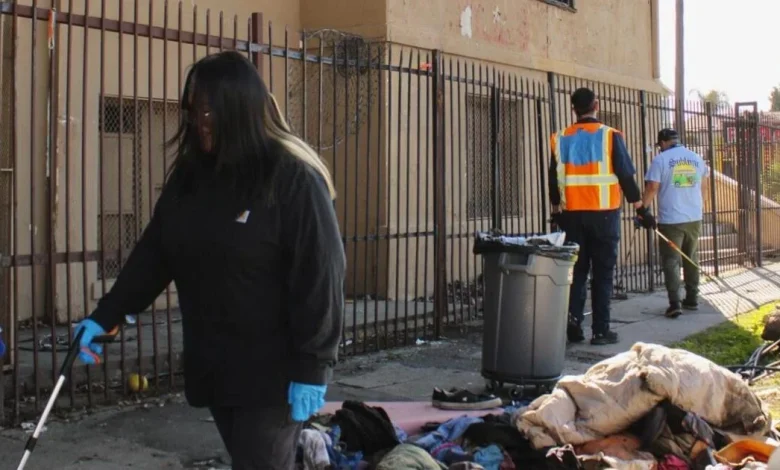
South Central Cleanup cleaning an abandoned church. Photo by Brenda Verano
Carlos Cabrera was born and raised in South Central L.A. He is known in the community and on social media as South Central Cleanup. For the past months, he has organized cleanups throughout the neighborhood, picking up everything from a single item left on a curb to massive, multi-story piles of trash.
“If you’re from South Central, you are often told to work your hardest to get out of the hood, to get out of the slums. I never understood that. We are told to leave our home instead of trying to make it better,” he told CALÓ News when asked what inspired him to begin picking up waste. “The energy of an area after a cleanup changes completely.”
He began his cleaning efforts in June of this year, after he got a puppy and began walking him.
Carlos Cabrera, known in the community and on social media as South Central Cleanup. Photo by Brenda Verano
“It was a combination of two things: work got super slow because of the ICE raids and I got a dog. He was only a couple of months old then and he would walk into the trash, sniff the dirty water left behind, get super dirty and sometimes we couldn’t even walk the sidewalk because of the dumping that took over the street,” he said. “So in the mornings, before getting my day started, I would take a bag and start picking up around the neighborhood.”
He began posting his cleanup videos on social media through his South Central Cleanup page earlier in June, not thinking much about it.
Cabrera, who had always enjoyed watching landscaping videos on YouTube, thought others might enjoy the time-lapse videos of his cleanups. Today, he has more than 25,000 followers on social media and regularly hosts cleanup opportunities throughout South Central L.A., where, sometimes alone or with volunteers, he fills anywhere from five to 15 bags of trash and debris.
Cabrera, whose family is from Puebla, Mexico, grew up in a single-parent household with three additional siblings and said his upbringing influenced his cleaning efforts. “Our family is from a small rancho. I’m kind of used to seeing everyone clean, not just after themselves, but also for their community. It was the same at home. My mom instilled that in our siblings and me,” he said.
Cabrera, almost six months into his cleaning efforts, has built his own independent system to pick up and dispose of trash. From trash bags, gloves and hand sanitizer to trash grabbers, shovels, rakes and brooms, all the materials he provides for volunteers have been purchased with his own funds with additional donations coming from community members.
Personal items such as clothes or shoes are often found in illegal dumping sites. Photo by Brenda Verano
One of his most used pieces of equipment in almost every cleaning is his sharp disposal containers, which he uses to collect and dispose of needles and syringes safely.
Sabrina Carthan volunteers with South Central Cleanup a couple of times a month. Carter, who also lives in South Central, said he found Carlos through social media when she recognized the local areas he was cleaning.
“That inspired me to want to come and help and do whatever I can to help out somebody that’s doing something really amazing right here in the neighborhood,” she said.
Carthan said one of the most surprising things she has encountered through volunteering is other people’s perspectives on trying to keep her neighborhood clean. “Some people think we are [cleaning] because we have to do community service hours or because we owe parking tickets,” she said. “We’re just everyday people who want to come and help the city look better. South Central is so beautiful; our history, our legacy, and the people that are here now are ever-changing.”
Carthan said she, like many other residents, has lost faith in the city’s leadership to resolve and contain the illegal dumping issue. “I don’t want to ever rely on the city or the government,” she said. “This is our community. This is where we live; this is where the kids walk by.”
A rapidly growing issue
The community in South Central L.A. is fighting a constant, rapidly growing issue: illegal dumping.
Characterized by some of the most socially, culturally and historically important locations in the country, including Central Avenue, site of the West Coast jazz scene in the 30s and 40s, the former Black Panther Party headquarters in L.A. as well as one of the epicenters of the Watts rebellion in 1965, South Central has also been contaminated by the heavy dumping of trash.
South Central, LA.Photo by Brenda Verano
It is not uncommon to see piles of garbage, including household trash, construction debris, bulky items like furniture and hazardous materials, blocking streets, alleys, empty lots and sometimes taking over entire areas.
In 2024, illegal dumping in the city hit its highest level in three years. South Central L.A. was among the communities that were dumped on more than other areas, with four of the 10 communities with the highest dumping counts that year being in that part of the city, including Florence, which registered 2,187 reports that year.
In 2025, the numbers increased and South Central L.A. dumping did too.
According to a Crosstown study, in the first two months of 2025, Council District 8, which covers a large swath of South L.A., recorded 3,329 dumping reports, a 57% increase from the 2,118 dumping reports in the first two months of 2024. In Council District 9, which also comprises a big portion of South Central, there were 2,164 reports of illegal dumping, a 32% increase from the previous year.
An overwhelming problem for the city
In L.A., different agencies like the Los Angeles Sanitation and Environment Department (LASAN),MyLA311 and the Bureau of Street Services oversee and manage illegal dumping and trash, three of the city’s most budget-impacted entities in the 2025-2026 budget.
In the summer, the L.A. City Council approved a revised budget for the upcoming fiscal year, setting aside nearly $14 billion in expenditures.
A memorial was buried under trash. Photo by Brenda Verano
Initially, LASAN faced proposed budget cuts, but the adopted budget eventually restored some funding, specifically for clean-water and plant positions. The initial proposed cuts were part of a citywide effort to close a significant budget gap, which, according to CD-9, has still impacted the council’s efforts to combat things like illegal dumping.
“With those budget cuts forthcoming, we knew it was going to really impact CD-9,” James Westbrooks, CD-9’s deputy chief of staff, told CALÓ News.
Westbrook said that with the rapid and overwhelming growth of illegal dumping, even the city has felt challenged in cleaning, reporting and enforcement. “Right now, we have seen [dumping] exasperated over the last couple of months. We’re hoping to stay on top of it and make sure it doesn’t get any worse,” he said.
Budget allocation
When it comes to the budget, the clear differences between departments and agencies are alarming. “Don’t tell me what you value; show me your budget and I’ll tell you what you value,” Kenneth Mejia, L.A.’s City Controller, wrote in an October social media post.
According to the controller’s 2026 budget breakdown, the Los Angeles Police Department had the highest expenditure, with a $3.3 billion budget, in comparison to the still-high but less than double $1 billion budget for sanitation, something that CD-9 says has a clear effect on how much the district can do, especially as, according to Westbrook, not many people in the district report illegal dumping through the MyLA311 hotline or app.
Nathan (left) and James Westbrooks (middle) at one of the district’s hotspots. Photo by Brenda Verano
With MyLA311, a service request system, residents can report common municipal issues such as bulky item pick-up and help keep a record of how much of services are being used and needed. Westbrook said that adequately reporting illegal dumping is important for allocating funding, tracking expenses and assessing the need among the community.
“CD-9 is probably amongst the lowest reporting, but we’re actually, ironically enough, when it comes to [trash and waste] tonnage collected, we’re amongst the highest,” Westbrook said. “We’re really trying to get people to call more. The more people call and use the app, the more the city measures their responses.”
According to Westbrook, four to five CD-9 rapid response teams are out on any given day, many of them monitoring and revisiting what they call “hot spots.”
Nathan, lead for the CD-9 rapid response team, said the job is demanding. He and his teams receive an average of 10 to 15 cleanup requests a day. “There are times when the calls just keep coming,” he told CALO News. “If we have already pending requests, we go based on that; if not, my team and I go around and find illegal dumplings ourselves.”
He said hot spots are areas where dumping happens various times a week, if not daily. “We will clean it up and by the next day, it will be the same or worse,” he said.
Nathan said the hot spots are often in alleyways, secluded areas, freeway entrances, vacant lots and adjacent to homeless encampments. “We see anything from furniture to heavy bags of food, tires, wiring, recycling [items], anything,” he said.
An empty lot has become a hot spot for dumping. Photo by Brenda Verano
In November, a total of 245 tons of trash and debris were collected in CD-9 alone, as stated by Angelina Valencia, a spokesperson for the district. The 245 tons came from agencies working inside the district, including the Coalition for Responsible Community Development (CRCD), the L.A. Conservation Corps (LACC), LASAN, and the district rapid response team.
Westbrook said one of the latest things the district is looking to do is to be more proactive as far as catching people in the act of dumping. He said in previous years the district had installed cameras on the dumping hot spots to identify and fine the people behind the dumping. “Those [preventative] efforts were really impacted when we had these budget cuts, but we are talking with sanitation, talking with the mayor’s office to see what we can do to prevent people from doing it,” he said. “They can’t be using our backyards in our community as dumping grounds.”
Both Westbrook and Carlos with South Central Cleanup said the number of hot spots in the district has increased in the last month.
“I think it’s a combination of different things. One [being that] people know we’re going to clean it up, so they think, ‘oh, we’ll, we’ll dump it here because we know the city’s going to come back out here,’” he said.
A pattern that South Central Cleanup has also noticed.
“There are areas where I sometimes contemplate cleaning more than once a week because as soon as it’s clean, people will dump it again and again,” Cebrera said.
Both the city and Cabrera said that, more than keeping streets clean, the real challenge is educating people about the effects of dumping and influencing and spreading awareness of the real impacts of poor sanitation.
“I think our community has been taught that snitches get stitches and that one must mind their business or simply look the other way,” Cabrera said. “So there might be a neighbor that is doing the dumping and another that is deciding not to say anything. That’s a big part too.”
A broader issue
For other residents like Miguel Medrano, dumping is closely linked with environmental and social injustices prevalent in low-income working-class communities like South Central L.A., such as higher rates of asthma, exposure to hazardous materials and air pollutants and contaminated water, as well as a high concentration of liquor stores.
Miguel Medrano (left) and Sabrina Carthan (right) volunteering with South Central Cleanup. Photo by Brenda Verano
“I notice most [of the trash in dumping sites] comes from liquor stores. You mostly see cigarettes, beer bottles and cans and you see a liquor store on every corner,” Medrano said.
Cabrera has also seen a close pattern with illegal dumping and eviction and housing insecurity. “In many of these dumpings, you will see what looks like whole closets being thrown out: kids’ clothes, clothes with hangers and even shoes. [As if] someone just grabbed a closet and dumped it all,” he said. “With the ICE raids, people being suddenly taken [and] high rents, sometimes I wonder if that’s connected.”
Maria Sanchez, born and raised in South Central and part of one of the two neighborhood councils in CD-9, said civic engagement and holding city leaders accountable are also key elements to combat illegal dumping.
“I think it’s very important for everyone in South Central to hold the city accountable, go to [city] meetings, use the resources that [the city] has and join [their] neighborhood council,” she said. “We’re taking initiative upon ourselves to [clean] because this is our community. We want to walk our dogs, walk the streets and have people go through [the sidewalk] without bumping into trash or broken glass,” she said.
Westbrook said the city alone would not be able to keep illegal dumping under control. “The council office can’t do it alone and obviously, the community members can’t do it alone.”
South Central Cleanup volunteers on one given day. Photo by Brenda Verano
South Central Cleanup continues to host cleaning sessions throughout South Central and recently opened an Amazon wishlist for anyone wanting to support its and other volunteers’ work. Cabrera said that despite the huge responsibility, he has found friendships, a safe space and a sense of community in cleaning streets. “For the time I’m cleaning, I clear my mind and it can get very therapeutic,” he said. “It’s rewarding seeing other people caring for South Central, too.”
Cabrera said he has also been reached out to by residents in other communities and cities, asking for his support. “People in places like Lynwood and Montebello have reached out to me and unfortunately, I can’t get to everything. I also know there are so many other people doing similar work for their community and I hope it inspires others, too.”
L.A. residents can report and schedule a bulky item or excess trash pickup through 311 or using the MyLA311 app.