More investigations are being held into the long-term effectiveness of contamination remediation efforts at a derelict former petrol station on a prime Albany Highway site.
The site at 1156 Albany highway in Bentley adjacent to Bentley Plaza has been unoccupied since April 2021 when BP vacated it.
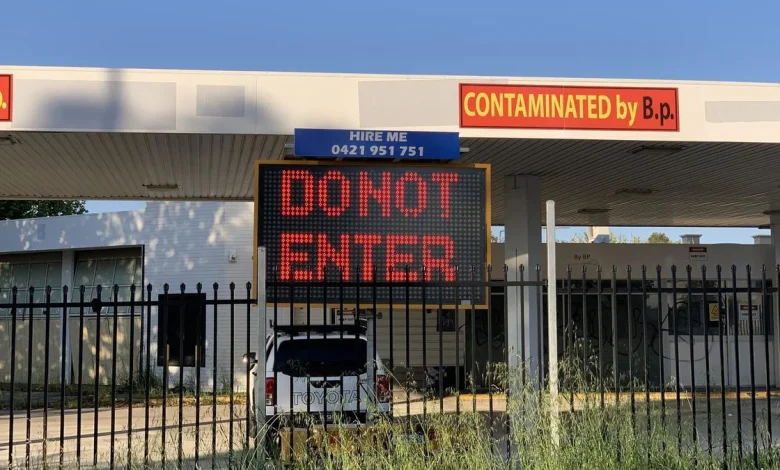
It currently has a variable message sign that reads “Do not enter, toxic, polluted by BP”, which was erected by the owner and according to residents has been there for years.
There are also large red banners that read “contaminated by B.p.”.
Mahomed Ahmed Badat, who has owned the site since August 2006, asked the Contamination Sites Committee in 2021 to decide who was responsible for remediating the site.
Camera IconA huge flashing sign warning people to not enter the site. Credit: David Friedlos
The CSC found BP was 100 per cent responsible for the contamination and had to remediate the site.
The CSC provides written notice of its decisions to all relevant parties but is not involved in the remediation of a site after a decision has been made.
Decisions by the CSC are based on the information that is provided to it. It does not have the power to carry out its own investigations.
According to the CSC report, the site was redeveloped and operated by BP Australia Pty Ltd between November 18, 1987, and April 29, 2021.
It contained a workshop, shop, office, storage and toilets, five petroleum fuel underground storage tanks and one LPG UST with fuel dispensers, parts wash area and one waste oil UST.
On April 30, 2021, BP no longer occupied the site.
Camera IconThe signs on the building read ‘contaminated by BP’. Credit: David Friedlos
BP said in the CSC report they “acknowledge that its operations of the site as a retail service station between 1987 and 2021 has resulted in the contamination of social and groundwater beneath the site with petroleum hydrocarbons”.
In their statement they said soil remediation works comprising excavation and off-site disposal of impacted soil was completed in 2000, with residual impacted soil remaining.
Soil classification and removal of fuel USTs and dispensers was carried out from February to March 2020, and off-site disposal of impacted soil and application of a bioremediation compound of the groundwater smear zone was undertaken between October 2020 and February 2021.
A Department of Water and Environmental Regulation spokesperson said the site was classified as “contaminated – remediation required” due to the presence of hydrocarbons in the soil and groundwater.
Hydrocarbons form the basis of fuels and many other materials.
“Remedial works were undertaken by the site occupier during 2020 and 2021, followed by groundwater and soil monitoring to validate the impact of the works.” the spokesperson said.
It just has to be fixed. Someone has to step in and resolve the issue.
“Both the remediation and subsequent monitoring were reviewed in a mandatory auditor’s report in 2023.
“Further investigations and assessments will be required to validate the long-term effectiveness of the remediation.”
The DWER spokesperson said when the results of further investigations, groundwater monitoring, risk assessment and a mandatory auditors report were provided to the department by the site occupier, the classification of the site would be updated.
City of Canning mayor Patrick Hall said management and remediation of privately-owned land that was contaminated was the responsibility of the Department of Water and Environmental Regulation, under the Contaminated Sites Act 2003, not local government.
“DWER’s responsibility includes the assessment, classification and ongoing oversight of the risks presented by contaminated land,” he said.
Mr Hall said the site was an “eyesore”.
“We really encourage all parties, including the owner and the agency involved, to get together for the benefit of the community and resolve the matter at hand,” he said.
“It just has to be fixed. Someone has to step in and resolve the issue.”
Mr Hall said the site had “enormous potential” on Albany Highway.
“There’s so much good that can come from making the property good,” he said.
The situation has gained social media attention, with people calling for answers.
In a comment on a video shared to YouTube, a user with the name MahomedB-c1r claimed BP had polluted the soils and groundwater and the site had toxic vapours and contaminated groundwater.
“The DWER Contaminated Sites Committee determined that BP are 100 per cent responsible for all contamination on the site and 10 per cent responsible for remediation works on the site since 2011,” they said.
“BP refuses and failed to remediate the site and has attempted to fob off the contaminated site without remediation and attempted to handover the site to the owners with written claims that the owner shall be responsible for the site in all respects, including remediation.
“The site remains dangerous to humans due to toxic vapours and contamination above background safety levels and a serious danger to humans.”
BP said they would not comment as the matter is currently before the courts.
The matter is listed for a directions hearing in the Supreme Court on December 15.