Some of my earliest memories are of watching my father surrounded by the boys who attended the Christian camps he ran. And as they laughed together in the sunshine, I can remember feeling confused. He seemed fun, charming even, so why was I so scared of him?
Growing up, my father John was a successful Queen’s Counsel, we lived in a country house in Hampshire, and my mother, Anne looked after me and my two older siblings. Dad was the centre of our world and passionate about his work, leading evangelical camps for teenage boys run by the Iwerne Trust, which students from nearby Winchester College attended as well as regularly visiting our home.
From the outside, we were the perfect family. My father was charismatic, a compelling speaker and influential in the local community. But in private, the atmosphere in our home was volatile and I can never remember a time when I wasn’t afraid of him, his rage in particular.
When I was five, we suddenly moved to Zimbabwe. My father said he had been called to do missionary work there and soon started running camps. But while my brother PJ, whom Dad was close to, was allowed to join in with the BBQs and pool parties, my sister and I watched from bedroom windows, keeping a low profile, dismissed as “distractions”.
Dad was always totally uninterested in me. The unspoken message was that women weren’t as intelligent or capable as men and existed purely to support them in their more important work. He frequently told my mother she was stupid and accused anyone who questioned him of being disloyal. As a young child, I felt confused. I didn’t even like my father, let alone love him, but thought I must be to blame.
Then, in 1992, a 16-year-old boy was found dead in a swimming pool at one of my father’s camps. His name was Guide Nyachuru, and we were told it was a terrible accident. What we did not know, however, was that Dad was subsequently charged with manslaughter. The case eventually collapsed.
To escape Dad’s control, I moved to the UK as soon as I turned 18. But attending church in London, I started to notice how a shadow would sometimes pass across faces when I mentioned I was John Smyth’s daughter. The Christian community is relatively small, and I realised there was something about my father that unnerved them.
Away from the toxic atmosphere of home, the fog of my childhood began to lift, and I started to have more questions. Why hadn’t any of our family visited us in Zimbabwe? Why didn’t my parents have any real friends? Why did they only very rarely visit England? My father had always made our move to Zimbabwe seem like a noble act in the name of missionary service. It didn’t make sense for a man who so loved to be admired to give up a glittering legal career.
I decided to ask my father about it when I went back one Christmas. I was scared to challenge him, but I think part of me was almost hoping a reasonable explanation would prove my doubts wrong. Dad flew into a rage, calling me disobedient and disloyal, and I left feeling even more suspicious.
open image in gallery
Fiona Rugg’s mother, Anne Smyth, was ‘completely controlled’ by her late husband (Channel 4)
Getting back to the UK, I decided to hunt down a copy of a book that I’d heard about. It was written by John Thorn, a former headmaster of Winchester College, where Dad had worked as an external evangelical leader. While I wondered if my father had been mentioned in it, I was convinced I would find nothing even as I opened the pages. Then I read a passage that filled me with horror.
Thorn had written about a barrister who had gained “personal control” over senior boys at the school and inflicted physical punishment on them. The man had been “quietly” banished to Africa. Thorn had not formally reported him. Dad was overbearing and approved of corporal punishment. He’d clearly left England under a cloud. But could a man who had done worse than that have been allowed to leave?
Aged 25, I got married, but I remember feeling sick and sad as Dad walked me up the aisle. I knew I should feel safe and happy, but instead I felt as if we were players in a farce about a happy father and daughter. I became a wife, a mother of two beautiful children, and threw myself into creating a new life. But 15 years later, in 2017, a Channel 4 News investigation blew everything apart as it detailed what had actually happened before we left the UK all those years before.
open image in gallery
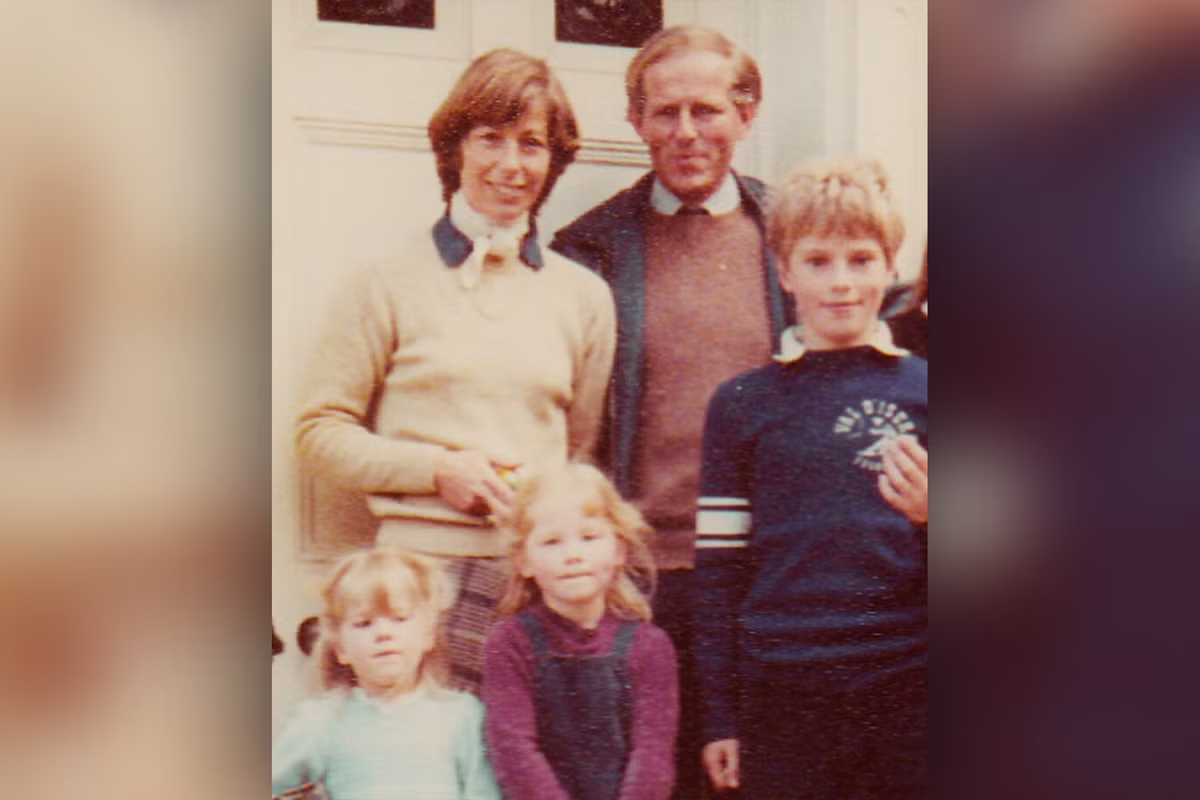
Fiona (bottom left) with her family in the 1980s. Rugg’s brother PJ Smyth (right) suffered abuse at the hands of his father John (Supplied)
It revealed how, in 1982, a vicar had written a report detailing 22 boys’ accounts of abuse at the hands of my father. One had attempted suicide. During Sundays spent at our home, my father had taken them to our garden shed and lashed them, in some instances hundreds of times, until they bled. He had groomed them to believe that he, as their spiritual “father”, had the right to “discipline” them. He had coercively controlled and abused them for years.
For the first time, I understood the truth. My father was a serial abuser. And as these men spoke about the devastating after-effects of their experiences, as well as being deceived and deluded, I thought back to the times during my childhood when my father had accused me of being deceitful and deluded about him.
My siblings and I were united in a desire to talk it over with Dad. By then, he was living in South Africa with Mum and we’d kept in touch over the years about family life. But although we emailed and phoned, pleading for a conversation, Dad refused to discuss anything. My brother, who had by then become a minister himself, offered to support Dad to face the truth and start making amends. Instead, Dad quoted endless scriptures via email about honouring your father and mother.
After a few months, we chose to cut contact with our parents. How could we be complicit in our father’s distortions now that we knew the truth?
open image in gallery
Guide Nyachuru’s sister Edith speaks in Channel 4’s two-part documentary about John Smyth’s role in her brother’s death (Channel 4)
But confronting reality isn’t a linear process because emotional loyalty – even to an abusive parent – runs deep. The rational side of my brain knew my father had done this, but some deep, illogical part of me wondered if it could really be true. In some awful way, accepting the full truth of who my father was finally made sense of my lifelong dislike of him.
When Dad died the following year of a sudden heart attack, I mostly felt not only relief, but also intense compassion for the men who had been abused and would now never get formal justice via the legal system. We were immediately back in touch with Mum and together arranged the funeral.
In 2024, the Makin Report concluded that my father had physically, psychologically and sexually abused 30 boys and young men in the UK – and around 85 in Africa. It also said the total “likely runs much higher” and found significant institutional failings in the Church of England.
The centre of this story is, of course, the survivors of my father’s abuse, but I have also come to understand that we, his family, were also victims. My brother, for instance, recovered memories of being physically assaulted by Dad from the age of seven. My mother, who met Dad when she was just 16, was completely controlled. But while she has wrestled with shame and regret about the past, I see her as his first victim.
open image in gallery
Rugg found evidence of a book written by the headmaster of Winchester College, which recounted details of a barrister who abused boys and was ‘quietly banished’ (Channel 4)
I also felt ashamed for a long time, and it was confusing unravelling the vacuum that was my relationship I had with Dad. There’s no neat ending but, strange as it may sound, I am grateful Dad’s crimes were exposed because it forced me to confront them and make sense of the past. I am a firm believer that bringing these stories out of the dark into the light is the way forward.
Therapy and support mean that I am in a different place now. And this is one of the reasons I have taken part in See No Evil, a two-part Channel 4 documentary about my father’s case that will air this week. In it, PJ and I talk to our mother meaningfully for the first time about the past. My brother and I are also in the process of setting up Survivor-2-Survivor – a charity dedicated to raising awareness and funding for organisations that support adult survivors of childhood trauma.
Abuse is so often hidden in the most secretive corners, but I know from experience that the past doesn’t have to be a prison. Nothing can take it away, but letting the light in by safely talking about your experiences, having people reflect back and reframe your childhood, doing the hard work of forgiveness, all of it can help you heal. I just want people to know that you can move on with hope.
As told to Megan Lloyd-Davies
‘See No Evil’ is on Channel 4 and available to stream on Wednesday 10 and Thursday 11 December at 9pm. Find out more about Survivor-2-Survivor at survivor-2-survivor.org