The three vulnerabilities the Minnesota Timberwolves have borne throughout their speciously successful first 23 games of the season mobbed up to undo them Monday night at Target Center in a 108-105 loss to the Phoenix Suns.
The Wolves came into the game with a bizarre, rescue-themselves, 5-game winning streak in which they never led at halftime (average deficit, seven points) yet always stormed back to triumph in the final two quarters (and, in one case, overtime), outscoring their foes by a collective 71 points.
This didn’t seem like an ideal gambit against the Suns, who arrived in Minnesota with a record of 10-1 when they led after the first period and 2-8 when they didn’t. During the pregame press conference with Wolves coach Chris Finch, The Athletic beat writer Jon Krawczynski understandably wanted to know the key areas of emphasis that might preclude Finch’s team from yet another slow start.
“Defensive intensity, for sure,” Finch replied, then added, “our ability to execute the game plan right out of the gate.” When Krawczynski followed up by asking if the game plan issue was about the need to focus, Finch conceded that “oftentimes it is a focus thing,” calling it “not execution, it is just a kind of readiness.”
Related: One of the many things Minnesota women’s sports get right: field trips for the next generation of fans
Ah, but the Wolves were once again neither ready nor focused from the opening tip on Monday. The Suns parlayed three offensive rebounds and a steal to jump ahead 6-0 within the first two minutes and held the lead the entire first quarter and four minutes past halftime, when the Wolves finally tied it up at 69. Eleven seconds later, center Rudy Gobert was ejected for a flagrant foul level 2 for a forearm shiver to the back of his counterpart center Mark Williams while Williams was in the air.
Nevertheless, the Wolves continued to battle valiantly in a physical game and with less than two minutes to play in the third quarter it was again tied at 82. The team’s unorthodox (and non-point guard) playmakers each did their job by drawing defenders at moving the ball — Julius Randle to Anthony Edwards and then Ant out to Mike Conley at the top of the arc.
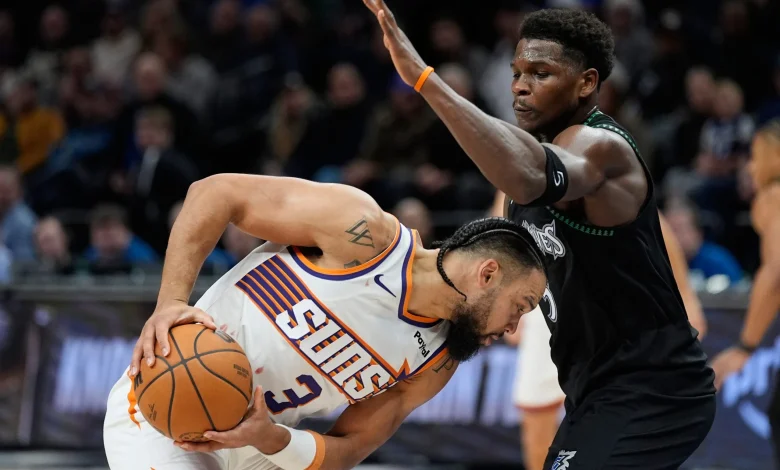
Phoenix played it perfectly, closing out on Conley to prevent the catch-and-shoot three-pointer but then veering to Conley’s right to close out the passing lane along the perimeter. It created a wide-open, essentially red-carpeted path straight to the basket. Conley’s newfound nightmare.
Minnesota Timberwolves’ Mike Conley (10) possesses the ball against the Boston Celtics during the first half of an NBA basketball game, Saturday, Nov. 29, 2025, in Minneapolis. Conley’s once-reliable floater has found the bottom of the net much less frequently this season. Credit: Lily Dozier/AP
The floaters began to clank
When Conley came to the Wolves from Utah in a trade-deadline heist (that also brought them Nickeil Alexander-Walker and a couple of second-round picks for D’Angelo Russell) in February 2023, the veteran lefty’s right-handed floater was appropriately familiar and feared by opponents as an accurate complement to his long-range prowess. In 24 games with the Wolves to close out that 2022-23 season, he made a career-high 51.5% of his twos to back up a then-career-high 42% of his threes. In his first full season in Minnesota, he bumped up the treys to 44.2% and shot a very respectable 48.1% from inside the three-point arc.
But last season, the two-pointers — and most notably, the floaters — began to clank. Conley could still bomb away from long-range — 41% on his treys — but accuracy on the shorter shots plummeted to 38%, the first time he had dipped below 40% in his then-18-year career. And thus far this season, the visuals have been sadly poignant, as Conley has defaulted to just 31 two-point shots in 24 games, making a mere 11, for a shooting percentage of 35.5%.
With the entire lane open and the shot clock ticking down, Conley was compelled to attempt that once-deadly, now-disparaged right-handed floater from 11 feet out. It nudged over the front of the rim, bounced off the back iron and fell harmlessly to the right.
With the score tied at 84 to begin the fourth quarter, the Suns went on a 14-3 run in the first 3:17 of the period and never relinquished the lead.
During the five-game winning streak, Conley, who has been regularly coming off the bench for the first time in his career, was a valuable cog in those second-half comebacks. Yes, the two-pointers are no longer reliable and his relative lack of quickness and sinew on defense has made his always-small stature easier for opponents to target at that end of the court. But the poise, ball control, decision-making and calming court presence continue to age like whiskey and have often served as a vital balm to a roster that lacks the requisite amount of all of those virtues. That’s why the Wolves were +33 in Conley’s 44 second-half minutes on the court during the winning streak, and just +31 in the 76 minutes he sat.
But the slippage in Conley’s game is undeniable. On Monday he missed all five shots he took — three treys and a pair of twos — a scoreless performance somewhat mitigated by his four assists versus only one turnover, which remains an abiding saving grace in his skill set. But the Wolves were -7 in his 15:18 on the court in a frustrating three-point defeat.
Related: Winning games won’t be enough. How the Twins can start to win back fans
Conley’s decline is one of the things that has dampened the Wolves’ prospects for championship contention over the first seven weeks of the season relative to expectations at the start of training camp. Replacing him with Donte DiVincenzo in the starting lineup has tilted the playmaking duties more firmly in the direction of Randle and Ant, who are players who stack dimes more often by drawing multiple defenders and then finding the open shooter, players who always have the green light to call their own number with relatively little concern about depriving their teammates of touches.
To be fair to the current status quo, the Wolves run a more efficient offense, points scored per possession, relative to the rest of the NBA, than in any season since the full Jimmy Butler campaign under Tom Thibodeau in 2017-18. The assist percentage and assist-to-turnover ratio are very similar to last season. So, purely by the analytics, the flip from Conley to DDV is a net plus, not something that needs to be fixed.
But if you watch the Wolves on a consistent basis, the eye test says the offense runs hot and cold. Not all assists are created equal. An open shot on the fourth pass of the possession provides greater team rhythm, unity and goodwill then an open shot off a single pass. Neither Randle nor Ant are as adept at interior passing as they are kicking the ball out or swinging it to the other side of the perimeter. That creates stagnation in the half-court, as players ring the perimeter awaiting that kickout or swing pass rather than cutting for the hoop.
Then there is the poise factor. When Conley was the sensei on the court as well as in the locker room, the Wolves were more frequently locked in mentally, following his lead. Both Randle and Ant have been enjoyably resourceful at leveraging their scoring prowess into good looks for their teammates, but it isn’t the same as having a masterful regulator as your maestro-in-waiting when defenses effectively stymie the dynamic duo.
Last but not least, having DDV in the starting lineup means the “Big Ragu” isn’t boosting the bench scoring with his fearless three-point shooting.
On Monday night, the five non-starters who are supposed to comprise Finch’s full complement off the bench shot 3-for-20 from the field. One of those players, Rob Dillingham, didn’t play. Another, Terrence Shannon Jr., went scoreless in a flimsy 3:38 of action.
The most productive bench player was journeyman combo guard Bones Hyland, who logged 15:47 — his first double-digit minutes since late October — and scored 14 points on 5-for-8 from the field. The Wolves were +7 when he was on the court, the best mark on the team.
Playing Hyland wasn’t exactly a desperation measure — it isn’t that uncommon for a coach to seek a spark from someone at the end of the bench — but it exposes a couple of troubling issues. The Wolves need more offense from their bench crew and they are not getting it from a trio of players Finch refers to as his “young core.”
Thus far this season, the Wolves rank 28th in the 30-team NBA in both minutes played and points scored by their non-starters. That’s down from 24th in minutes and 19th in points last season, when Finch kept a very taut eight-player rotation. As you recall, two of those players were the Big Ragu and Alexander-Walker (“Sixth man” Naz Reid was the third member.)
When I spoke to Finch in September before training camp, he explicitly noted that one of the key factors in this upcoming season was how much depth the “youth core” could provide. Thus far, the verdict can be succinctly described as two duds and a stud.
A hound dawg on defense
The stud is Jaylen Clark, who has lived up to his reputation as hound dawg for on-ball defense — the best or second-best wing-stopper on the team, depending on how Jaden McDaniels matches up with the opponent’s top wing. When the “non-Rudy” frontcourt of Naz and Randle was getting blitzed on defense at the beginning of the season, Finch plugged in more minutes for Clark and McDaniels beside them at the same time and dramatically reduced the damage.
Minnesota Timberwolves guard Jaylen Clark (22) stands in the first half of an NBA basketball game against the New Orleans Pelicans in New Orleans, Thursday, Dec. 4, 2025. Credit: Ella Hall/AP
But the revelation on Clark is the breadth of his game. He can get after fleet perimeter scorers “like a dog chasing a car,” as Finch put it. But he can also revel in the mosh pit beneath the hoop, be it hanging out for cuts and putbacks in the dunker’s spot on offense (Gobert’s role) or jousting for defensive rebounds. Like ex-Timberwolf Jarred Vanderbilt before him, he loves to ambush opponents in their backcourt after they’ve just received the ball via a rebound or an inbounds pass.
On offense, Clark has a subtle (but increasingly glorious after you notice and then look for it) sense of court spacing and pacing. He gets off the ball quickly with smart, simple passes that usually have a low-risk, medium-reward impact on the offense, then parlays that wisdom by moving to a place on the court that provides the maximum benefit and team maneuverability for that pass. His shot mechanics remain stiff but serviceable and are uplifted by his solid shot selection.
Put simply, Clark provides wonderful comic relief and enjoyment playing like the proverbial bull in a china shop—while being shrewd enough not to break nearly as much china as you’d suppose. You laugh at his audacity. The laughter deepens when you realize that what’s getting broken are the intentions of his opponent and the lethargy of his teammates.
Speaking of broken, there are some potential fractures and bruises showing on the spirit, ankle and reputation of Terrence Shannon Jr. through these first seven weeks. While Clark was tasked with filling NAW’s defensive acumen, “TJ” was supposed to be the carousing bucket off the bench, injecting pace and physicality into the second-unit offense sorely in need of a new sidekick for Naz now that Ragu is starting and NAW is gone.
The front office and coaching staff have twice been ready to anoint him as the eighth man alongside bench stalwarts Naz and (now) Conley and ahead of both Clark and Dillingham. He was formally installed there on opening night until his substandard performance and then an ankle injury gave Clark more opportunities. When he returned and had one of those hell-bent-for-layups performances that are his charismatic calling card against OKC in late November, Finch was strongly hinting that the “nine-and-a-half player rotation” (where the coach leaves a different one of the top ten players out of the rotation according to matchups and the course of the game) would be pruned in the near future. But then Shannon reverted to his mysterious funk and when I asked Finch about his earlier comment before the Phoenix game Monday, he backtracked and said a “10-player rotation” was still theoretically in effect. Indeed: After the game we learned from Bones Hyland that there was some indication he would play.
Which brings us to Rob Dillingham, whose performance is only teasing those who really want to be teased, and disappointing to the rest. By now we can concur that for whatever reason Dillingham and Finch have not been good for each other. The situation is organically fraught: Dillingham needs a healthy dose of competitive minutes to ascertain how his very obvious virtues and vices can be tempered and then molded into the fabric of this team, but as it now stands, the Wolves simply can’t afford the learning curve.
The perpetually painful attempts to effectively conjoin Trae Young with a successful formula for the Atlanta Hawks casts a dark shadow. Dillingham and Young have obvious differences but, like Young, there is a natural flamboyance to Dillingham’s game that Finch has been trying to bleach out, and I’m not sure you can dissolve the bad and leave the good in that acerbic rinse.
Finch has long maintained that what he wants from Dillingham is for him to put pace in the game, break down defenses off the bounce and get others involved in the process. He frequently noted with approval that Clark and (before the pitfalls) Shannon understood what they did best and hewed to it. But what Finch believes Dillingham does best may be wishful thinking. In any case, Dillingham frequently performs like he’s trying to get with the program but that his heart isn’t in it. There isn’t a lot of joy in his minutes.
To close this on a somewhat good note: Finch really appreciates that Dillingham frequently busts his underweight ass on defense. Dillingham notices the appreciation and keeps grinding. You can’t teach size, but you can at least foster desire.
I’m sure there are those who listen to me prattle on about three intertwined vulnerabilities — less poised stewardship on offense, a surprisingly thin bench and a disturbing lack of sustained team commitment toward a killer instinct — and wonder if I’ve looked at the standings lately.
The Wolves are 15-9, a pace that would result in a 51-31 record. They have the eighth-best offensive rating (points scored per possession) and the 13th best defensive rating (points allowed per possession), which produces the 7th best net rating (points scored minus points allowed per possession). So what am I whining about?
A few things. According to basketball-reference.com, the Wolves have played the second-easiest schedule in the NBA. They are 9-1 against teams with losing won-lost records from the Western Conference and 4-0 against losing teams in the Eastern Conference. Against teams in the West with winning records they are 1-7; against winning teams in the East, 1-1.
That composite record of 15-9 is currently good for no better than sixth in the Western Conference, which is a lot more bifurcated between objectively good and bad teams than most folks thought to start the season. Specifically, the Mavericks, Clippers and Pelicans are a lot worse than anticipated, and the Grizzlies too are under .500 with roster issues surrounding Jah Morant.
If there is less depth in the West, teams currently ahead of the Wolves, like OKC and Denver, of course, but also Houston, the Lakers and San Antonio are likely to keep winning at a similar pace. Those projected 51 wins, assuming the Wolves kept that pace against tougher competition, might not automatically earn them home court advantage in the first round after all.
Character is an issue. The body language and on-court performance of this team points toward them playing just well enough to win rather than naturally challenging themselves to see how high their best effort and execution will take them.
[In the And One newsletter, I also compare the remarkable health of the Wolves roster to what they’re rivals in the West are facing. Subscribe here if you wish.]
Certainly the potential is there for significant improvement: Under Finch, the Wolves have figured it out and developed synergy over the course of every season under his tutelage.
But this season too, that will be a necessity.
Related