The Geminids are one of the best meteor showers of the year—and the weirdest. Here’s how to see them

What are the Geminids?
Most meteor showers occur when Earth passes through debris trails shed by orbiting comets— the bits of ice and dust burn up in our atmosphere, producing shooting stars. Conceptually, the same process creates the Geminids. But instead of passing through a comet’s tail, Earth passes through the trail of Phaethon 3200, which sheds larger, tougher, and rockier debris than comets.
(This island is the best place for stargazing in Spain.)
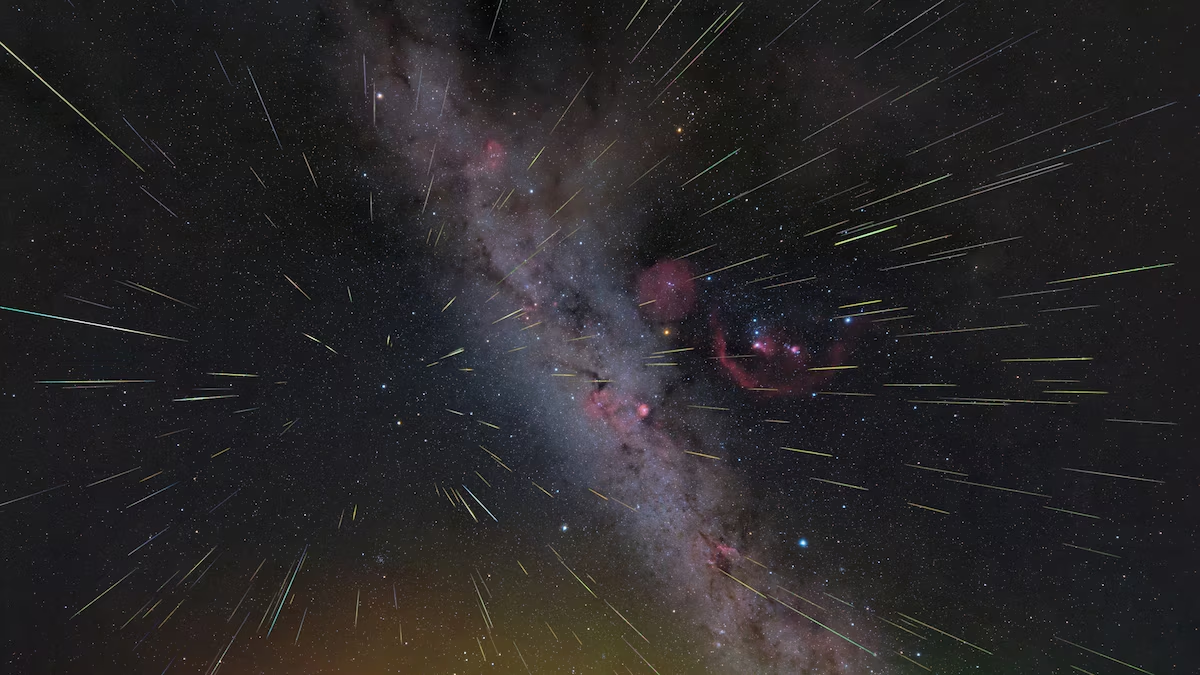
“This material is larger on average and survives further into our atmosphere and tends to produce brighter meteors,” says Rubert Lunsford, the journal editor of the American Meteor Society. Phaethon 3200’s debris also contains more metal. “When these metals are heated during the passage through our atmosphere, they produce colors associated with each type of metal,” he adds. Calcium and silicon produce orange; iron and sodium produce yellow; nickel produces green; and magnesium produces blue.
This two-hour sequence from the Solar and Heliospheric Observatory shows asteroid Phaethon (circled) moving near the Sun in May 2022. Scattered white specks mark cosmic rays striking the camera.
ESA/NASA/USNRL/K. Battams
Radar images from the National Science Foundation’s Arecibo Observatory capture near-Earth asteroid 3200 Phaethon during its close approach in December 2017, when it passed within 6.4 million miles of Earth—its closest visit until 2093.
Arecibo Observatory/NASA/NSF
What is Phaethon 3200?
It’s a comet! It’s an asteroid! It’s…Phaethon 3200? This rocky object straddles the line between a comet and an asteroid, though most astronomers consider it the latter. “Phaethon is an approximately six-kilometer-diameter asteroid that passes very close to the sun, within half the distance of Mercury,” says Qicheng Zhang, an astronomer at Arizona’s Lowell Observatory. Such orbits are far more common to comets than asteroids.
Phaethon displays other cometary characteristics, too. Most notably, it brightens and forms a small tail as it approaches the sun. But because Phaethon 3200 is rocky, not icy, that tail shouldn’t exist. However, in a 2023 study, Zhang and colleagues discovered that the tail is composed of sodium gas instead of the vaporized dust found in comets’ tails.