How Trump’s AI push, energy prices and angry neighbors are colliding in the Arizona desert

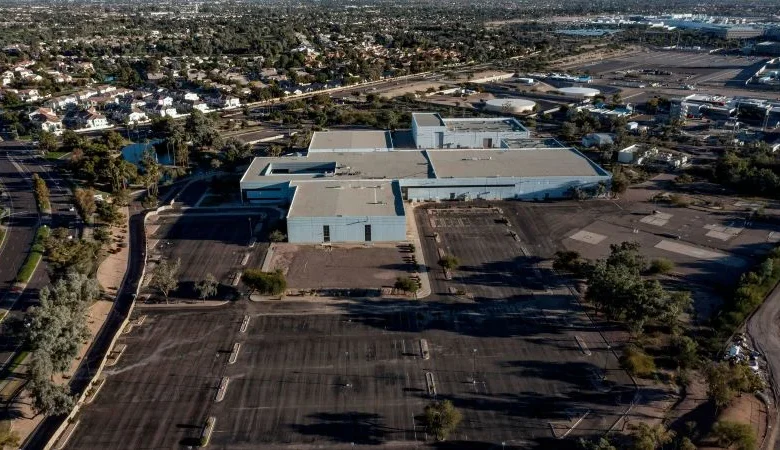
Chandler, Arizona
—
Andy and Carrie Hoefer knew little about data centers until a notice arrived informing them that one might be built across the street from their condominium complex.
Only then did they make a startling discovery: Ten data centers already operate in the area around their home.
“Do we really need 11?” Andy Hoefer asked.
The city of Chandler has spent years wrestling with that question, just as communities around the country debate the economic and environmental trade-offs of these hulking, resource-intensive warehouses of servers and other IT equipment that power everything from streaming services to online banking
In battleground Arizona and beyond, the politics of data centers are unsettled, not falling neatly along partisan lines. And President Donald Trump has injected himself into the fights, throwing the full weight of his administration behind winning the artificial intelligence race by whatever means possible — including fast-tracking data centers.
Chandler, for its part, decided three years ago it didn’t need another data center. After a decade of noise complaints and rising worries about dwindling water supplies and surging electric bills, Chandler became one of the first cities in the country to adopt restrictions designed to make opening data centers far more difficult. The ordinance sent a clear signal to certain technology companies to rethink expansion in the fast-growing Phoenix suburb.
Now, a developer has proposed a facility that is expected to be more powerful than any data center already operating in Chandler. The company argues the project — a $2.5 billion technology park anchored by a data center as long as a football field and seven stories high — would position the city at the forefront of an artificial intelligence boom, attracting new businesses and bringing renewed prestige to one of the state’s most dynamic technological engines.
Chandler city staff have recommended against it, warning data centers historically bring few jobs and many complications. The developer, however, has enlisted a high-profile advocate: former Arizona Sen. Kyrsten Sinema, a Democrat-turned-independent who is closely aligned with Trump’s AI offensive. Sinema recently cautioned city officials that the Trump administration might someday force a data center on them if they block this one. The City Council is scheduled to vote on the measure Thursday.
Residents are pushing back. Emails opposing the new data center outnumber supporters by more than 20-to-1, according to a City Council memo. Andy Hoefer, a 65-year-old financial planner, designed and sent more than 2,000 post cards to neighbors to raise awareness, while Carrie, a 63-year-old registered nurse, knocked on hundreds of doors to rally opposition.
“I’m not against AI; I think it’s great,” she said. “But I don’t want to become a subject in a future study on what it’s like to live in such close proximity to so many data centers.”
Chandler didn’t set out to become a data center hub. Once covered in cattle, cotton and ostrich farms, the valley city’s population exploded after Intel opened a production facility in 1980. Other blue-chip businesses, such as Wells Fargo, Northrop Grumman and Microchip Technology, followed. Chandler is now a key cog in the rise of Arizona’s Silicon Desert.
Then, a developer’s post-Great Recession plan to turn an old Motorola facility into a 152-acre technology park didn’t materialize. The initial proposal called for just one data center, former City Councilmember Rick Heumann said, but when tenants didn’t arrive, more data centers filled the empty land. By 2023, when the city’s new rules on data centers went into effect, 10 had set up in Chandler’s main corporate corridor.
“There’s like no jobs to speak of,” Heumann said, bristling at the fortified structures as he drove by on a recent Thursday morning.
The city estimates that the tech park employs fewer than 100 people and that data centers in general bring “extremely low employment per square foot” compared with other industries, Chandler staff wrote in one presentation.
Cepand Alizadeh, the government relations director for the pro-data center Arizona Technology Council, argued that these facilities create thousands of construction jobs and that the full-time positions offer competitive salaries and attractive benefits.
“For every one job at a data center, six other jobs are created in a local ecosystem,” Alizadeh said.
For years, residents complained of droning sounds coming from the facilities. Abatement efforts have lessened the burden, but locals still chime in on neighborhood Facebook groups when these facilities loudly test their backup generators. The local electric utility, Salt River Project, built additional substations and utility lines nearby just to service the data centers. Concerns about water used to cool these buildings habitually arose in the desert community.
But Adam Baugh, an Arizona attorney representing the project, says it’s unfair to compare their proposal for an artificial intelligence data center to those already operating in the city. This one, they contend, will attract companies eager to set up shop next to their cutting-edge technology, and they’ve promised to build five additional structures to house future tenants.
“Calling this a data center is like comparing a Walkman and an iPhone and saying they’re both musical devices,” Baugh recently told the city. He did not respond to emails from CNN.
The developer of the new project, Jeff Zygler of ActiveInfrastructure, did not respond to a request for comment.
Already this year, the data center debate has echoed through statehouses and shaped key races. Georgia voters last month ousted two Republicans from the state utility board in response to soaring electric rates blamed in part on data centers. That same night, Virginia Gov.-elect Abigail Spanberger vowed to “make sure that data centers pay their fair share” in her victory speech.
Both parties anticipate the issue will surface in the midterm elections as Democrats sharpen their message on rising power bills and other affordability challenges and as Republicans brace for an electorate increasingly attuned to the costs of Trump’s AI agenda.
The politics around data centers are “still emerging,” in part because hyperscalers are so new and developers are rushing to build them in so many places, said Harvard University sociology professor Jason Beckfield, who is studying data centers.
“A lot of people feel like these things drop from the sky,” Beckfield told CNN. “The developers are under huge pressure to get these things done as fast as humanly possible.”
Data centers like the one proposed in Chandler are a key pillar of Trump’s plan to beat China and become the leading AI superpower. Under an AI action plan released in July, the White House recommended easing federal rules and expediting permits to construct data centers.
Against that backdrop, Sinema recently raised eyebrows by suggesting Chandler’s choices in the future may be limited.
“Federal preemption is coming,” she said at the city’s October zoning meeting. “Chandler right now has the opportunity to determine how and when these new, innovative AI data centers will be built. When federal preemption comes, you will no longer have that privilege.”
Sinema introduced herself as the co-chair of the newly formed AI Infrastructure Coalition, an industry group she founded shortly after leaving Congress. She told CNN she has a contract with the company building the Chandler project, a fact she didn’t share during her public remarks. Emails obtained by CNN through a public records request show Sinema meeting with city leaders to discuss the data center since midsummer.
The former Arizona senator told the board she works “hand in glove with the Trump administration,” and her remarks were widely interpreted as a threat from Washington. The White House did not respond to a request for comment.
Her appearance attracted local news coverage and seemed to intensify opposition. In emails sent to City Hall after the zoning meeting, residents repeatedly referenced Sinema’s statements and some told CNN they weren’t aware of the data center project before her involvement became publicized.
“It wasn’t a threat, it was a promise,” said Councilmember OD Harris. “People are fired up over this now, and they’re fired up because of Sen. Sinema. She shouldn’t have come.”
Cities are increasingly concerned that Sinema foreshadowed a looming fight. Trump’s allies are already laying the groundwork for his administration to overrule local rules to build the infrastructure supporting AI expansion, said Angelina Panettieri, who tracks technology legislation for the National League of Cities. In pushing ahead with Trump’s AI action plan, the Federal Communications Commission, for example, has discussed whether cities and counties have regulations that “could inhibit U.S. leadership in evolving technologies like artificial intelligence.”
In an interview this week, Sinema said her remarks have been misconstrued.
“I believe in local control,” she said.
Massive energy demands
Tech companies’ race to dominate artificial intelligence is rapidly transforming communities across the nation.
Virginia has the biggest data center cluster in not just the US, but the entire world. Texas and Ohio are becoming major hubs, too. But tech companies are looking west — increasingly, toward Arizona.
The state’s desert landscape, although punishingly hot, is relatively flat and not prone to disasters like hurricanes, floods or earthquakes. It’s also financially attractive: A generous state tax credit exempts companies from paying state or local taxes on their computer equipment inside the buildings.
But local officials are growing increasingly uncomfortable with the energy and resource demands from data centers. Arizona is a water-scarce state whose share of the Colorado River is dwindling at the same time farms are pumping vast amounts of groundwater to grow vegetables and forage crops in the desert.
Some data centers use water to cool their stacks of overheating computer servers, but companies — including the builder behind the Chandler project — are more likely to propose “dry cooling,” essentially using air conditioning instead of water. That may be good news for water resources, but it means data centers need even more electricity to keep cool.
Trump has publicly suggested that US energy production will have to double to meet the demands to win America’s AI race against other nations. A 2024 report by the US Department of Energy estimated that data centers would consume between 6.7% and 12% of the nation’s electricity by 2028.
The two major utilities serving Arizona acknowledged receiving eye-popping electricity requests from data centers. As demand has increased, so too have Arizona’s electricity prices. One utility, Arizona Public Service, this summer asked the Arizona Corporation Commission to approve a 16% rate hike.
There is mounting consumer frustration that price spikes are connected to the data centers. Arizona Public Service spokesperson Ann Porter said the requested rate hike “doesn’t include costs of infrastructure that might be needed to be built in the future to serve data center customers.” Industry groups have contended electric prices are rising everywhere, even in places without data centers.
Still, utilities are now charging tech companies up-front for the massive amounts of electricity they want to use to ensure residents aren’t stuck with the bill. For the proposed data center in Chandler, the Salt River Project, the local utility, is requiring the developer to pay $242 million to cover the costs to build additional capacity.
The amount of electricity data centers are requesting is nearly equivalent to the Salt River Project’s current power capacity, said utility spokesperson Jennifer Schuricht — and it will take building new power plants and infrastructure to satisfy it.
Forecasting how much energy to plan for is an inexact science — especially when the estimates from data centers appear to be wildly inflated, said Kelly Barr, associate vice president at Arizona State University’s Global Futures Laboratory and a former executive at the Salt River Project. And in Arizona, where air conditioners are the difference between life and death during summer months, the consequences of guessing wrong are dire.
Ensuring the grid runs reliably is utilities’ “top priority,” Barr said.
“If that means data centers are served a bit later, then that’s simply what has to happen,” she added.
A 6-foot wall is all that separates Patrick Griffith’s backyard from his city’s explosive growth.
Through triple-pane windows, the 61-year-old retired insurance adjuster can still hear the traffic from a road leading to an ever-expanding Intel plant. His ficus tree can’t fully hide the power lines that send electricity across the desert into power-hungry tech hubs. Some nights, the stench from a nearby water treatment plant spoils plans to dine on his patio.
But it’s the data center planned for across the street from his wall that may finally push him out of his two-story home after three decades.
“My wife has been ready to go for some time,” Griffith said. “If they build this, I may give in.”
While outnumbered, advocates for the project are quietly hoping for success. Chris Tiller, a local real estate agent, is worried the city is too committed to an aging model dependent on large corporations building massive offices on vacant land.
“It’s 2026. Adapt or die,” Tiller said at a recent City Hall listening session on data centers.
Zygler, the developer, has not in public remarks identified prospective users of the data center or the companies that might move next door. Zygler also could not point to a similar project operating in the state, though he said two are under construction. That worries some city officials who remember the last decade all too well.
“I’ve asked them: ‘Can you tell me this is not a ‘Field of Dreams’ scenario where you build it and hope they come?’” said Councilmember Matt Orlando. “If they want a vote from me, they need to give me some answers.”