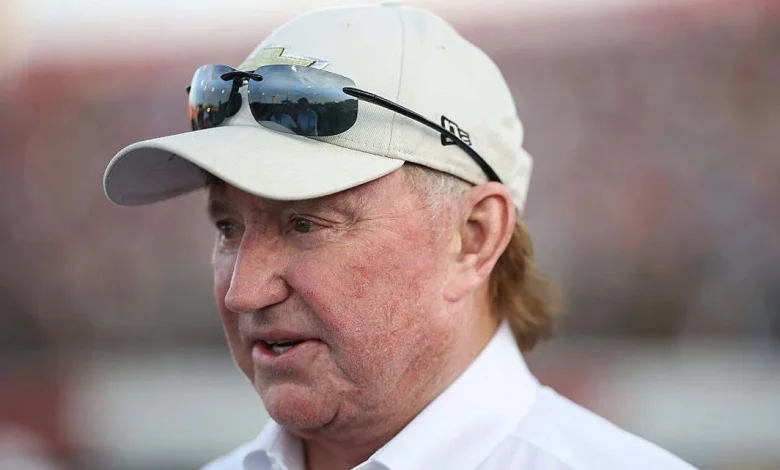
RCR team owner and NASCAR Hall of Famer, Richard Childress waits on the grid prior to the NASCAR Cup Series All-Star Race at North Wilkesboro Speedway on May 18, 2025 in North Wilkesboro, North Carolina.
Getty Images
Five witnesses testified Tuesday in the trial that has grabbed the stock car racing world’s attention — but it was someone not employed by NASCAR, 23XI Racing or Front Row Motorsports who was most revealing.
Longtime Cup Series owner Richard Childress confirmed during his testimony Tuesday that he had engaged in discussions to sell a portion of his 60% stake in Richard Childress Racing, the company he founded in 1969.
The six-time Cup Series champion owner, who famously owned the car that helped bring Dale Earnhardt and the sport of NASCAR into the nation’s consciousness in the 1980s and ‘90s, appeared confused when he was asked during cross-examination about what he thought were confidential discussions with a group that includes former NASCAR driver Bobby Hillin Jr.
“I don’t want to answer that,” Childress said at one point during this line of questioning, before District Judge Kenneth Bell reminded him he was under oath and obliged to answer to the best of his ability.
RCR team owner and NASCAR Hall of Famer, Richard Childress walks the grid prior to the NASCAR Xfinity Series BetRivers 200 at Dover Motor Speedway on July 19, 2025 in Dover, Delaware. Sean Gardner Getty Images
Childress said that he sent Hillin a termination letter earlier this year — “They don’t have the money,” Childress said — and that both parties signed a non-disclosure agreement pertaining to RCR’s finances. Childress also clarified that Hillin was mainly going to purchase the stake in the company owned by Chartwell Investments, which has wanted out of their ownership of RCR for the last “five or six years.” When asked directly, Childress admitted to considering selling part of his stake to Hillin, too.
Once the jury departed for the evening, plaintiffs counsel requested to Judge Bell that the defense turn over the documents they have concerning Hillin’s claims about Childress’s finances and to find the source who availed those documents to NASCAR. The two legal teams were told to discuss the matter Tuesday evening.
Still, the 80-year-old NASCAR Hall of Famer answered more than he wanted to, as was apparent in the Potter Courtroom in the U.S. District Court of the Western District of North Carolina in uptown Charlotte. The answers, though not at the center of the case, were ostensibly relevant, however.
Jesse Love, driver of the No. 2 Whelen Chevrolet, and NASCAR Hall of Famer and RCR team owner, Richard Childress embrace in victory lane after winning the NASCAR Xfinity Series Championship at Phoenix Raceway on November 01, 2025 in Avondale, Arizona. Meg Oliphant Getty Images
The fact that Childress is looking to sell a portion of his stake in RCR demonstrates that life in the Cup Series isn’t easy, something that he testified to at great length on Tuesday. Childress confirmed that his business affairs have yielded 55 straight years of EBITA — an economics term that shows a company’s operational profitability before interest, taxes and other processes — but he also clarified: “I have other businesses to pay our bills for NASCAR.”
“I’d be broke if I was just doing the Cup teams,” Childress said.
Those businesses include ECR Engines, a high-performance combustion engine development and production company, as well as RCR Manufacturing Solutions, which produces weapons and vehicles for the military. Both profitable businesses operate on the Richard Childress Racing campus in Welcome, North Carolina. Childress also owns a vineyard in Lexington.
Childress, despite being forced to disclose some aspects of his business, was not deterred by his primary point of being called as a plaintiff witness.
“That money should be going into my bank account (instead of) going to pay my NASCAR teams,” he said.
NASCAR President Mike Helton, left, chats with owner Richard Childress at Lowe’s Motor Speedway in 2001. CHRISTOPHER A. RECORD
The point Childress was trying to make
Prior to his cross-examination, Childress was guided down a line of questioning from plaintiff attorney Danielle Williams and was direct in his frustrations with NASCAR and its current model of business.
His main gripe was with the 2025 charter agreement.
“We were negotiating a better contract for the charters,” said Childress, who owns two full-time Cup Series charters. “And then it just didn’t happen that way.”
Childress is referring to the document that was the catalyst to the lawsuit that has led us to this trial. The lawsuit was filed in October 2024 and involved Cup teams 23XI Racing and Front Row Motorsports asserting that the sanctioning body of NASCAR operated as an unlawful monopoly.
NASCAR Sprint Cup Series team owner Richard Childress looks on during the NASCAR Sprint Media Tour hosted by Charlotte Motor Speedway’s stop at Richard Childress Racing on Tuesday, January 25, 2011, in Welcome, North Carolina. Jeff Siner MCT
A quick refresher on the charter agreement: NASCAR established its charter system in 2016. A “charter” can be thought of like a franchise, similar to how the Chicago Bulls belong to the NBA. Cup teams that own one of the 36 charters have certain benefits; they have guaranteed entry into every race, for instance, and thus a guaranteed slice of each race weekend’s purse.
Team owners this week have testified that the 2016 deal was a good start but that come the expiration of that deal — in 2025 — the sport ought to improve the charter system. For the teams, that meant making the charters “evergreen,” or permanent.
Such a prospect would make it so teams wouldn’t have to forfeit their charters if they didn’t sign on to a new charter agreement, which, if trends persist, get renegotiated after seven-to-nine years. It would also foster a partner-to-partner relationship rather than a contractor-to-employer relationship, teams say — all teams want is an asset that can’t be taken away and that appreciates or depreciates as the sport fares over time.
“It wouldn’t cost NASCAR nothing to give us a (permanent) franchise,” Childress said. “All we want to do is be good partners.”
Childress also agreed with other owners who have testified and said that NASCAR offered the teams a “take-it-or-leave-it” ultimatum in September: In other words, if you don’t sign now, you lose your charters. Childress ultimately decided to be one of the 13 teams to sign onto the charter agreement.
The only two teams that didn’t sign the agreement are the ones who sued NASCAR and are the plaintiffs in this case: 23XI Racing (owned by Michael Jordan and Denny Hamlin) and Front Row Motorsports (owned by Bob Jenkins).
“We would’ve lost them,” Chidress said. “… Financially, I couldn’t lose our charters.”
Cup team owner Richard Childress watches practice from atop his transporter at Lowe’s Motor Speedway in 2006. JEFF SINER
Jim France takes the witness stand to little avail for teams
NASCAR board chairman and CEO Jim France took the witness stand Tuesday and was examined by plaintiff attorney Jeffrey Kessler. His testimony was largely uneventful; he mostly deflected Kessler’s questions, citing a faulty memory and relying on generalities.
For instance, when plaintiffs showed in evidence an email in which NASCAR president Steve O’Donnell wrote that “Jim’s overarching comment” in a charter negotiations meeting was a fiery one — “We are in a competition … we are going to win!” — France was steadfast.
“I’m not sure,” France said, when asked to recall his message to NASCAR leadership. He added, “That would be his interpretation.”
France had a similar response when he was shown a bevy of letters from NASCAR Cup Series owners during charter negotiations — leaders France referred to as friends, like Rick Hendrick and Roger Penske. He was asked about one line in particular from Hendrick, owner of Hendrick Motorsports: “HMS has won two Cup championships and lost $20 million (in the last five years). … To be asked to consider a lesser deal as your most recent proposal suggests is a slap in the face. I will not agree to it.”
France’s response when he was asked if he sees the letter: “I do see that.”
When asked if he remembers how the letter made him feel: “I do not recall.”
Jim France (center), NASCAR chairman and CEO, departs the Charles R Jonas Federal Building on December 1, 2025 in Charlotte, North Carolina. Grant Baldwin Getty Images
Other notes from NASCAR trial Day 7
—The five witnesses who testified Tuesday, in order: plaintiff expert economist Edward Snyder (who finished up from Monday), accountant Anthony Smith, NASCAR commissioner Steve Phelps, Childress and France.
—Phelps reiterated the company line, stating that the charter system was good for NASCAR and that he set out to strike a compromise with the teams knowing that NASCAR did not want permanent charters. He also added that the Next Gen car is the “safest car in motorsports”; when reexamined by plaintiff counsel and asked about the concussions that transpired in 2022 and even one that ended the career of Kurt Busch early, Phelps acknowledged those early bumps but also acknowledged the progress the car has made and clarified that this car is safest against “big hits” that could cause “fatalities.”
NASCAR commissioner Steve Phelps speaks to the media during the NASCAR annual “state of the sport” press conference on Oct. 31, 2025, at Phoenix Raceway. Jared C. Tilton Getty Images
—France was the final witness called by the plaintiffs. His cross-examination will continue and conclude Wednesday. Defense attorney Chris Yates informed Judge Bell that it is his team’s goal to get through all their witnesses by the end of the week, meaning that closing arguments are possible for Monday.
“We will endeavor to be as efficient as possible,” Yates said.
Plaintiffs counsel appeared skeptical of this goal as the defense still has over 10 people on its potential witness list; Yates said he and his team will pare down the witness list Tuesday night.
This story was originally published December 9, 2025 at 8:14 PM.
Alex Zietlow
The Charlotte Observer
Alex Zietlow writes about the Carolina Panthers and the ways in which sports intersect with life for The Charlotte Observer, where he has been a reporter since August 2022. Zietlow’s work has been honored by the Pro Football Writers Association, the N.C. and S.C. Press Associations, as well as the Associated Press Sports Editors (APSE) group. He’s earned six APSE Top 10 distinctions for his coverage on a variety of topics, from billion-dollar stadium renovations to the small moments of triumph that helped a Panthers kicker defy the steepest odds in sports. Zietlow previously wrote for The Herald in Rock Hill (S.C.) from 2019-22.
Support my work with a digital subscription