You Can Binge JJ Abrams’ Amazing Cyberpunk RoboCop Replacement Show in 10 Hours (& You Should)

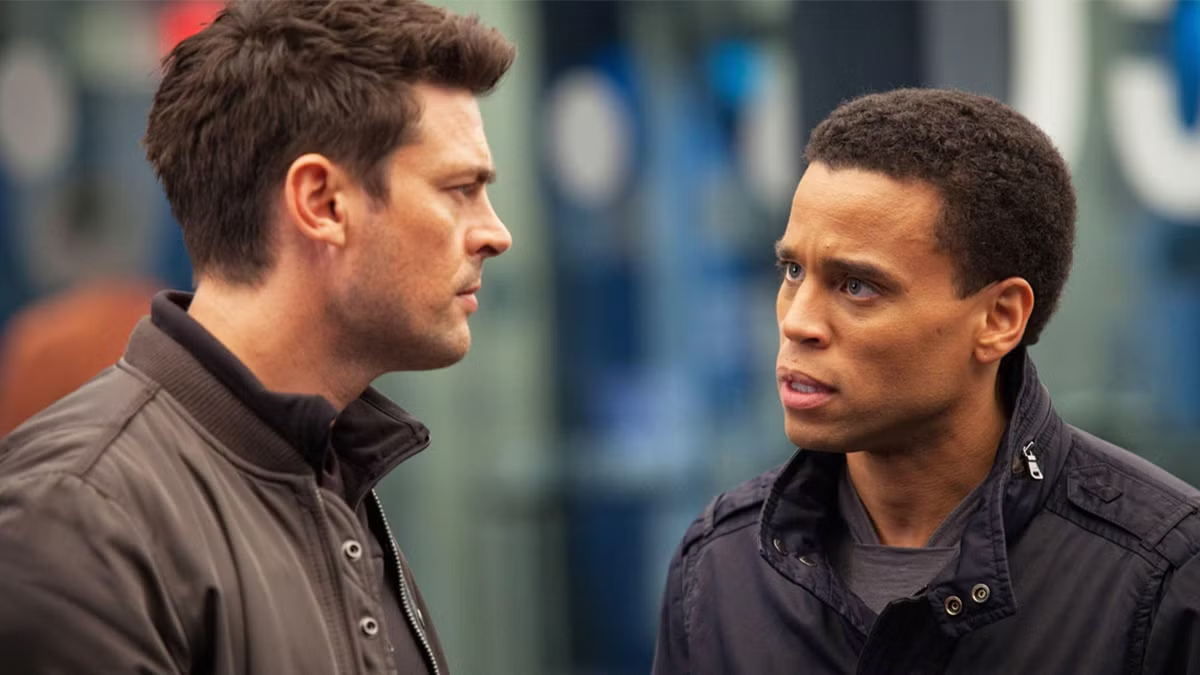
In the world of network television, it’s a difficult task to ensure a show’s longevity from start to finish. Even the best shows out there may fail to reach a wider audience and evolve. Unfortunately, this is the fate that befell Almost Human, an underrated 2013 cyberpunk sci-fi show executive produced by J.J. Abrams and created by Fringe‘s J.H. Wyman.
This fascinating hybrid of RoboCop, Blade Runner, and Total Recall aired on Fox and starred Karl Urban and Michael Ealy as a human cop and his android partner. They reluctantly team up to fight the crime running rampant in the technologically-advanced world of New Pittsburgh in 2048, with each episode of the show’s sole 13-episode season being dedicated to a new case. Ultimately, the show was no classic, but it is still a great series that deserves a rewatch, mostly thanks to its brilliant approach to characterization and world-building.
Almost Human Wore Its Influences On Its Sleeve
Image via 20th Century Television
When analyzing why Almost Human may have struggled to pin down an audience quickly enough to justify that second season, it’s hard to look past its many influences. Elements of RoboCop, Blade Runner and Total Recall all immediately leap out to any audience member and keep it from being original. Flickers of I, Robot and Demolition Man‘s San Angeles make it a unique dystopian sci-fi story, but immediately make it hard for audiences to get behind.
To some viewers, though, noticing these inspirations would have been a selling point. After all, the show was obviously aimed at fans of such science-fiction material, and just because something wears its influences on its sleeve, it doesn’t inherently have less merit. It’s all about what Wyman, Abrams, and company do with those influences that matters, anyway.
However, when the show was released, many critics took a negative slant on these inspirations and wrote Almost Human off as being derivative. Unfortunately, by the time viewers heard about how it distinguished itself as a unique entry in the cyberpunk genre as the season gathered steam, the damage was already done.
Another possibility for the tepid reception to Almost Human could have been its strict adherence to police procedural structure. The show followed a case-of-the-week approach, with Urban’s John Kennex and Ealy’s DRN-0167 (or ‘Dorian’) looking into a new threat every time. These days, this kind of show is often labeled generic or formulaic to the procedural genre, even if the seemingly disparate stories have recurring elements and build to an overall season-long story.
However, in 2013, network TV was in a renaissance of procedurals, be they cop-based (CSI: Crime Scene Investigation, Blue Bloods), horror/fantasy-influenced (Supernatural, Grimm) or sci-fi themed procedurals (Warehouse 13, Eureka). Even Fringe, which Wyman penned 32 episodes of, ran for five full seasons, so it doesn’t seem like this would have been a deal-breaker for audiences.
Creator J.H. Wyman Was Happy With Almost Human, Even If It Ended Early
Image via 20th Century Television/courtesy Everett Collection
As tough a pill as it is to swallow, sometimes shows just don’t get the reception they deserve and end too early. But there are many factors that can contribute to that. In the end, there was no one smoking gun responsible for Almost Human not building an audience, but when those viewers did begin to dwindle, even with its five-year plan.
Still, in 2014, Wyman told Collider that he was at peace with the idea of people not liking Almost Human, because he was allowed to make the show exactly as he first envisioned it. However, he bristled at the notion of anyone claiming he didn’t know where the story would have ultimately gone, or that he didn’t know how to explore the themes he was interested in. “I can’t live with people saying, ‘There just seems to be no plan here,’ because there is a plan,” Wyman insisted. “And a lot of people fall into that, where they don’t know what their show is yet.”
Almost Human is a classic example of a series that just needed more seasons. The series explored many dark topics that showed how twisted this advanced future could be. One example follows the use of sex robots that wear the skin of homeless women who were taken, something even modern sci-fi shows haven’t dared to explore.
That said, he insisted that he didn’t have as dim a view of humanity and its intersection with tech as the cyberpunk scribes who inspired him. “I’m a little bit frightened of technology and leaving humanity behind,” he explained. “I was just confused why all these great writers, who had influenced me to such a great degree, like Asimov and Dick, always had this interpretation of the future that was so dark and dour. I just have a different impression of the human race. I think we’re really resilient.”
Almost Human’s Central Characters and World-Building Were on Point
Image via 20th Century Television
With these words in mind, it seems likely that Wyman might have distinguished Almost Human even further in subsequent seasons. There was a chance it would’ve explored an optimistic look at the future, as opposed to the usual cyberpunk dystopia. It’s hard to say for certain if it would’ve worked. But considering that the strongest elements of the show were its friendship between its central characters, it sounds more and more like it had a chance.
In terms of creating its own rich canvas to tell stories within, Almost Human‘s first season burned through interesting ideas at an incredibly fast rate. It had cybernetic limbs, mechanical organs, synthetic souls, a DNA bomb, and a shadowy criminal organization called inSyndicate pulling the strings behind the scenes. New Pittsburgh was sleek and beautifully futuristic on the surface, but beneath that facade lay an underbelly falling to ruin and crawling with tech-augmented criminals.
Finally, though, the greatest praise must go to The Boys star Urban and Westworld’s Ealy, because without their core relationship working so brilliantly, the show would have had a hollow center. Urban has always been a charismatic and incredibly fun actor to watch, and he excels in sci-fi properties like the underrated Dredd and Star Trek. As Kennex, he instantly brings a sense of leading man cool, but also dramatic gravitas, and he perfectly portrays the conflicted interior of a man who has every right to hate androids, but not his new partner.
As Dorian, Ealy’s glassy-eyed expressions make him read perfectly as an android, but because he is a model created specifically to mimic human emotion, there is an uncanny layer of empathy to him, too. The show plays with the idea that this ‘almost human’ robot is actually more in touch with the emotions of others than most regular human beings, raising the question of if he truly is less than human.
Best of all, though, Dorian isn’t only more empathetic than Kennex, he’s also capable of giving the grizzled gumshoe a run for his money when it comes to humor. In fact, some of the show’s best moments simply feature Kennex and Dorian’s buddy cop bantering while their bond grows. All in all, it’s a shame fans never got to see the characters again, but at least they left behind 10 hours of highly watchable cyberpunk goodness.
Release Date
2013 – 2014-00-00
Showrunner
J.H. Wyman
Directors
Joe Begos
Writers
Justin Doble, Cheo Hodari Coker, J. H. Wyman