SPOILER ALERT: This story contains spoilers for the first two episodes of “Percy Jackson and the Olympians” Season 2.
The “Percy Jackson” fandom is known for being especially sensitive to on-screen changes from the book series written by Rick Riordan — as evidenced by their outright rejection of the two “Percy Jackson” movies that 20th Century Fox made in the 2010s. But with the Disney+ series “Percy Jackson and the Olympians,” which launched its first season in December 2023, Riordan and his team of writers struck a balance between honoring the middle-grade novels that fans loved while making adjustments to help the story feel fresh as it entered a visual medium. Among both critics and viewers, the season was judged to have done that successfully. That work continues in the newly released second season, which is based on Riordan’s 2006 novel “The Sea of Monsters” and features some noticeable changes from the beginning.
The season opens with Grover (Aryan Simhadri) out in the wilderness searching for the lost god Pan, as he set out to do at the end of Season 1. On his search, he runs into some familiar faces from Camp Half-Blood, but he quickly realizes they’re foes, not friends — they’ve joined up with Luke Castellan (Charlie Bushnell) on his fight to take down the gods of Olympus and serve the titan god Kronos. But there’s a more immediate danger: A giant tentacled monster approaches and pulls Grover into the sea.
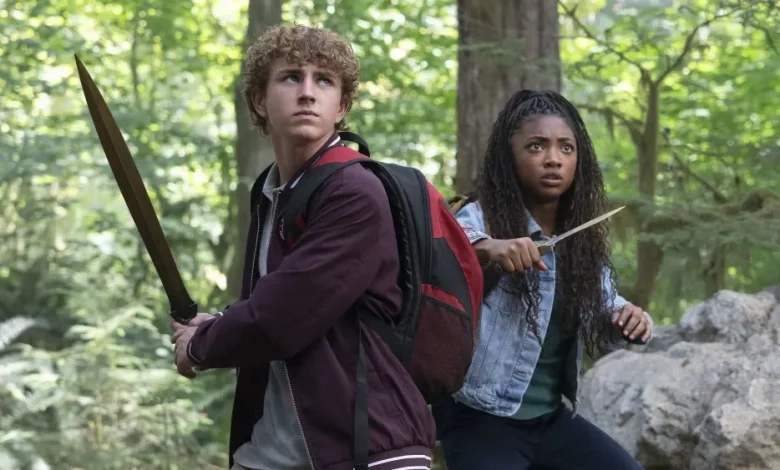
Percy (Walker Scobell) is finishing out the school year in New York City where he lives with his mom, Sally (Virginia Kull) — plus Tyson (Daniel Diemer), a young Cyclops whom Sally met and has allowed to live with them. While Percy and Tyson are walking to school, Annabeth (Leah Sava Jeffries) appears in a magical cab driven by the Gray Sisters (Sandra Bernhard, Margaret Cho and Kristen Schaal). She’s been having dreams about Camp Half-Blood being in danger, so the group drives there with the Gray Sisters, who give them a set of numbers Percy later realizes are the coordinates to Grover’s location. At camp, they’re attacked by Laestrygonian giants. During the fight, Annabeth, a hater of Cyclopes, reluctantly permits Tyson to cross the boundary that keeps monsters out of camp, while Clarisse (Dior Goodjohn) and her team of warriors fight off the Laestrygonians.
Leah Sava Jeffries as Annabeth Chase
When they enter camp, however, they find that Luke has stabbed a poison-laced dagger into the magical tree that upholds the protective boundary. It’s a major betrayal of everyone at camp, especially because that tree contains the soul of his old friend; Thalia, the demigod daughter of Zeus, once sacrificed herself to save Luke and Annabeth from monsters and Zeus turned her into the tree so she would live on somehow. Luke gets away, then Percy and Annabeth are apprehended by Tantalus (Timothy Simons), the new camp director after Chiron (Glynn Turman) was fired for being a son of Kronos. Tantalus wants to kill Tyson until a trident materializes above Tyson’s head, revealing that he is a son of Poseidon (Toby Stephens) and a half-brother to Percy.
With the camp’s protective border being weakened, it becomes clear that someone needs to travel to the Sea of Monsters to obtain the Golden Fleece, the only thing that can save Thalia’s tree. Conveniently, that’s also where Grover is located. Though Tantalus chooses to send Clarisse on the quest to find it, Percy, Annabeth and Tyson set off on an unsanctioned quest of their own as the second episode closes.
Riordan and executive producers Jon Steinberg, Dan Shotz and Craig Silverstein spoke with Variety to break down the ways they saved time, upped the stakes and deepened the relationships at the beginning of “The Sea of Monsters.”
(Note: Riordan was interviewed separately from Steinberg, Shotz and Silverstein.)
In the book, the Mist that keeps mortals from being able to see monsters also keeps Percy from realizing that Tyson is a Cyclops at first, but in the show, Percy already knows at the beginning of Season 2. What was behind that change?
Rick Riordan: We have to look at ways we can tell the story more efficiently, especially at the beginning. How do we get into the story quickly and still have the same impact? We compressed a pretty great deal from the first few chapters. We’re heading in the same direction. We’re getting to the same point, just a little bit quicker.
Craig Silverstein: It was about understanding the idea of the Mist. Now that Percy’s been able to see monsters for what they are, why can’t he see Tyson? There’s not a great reason for it, and the revelation of Tyson doesn’t change that much. He’s still this kid who has stayed at his house, who his mom brought in. He still has to take care of him. It seemed like a smart and efficient change when you’re trying to get everything into 40 minutes.
Dan Shotz: And we wanted to launch the trio right away — the new trio, now that Grover is missing. This is our group for the season, and we wanted to have that happen as fast as possible.
Similarly, Luke is shown stabbing and poisoning Thalia’s tree in the Season 2 premiere, whereas in the books, Chiron is suspected of being the assailant, and it isn’t revealed to be Luke until toward the end of the book. Walk me through that choice.
Riordan: There is something valuable, in the TV version, about seeing that moment in real time. It’s powerful. It immediately makes you understand the stakes when Luke and Percy lock eyes with each other. The challenge is issued right from the beginning. It’s not as slow burn a mystery as it was in the book, but I think it’s an effective way to tell that story in the new medium.
Silverstein: When you’re doing the screen adaptation of anything, you want to see it on screen. You want to see your hero and your antagonist face each other, so it was important to see Luke — and Blackjack [the Pegasus he’s riding].
Charlie Bushnell as Luke
As a result, Zeus fires Chiron simply for being a son of Kronos, instead of for poisoning the tree. As Percy points out, Zeus is also a son of Kronos, so these changes seem to add an extra ragey, unreasonable quality to Zeus. What were you trying to say with that relationship?
Riordan: I have to admit, I don’t know that I’ve thought about it in that way, but you’re right. It does feel more capricious, more ill-considered on Zeus’ part. That goes along very well with the themes we’re exploring in the second season. And Luke, even though he’s our antagonist, he’s not wrong. He has a point: The gods can be really, really terrible parents, and not the greatest leaders. So that does underscore sympathy for the enemy here. Who’s on the right side? I think it’s OK that viewers may have some very mixed feelings about who’s the hero here.
Silverstein: It’s the rage and the hypocrisy of the gods. Your hero and your antagonist are uncomfortably on the same page about some things.
There’s certainly tension between Percy and Annabeth at the start of “The Sea of Monsters,” but it’s mostly about Annabeth’s dislike of Cyclopes. On screen, deeper personal wounds come to light. They’re upset at each other how disconnected they started feeling during their year apart, and about the details they both left out of their letters. Knowing where the two of them end up, how were you approaching their relationship at this point in the series?
Riordan: As the kids say, it hits different when it’s on the screen. Seeing it visually just has a bigger impact, so I have learned to be cognizant that a moment I describe in writing may come across as much more powerful — and maybe too powerful — if it were shown the same way on screen. So we have a lot of conversations about, “What is this going to look like when the characters are interacting with each other? What’s the attitude that they have toward each other?” It’s important that we honor the source material story, in that Percy and Annabeth’s relationship is a very slow burn, and we’re not going to get there right away. It’s delayed gratification. Are they going to be more than friends? We don’t know, and that’s not going to be answered for quite a while. However, their friendship is deepening and being tested in new ways, and it’s even more powerful to see that in the second season.
And, oh, boy, wait till you see the third season.
Shotz: We wanted to set up what happens with every kid. As they have a year away and come back, they’ve changed. They’ve had new life experiences. She has never been out in the real world in the last five years, and this experience has really been challenging for her, and it’s really hard to talk about. As they’re trying to reconnect after a year, all those bonds are shifting. The connection she was hoping to have with her father out in the real world wasn’t quite what Percy promised. Now, coming back together, they’re really in different places, and they have to find a new way of working together and being partners of the story. Because as you’re going to see for the whole season, this is really the Percy-Annabeth story. They’re together in this journey and have a pretty amazing arc as they face all of these trials at the Sea of Monsters.
Even though it’s still a slow burn, in Season 1 there were slightly more hints about a future romance for Percy and Annabeth than there were in the books. There are a few hugs, and a few accidentally flirtatious comments. At this point in the story, in the TV version, do you think Percy and Annabeth are aware that they have crushes on each other? Or are they too overwhelmed by the complications of their friendship and the monsters they’re fighting to realize?
Riordan: It is skewed a bit by the fact that the actors are growing up — and there’s not much we can do about that. We just have to keep going as at the pace we can go. But seeing them be as as much older as they are from Season 1, and then again in Season 3, it does skew our understanding of what might be going on in their heads. My guess is that they are still so conflicted, so much in crisis mode. Also, people that are potentially thinking about being in a relationship can have an incredible level of denial about what’s actually going on. I think there’s a lot of denial going on. A lot of fear. “There’s so much already on our plate. I can’t even think to go there right now.”
Jon Steinberg: There are things that happen visually that don’t need dialogue to come across, or that will come across no matter how much dialogue you apply to try to deny or resist it. There are a lot of reasons why this feels like a story worth telling. The relationship between those two kids, to me, is pretty central. From the outset: Two kids who have never met anybody like themselves, who find that they’re a lot less lonely when they’re around each other, is a really engaging and emotionally resonant story. What’s really interesting about about pushing them into this next adventure is that those relationships don’t stay heartwarming and easy. They get complicated, especially when you’re 13, 14, 15 years old. Engaging with that and making the hard moments of that friendship is just as important as the as the easy ones. It’s something I’m really proud of with the show.
In the book, Clarisse gets sent on the Sea of Monsters quest alone, and Percy, Annabeth and Tyson go rogue by starting their own quest. They go rogue here too — except Annabeth is initally set to join Clarisse without Percy, making Percy worry she’s betraying him somehow. Talk to me about how you wrote those scenes.
Silverstein: It’s all just a dramatic escalation of the basic tension, just pushing it up and up. In Episode 2, the climax of that was the confrontation on the beach between them, which was born out of, interestingly enough, a production challenge. That episode was written differently. In the book, the harpies [winged spirits who serve as cleaning staff at camp and eat campers if they sneak out] come with to stop them from leaving, and we got nervous about the way the harpies were going to come off. The idea was that it would be this confrontation between Annabeth and Percy bringing the real fireworks.
Shotz: And at the end of Episode 2, we’re sort of launching them on the quest, and you don’t want everything to be all perfect between them. There are things they are going to have to work through as they go to C.C.’s, as they have to deal with Clarisse, as all the stakes happen on Polyphemus’ island. Everything, as it moves forward, is a trial for their relationship. Not just trials of stakes for the larger mythology and story, but for Percy and Annabeth and how they’re going to come together.
Daniel Diemer as Tyson
Since Grover is gone for much of “The Sea of Monsters,” we lose the slightly older peacekeeper and voice of reason in the trio. Instead, we have Tyson, who is loyal and strong but also pretty naive, which puts more responsibility on Percy and Annabeth. How did his introduction affect you as you wrote Season 2?
Riordan: Tyson is such a hard part to to get right. Daniel Diemer was a gift. He just has the right energy: He’s a big brother, but he’s also got a sweetness and a vulnerability to him that makes him someone you want to wrap a quilt around and feed cookies to. But he’s also got this incredible power. He adds a lot, and he adds it very quickly. At the beginning, viewers should be thinking to themselves, “Wait a minute. Where’s my trio? Who’s this new guy?” But that’s the way the story should be. We made this group, and now we’re breaking it up to see what happens when they don’t have the trio together. What happens when you have Tyson instead, who Annabeth doesn’t trust and Percy’s got mixed feelings about too? Daniel brings a sympathy and a feeling of quiet strength to this group, and it really helps that he’s just a lovely person in real life.
Silverstein: Ultimately, he doesn’t intend to be, but he becomes another thing between Percy and Annabeth that’s giving them trouble reconnecting. She has to let him into the barrier, but she’s warned Percy that he can’t enter. She comes and tries to talk to Percy [in his cabin on their first night at camp], and he’s dealing with Tyson. Tyson doesn’t mean to be a problem for them. And Grover would know exactly how to make this relationship blossom. But Tyson becomes an extra responsibility that they need to balance when they head out into the world. And how do you balance different kinds of friend groups against each other? How are Tyson and Grover ever going to get along if they manage to get Grover back? There’s all these questions, but that’s what happens when you grow up. You add friends. New people come in, and you gotta figure out how to work them in with your besties,
This interview has been edited and condensed.