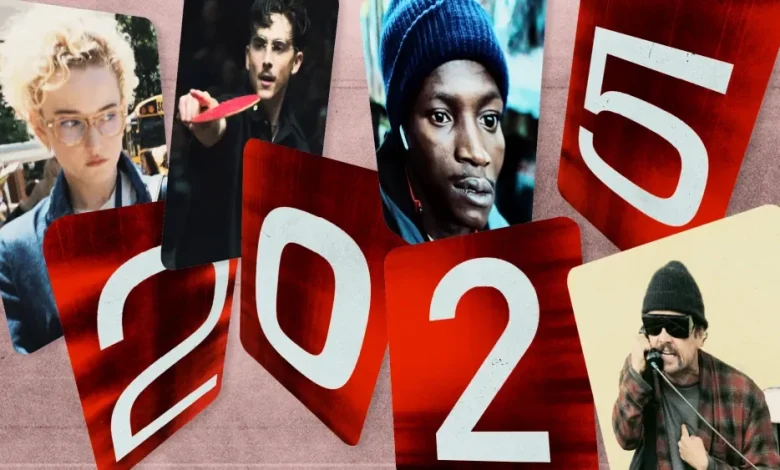
Movies are the great escape. “Optimistic endings, passionate romances,” sings the incarcerated dreamer of “Kiss of the Spider Woman,” who looks to old Hollywood movies as an oasis of beauty and faith. Yet in 2025, a year when the drama of entertainment was eclipsed by the cataclysm of reality, the movies we escaped to often had a singular real-world vibrance. The title of “One Battle After Another” aptly encapsulates a moment when the drama often seemed to be spilling from the screen into people’s daily news feeds. (The prison sentence recently given to the Iranian director Jafar Panahi by his country’s regime almost felt like an additional act of “It Was Just an Accident,” his enthralling exposé of despotic cruelty.) In 2025, Variety’s chief film critics, Peter Debruge and Owen Gleiberman, found one movie after another, from “Marty Supreme” to “28 Years Later,” in which escape itself was tinged with the bite of reality. Here are the movies that made us dream, in part because they were powerful enough to wake us up. (Click here to jump to Owen Gleiberman’s list.)
-
Peter Debruge’s Top 10
-
1. Dreams
Seventeen-year-old Johanne (Ella Øverbye) discovers love vicariously, in the pages of a book, and when that overwhelming feeling toward another person strikes her for the first time, her instinct is to put it down in words. For a time, her heightened emotional state — an adolescent obsession with a teacher named Johanna (Selome Emnetu) — is a secret shared only with the audience. Little by little, as this shy teen lets others in, Norwegian director Dag Johan Haugerud invites us to question how much of what we see and hear really happened, and how much occurred in Johanne’s head. A novelist who rightly recognizes cinema as the medium of our time, Haugerud intuits the use of color, texture and music better than many career filmmakers, illuminating Johanne’s personal awakening, while daring to raise provocative questions about how various parties inevitably experience a relationship differently. Though some purists view narration as a crutch, Haugerud’s Oslo Trilogy — three loosely interconnected studies of modern attraction, titled “Sex,” “Love” and “Dreams” — demonstrates how deeply voiceover can enrich the psychological dimension of a movie. Here, in a queer film that open-heartedly reflects a generation unconcerned with labels, is the project that best delivers on the promise of Norway’s last cinematic marvel, Joachim Trier’s “The Worst Person in the World.”
-
2. Souleymane’s Story
Image Credit: Courtesy of Cannes Film Festival
Operating in the urgent ripped-from-reality style of the Dardenne brothers, French director Boris Lojkine focuses our attention on a single, intensely relatable example of Europe’s immigration crisis: an earnest (if not entirely honest) Guinean refugee seeking asylum in Paris. The film reveals a far less romantic side of the iconic city, exposing challenges I’d never considered: how those without papers must pay exorbitant fees to opportunistic middlemen, for example, or the daily struggle for a place to sleep. A mechanic with no previous acting experience, Abou Sangaré was awarded at Cannes for his affecting turn as Souleymane, whose story — the one he finally shares with the social worker in his all-important interview — was directly informed by Sangaré’s own experience. Lojkine’s attentive portrait puts a human face on a larger crisis, inviting us to consider the rich lives of all those anonymous delivery drivers we routinely overlook. Amid such hostility, even a small gesture of spontaneous kindness (like the restaurant worker who offers him a sweet) can mean the world.
-
3. One Battle After Another
Image Credit: ©Warner Bros/Courtesy Everett C
You can draw a direct line from the classic American Western through John Ford’s “The Searchers” to Paul Thomas Anderson’s wild postmodern spree, in which justice (in the form of Sean Penn’s turkey-strutting Col. Lockjaw) comes for a shaggy old outlaw (Leonardo DiCaprio’s Bob Ferguson). I see this “Battle” as the latest deconstruction of the archetypal American hero: In a more classical movie, Bob would be the one to save the day when Lockjaw nabs his daughter Willa (Chase Infiniti), but part of the joke here is that DiCaprio’s character, once a resourceful member of an idealistic anti-government group, is too brain-sozzled from years of indolence and drug abuse to be much help. Bob’s always two steps behind, whereas Willa proves clever enough to defend herself. Though every scene remains seared in my memory, my favorite occurs between DiCaprio and Teyana Taylor (as Willa’s independent-minded mom), when she walks out on her family. That moment’s a clue as to where the film’s soul really lies: a complicated portrait by Anderson of his experience of fatherhood.
-
4. Sound of Falling
Rare is the movie that requires us to rethink the way we make sense of movies, and precious are those directors, like visionary newcomer Mascha Schilinski, who are capable of proposing an intuitive alternative to a century of film narrative. I might go one step further and point out that male directors have been largely responsible for shaping the model which now dominates — that of the goal-oriented protagonist, trying to solve a specific problem within a limited timeframe. By contrast, Schilinski chooses to focus on a single location, a rural German farmhouse seen through the eyes of multiple generations. She enigmatically weaves back and forth through the eras, finding echoes of past traumas and tragedies (a young woman, who must be sterilized before serving as a maid, throws herself under a cart, while another girl leaps from the hayloft, convinced she can fly). This unconventional form can be disorienting at first, but is richly rewarding as we start to know the characters and make abstract connections, free-associating between the various strands.
-
5. 28 Years Later
Image Credit: Everett Collection
It wasn’t quite 28 years ago that director Danny Boyle and screenwriter Alex Garland radically rethought the zombie movie with “28 Days Later,” shifting the focus from the social commentary of George A. Romero’s “Living Dead” movies to a visceral treatment of the genre’s underlying phobias: fear of infection, horde behavior and loss of autonomy. Wisely ignoring (relatively weak) sequel “28 Weeks Later,” the pair now return to a still-quarantined U.K., observing how human survivors have reverted to primitive tribes. Meanwhile, “the infected” have evolved (the word “zombie” is spoken only once, by a soldier visiting from the European mainland), which supplies the movie with some highly effective thrills, though the reason this movie rocked me — emotionally, I mean — is that Boyle et al. clearly recognized they were telling a post-pandemic narrative for a society (ours) that had just endured a pandemic (COVID-19), building in an opportunity to grieve and process what we’ve collectively been through via the cathartic Bone Temple sequence.
-
6. Marty Supreme
Image Credit: Courtesy of A24
Ping-Pong is a fairly silly pastime — a notion that isn’t lost on director Josh Safdie, who follows up the extended panic attack that was “Uncut Gems” with a breathless twist on the sports movie genre (one where the sport in question gets no respect). Coiled spring Timothée Chalamet all but vibrates as a fast-talking New York shoe salesman named Marty Mauser, who’s convinced he’s the best table-tennis player of all time — a dubious feat of greatness — until a Japanese pro with a mean stroke checks his ego. Still, Marty’s confidence is off the charts, as he hustles his way to a potential rematch. It all makes for an exhilarating character study, and an especially inspired use of Chalamet’s cocky off-screen persona. Safdie supplies Marty even more to compensate for behind pockmarked makeup, a peach-fuzz stache and crooked teeth, crafting a larger-than-life archetype we’ll be referencing for generations to come.
-
7. It Was Just an Accident
Image Credit: Courtesy of Sanfic
Between Jafar Panahi’s Palme d’Or-winning thriller and his close friend Mohammad Rasoulof’s “The Seed of the Sacred Fig” last year, Iranian cinema has turned a corner. For years, the country’s most vital film artists tried to convey their critiques of the regime as subtly and subtextually as possible, so as not to be arrested. Even so, both Panahi and Rasoulof have served time in Tehran’s Evin Prison, and this film marks Panahi’s unequivocal response to his oppressors: a warning to those in power that those they torture and punish will eventually turn the tables. But Panahi does something surprising with this premise — in which ex-prisoners recognize and capture their sadistic interrogator — questioning whether revenge is the appropriate response to such treatment. Shooting in secret under the most restrictive conditions, the master has delivered a work of surprising moral complexity, culminating in a twist that may have anticipated his own fate.
-
8. Train Dreams
Image Credit: Courtesy of Netflix
Director Clint Bentley (whose “Jockey” topped my 2021 best movies list) crafts an elegiac salute to the anonymous blue-collar laborers who gave their time, effort and sometimes their lives to felling trees and building railroads. With his rough hands and kind eyes, Joel Edgerton is more than merely convincing as softspoken logger Robert Grainier; he draws us deep into the private ruminations of a man who may have lacked education, but seeks to understand the love, grief and guilt he feels over his eight decades on earth. How many like him has America forgotten? In the tradition of Terrence Malick’s “Days of Heaven,” Bentley finds evocative images (like a tree that swallowed the boots nailed to its trunk) to enrich the beauty of Denis Johnson’s prose. Do yourself a favor and see it on the big screen, if possible, where that magic-hour grandeur — and the profound ideas it sparks — can envelop you completely.
-
9. The President’s Cake
Image Credit: Cannes
Just when you think you’ve seen movies from every corner of the globe (and more than a few set in galaxies far, far away), along comes a miniature marvel from a place like Iraq to expand your horizons. Drawing from memories of his own Mesopotamian childhood, writer-director Hasan Hadi centers his 1990s-set period piece on a peasant girl named Lamia (Baneen Ahmed Nayyef) who is given the responsibility of baking a cake in honor of Saddam Hussein’s birthday — a burdensome task for a 9-year-old with little more than a rooster to her name. But Lamia is clever, teaming up with a pocket-picking schoolmate to collect the necessary supplies in a film that unfolds with the same observational humanistic sensibility of the best films being made in neighboring Iran at the time — movies like “The White Balloon” and “Children of Heaven,” wherein the concerns of children illuminate the mindset of the nation.
-
10. Steve
Image Credit: ©Netflix/Courtesy Everett Collection
Netflix produces an awful lot of slop, but every once in a while, a little treasure like “Steve” sneaks through to remind that the streamer (which just this week made a bid for legacy studio Warner Bros.) is capable of more than holiday sludge and true-crime docs. Set in a last-chance school for delinquent young men, “Steve” reteams Cillian Murphy with helmer Tim Mielants, suggesting that instead of resting on the laurels of his Oscar win for “Oppenheimer,” the Irish actor remains thirsty for challenging work. In a career-best performance, Murphy plays the institution’s desperate headmaster, whose unwavering commitment to a handful of extreme cases can only withstand funding cuts for so long. Mielants’ inventive approach — an audacious balance between raw documentary-style footage of the troubled kids and conceptual glimpses into the mental states of its most vulnerable characters — makes the slow unraveling feel all the more acute.
10 more for good measure: “Black Bag,” “BLKNWS: Terms & Conditions,” “Bring Them Down,” “Bugonia,” “Hamnet,” “Jay Kelly,” “Nirvanna the Band the Show the Movie,” “Nouvelle Vague,” “Sorry, Baby,” “Twinless”
-
Owen Gleiberman’s Top 10
-
1. One Battle After Another
Paul Thomas Anderson’s greatest film since “Boogie Nights” is a dystopian adventure of hair-raising relevance and haunting desperation. It’s at once a political thriller, a bravura chase movie, a world-turned-upside-down satire, a movingly fraught father-daughter love story — and, more than that, a movie that plants us in the paranoid cave of anxiety that is life in an autocratic society, in this case one that uncannily mirrors what’s happening to our own Disunited States. What the movie is not is a “left-wing” rabble-rouser. The ragtag band of revolutionaries who toss firebombs and try to break immigrants out of prison cages are on the outside of society, but if you think that makes them radical you’ve taken on the point-of-view of the autocrats. Anderson leads us through a riveting rabbit-hole version of America today, with Leonardo DiCaprio as an ex-revolutionary dad so colossally flawed yet steadfast that he seems to stand in for all of our crushed dreams and everyday valor. No movie of recent years has taken the temperature of its time like “One Battle After Another.” And this one does it brilliantly enough to stand the test of time.
-
2. Marty Supreme
Image Credit: A24
Josh Safdie, flying solo as a director, has somehow brought off a movie that’s like “Uncut Gems” remade as a soulful all-American crowd-pleaser. At its center is Timothée Chalamet’s mesmerizing performance as Marty Mauser, an early-’50s Ping-Pong wizard from the Lower East Side who wants nothing more (or less) than to be the world champion of table tennis. He wants it so badly that he’ll lie, steal, seduce, discard, bully, and terrorize to get it. Is Marty, with his fiery stare and boyish mustache and sexy-geek motormouth confidence, an obnoxious narcissistic sociopath? Or is he a classic Hollywood hero, putting fear on the back burner to find his dream? Yes and yes! The beauty of the movie is the way it makes Marty a new-style antihero whose insane belief in himself is exactly what’s needed to transcend the karma of defeat. (Frank Capra would understand.) The movie, like Marty, is rude and funny and nervy and driven, but most of all it’s an exhilarating look at what it means to make up your own fate on the spot.
-
3. Sentimental Value
There are moments when Joachim Trier’s splendidly intricate, rapturously moving family drama recalls the lacerating dynamics of an Ingmar Bergman dreamplay. But Trier tugs that aesthetic into the contempo age of entertainment as hall-of-mirrors. He builds his movie around a stately old house in Oslo that’s a place of warmth, memory, terror, and ghosts, and he unfurls the story of two adult sisters, and their totemic filmmaker father, with an eye toward the mysteries of redemption. Renate Reinsve gives the finest performance by a female actor this year as Nora, whose crippling bouts of stage fright express how her life has lost its center. Stellan Skarsgård, in his finest performance since “Breaking the Waves,” is Nora’s famous director father, who appears to be a classic boomer artist-narcissist. When he offers her the lead role in his comeback film, which is a thinly veiled version of the twisted history of their family, it looks like he’s out for himself, but he’s really making the entire movie to save her. Trier keeps us off-balance, interweaving suicidal despair with a healing that feels as profound as the scars.
-
4. Bugonia
Image Credit: ©Focus Features/Courtesy Everet
Yorgos Lanthimos’s wild and woolly kidnap drama is a violent, hate-fueled, thrillingly warped act of cinematic screw-tightening. It’s also rooted in a humanity that sneaks up on you. At first we think we’re watching a gonzo duel of psychopathic wits: Emma Stone as a cutthroat pharmaceutical-company CEO who has mastered the defense mechanisms of the new “caring” corporation, and Jesse Plemons as the greasy hyper-progressive conspiracy-theorist incel who wants to torture her into telling the truth — about his drug-victim mother, and about the world we live in. For a while, it’s like watching “Misery” restaged as a riveting culture-war two-hander. But Stone and, especially, Plemons keep deepening their characters. (He does a piece of acting that’s like tragedy on the high wire.) And the trick ending has a blow-you-away power that’s worth a dozen doomsday dystopias.
-
5. Wild Diamond
Image Credit: Courtesy of Monterrey Film Festival
Religion, Karl Marx said, is the opiate of the masses. Today he would say the opiate of the masses is fame — the new fame, the lusty fickle kind, the one that’s at the center of Agathe Riedinger’s startlingly bold French drama. It tells the story of Liane (Malou Khebizi), a 19-year-old glam trainwreck who’s in thrall to the false gods of social media and reality TV. Liane preens and twerks and taunts her friends and posts her selfies. That’s her life. The key, for her, is how she coaxes the fame-whore theatrics right out of her spiritual trauma. She puts on a show for the world because “authentic” is what sells, and Malou Khebizi inhabits her with a surly dynamism that sears the screen. If the Dardenne brothers ever made a movie about what’s going on in the desperate soul of our image-junkie youth culture, it might look like “Wild Diamond,” which marks Riedinger’s arrival as a major filmmaker.
-
6. Mission: Impossible — The Final Reckoning
Image Credit: ©Paramount/Courtesy Everett Col
Using the threat of AI as a plot device requires no great feat of imagination. “Mission: Impossible — Dead Reckoning Part One” did it, with so-so results. But in that film’s cataclysmic concluding chapter, Tom Cruise and his director-collaborator, Christopher McQuarrie, take the danger of AI and elevate it into a global thriller soaked in dread. Cruise’s Ethan Hunt is really out on his own this time, carrying off his mission through a series of mortal zigzags that keep us hanging on every strategically improvised twist. And when Cruise makes the impossible incarnate by literally flying into the danger zone, leaving the safety net behind for a clinging-onto-the-plane-wing action sequence so spectacular it may be the most awesome piece of stunt expressionism since the days of Buster Keaton, you’re seeing Hollywood rediscover its primal spirit.
-
7. Lurker
Image Credit: Sundance Film Festival
In Alex Russell’s sleek and unnerving parable of the pathology of celebrity, Théodore Pellerin, as a hanger-on who will do anything to hang on, gives a performance that lays bare the reptilian underside of wide-eyed fan worship. His Matthew is working at an L.A. boutique when Oliver (Archie Madekwe), a tall British global-pop-sensation-in-the-making, wanders in. Matthew knows just how to play him, but he’s so crafty and “innocent” about it that he fools the audience as much as he fools Oliver. And these two are soon engaged in a mutual dance of opportunism that’s as head-spinning as the mixed-media universe that makes it possible. “Lurker” has been made with the craft of early vintage Polanski crossed with an up-to-the-minute awareness of what pop culture has come to mean when the famous and their fans are now chasing each other’s tails.
-
8. Weapons
Image Credit: Everett Collection
For all the horror movies that come out each year, there’s a box they tend to put themselves into, toying (cleverly or not) with shock cuts and ghost metaphysics and bloody genre tropes. But “Weapons” came out of the box as a bold new breed of chiller. What made Zach Cregger’s film the sleeper sensation of the year wasn’t just that it seemed to erupt out of nowhere, but that it was such a tingly and enticing off-ramp drama, influenced less by the dictates of horror than by the puzzle-piece gamesmanship of “Pulp Fiction.” Julia Garner as an alcoholic grade-school teacher who’s accused of having caused 17 of her students to vanish; Alden Ehrenreich as her lout of a policeman ex-boyfriend; Austin Abrams as a homeless burglar — the film submerges you in their sleaze and hopes and interlocking fates, so that when we arrive at the heart of darkness (in the form of Amy Madigan’s hypnotically warped performance as a harridan of evil), it feels like the final cathartic puzzle piece popping into horrific place.
-
9. Black Bag
Image Credit: Claudette Barius/Focus Features © 2025 All Rights Reserved.
Steven Soderbergh’s perfectly ingenious romantic thriller about two married British spies trying to outmaneuver each other is the year’s most captivating bauble. Written by David Koepp, it’s the apotheosis of Soderbergh’s “little” films, in that it’s a movie that wears its cleverness on its bespoke sleeve, but does it so…cleverly it keeps pulling you into its debonair orbit of tradecraft cunning. George (Michael Fassbender), a counterintelligence expert at the National Cyber Security Centre, is assigned to ferret out which of his colleagues leaked a top-secret software program. He invites four suspects over to dinner, the fifth suspect being his wife, Kathryn (Cate Blanchett). The film never loses its ebullient air of cutthroat nonchalance, but it has even tastier twists than a “Knives Out” mystery, and Fassbender and Blanchett spar like screwball-comedy stars brought into the age of metaphysical mistrust.
-
10. Nouvelle Vague
Image Credit: ©Netflix/Courtesy Everett Colle
It’s doubtful that any filmmaker who set out to replicate a famous time and place has done it as meticulously, as lovingly, as fetishistically as Richard Linklater does in his enchanting magic trick of a movie: a time-capsule drama about the making of Jean-Luc Godard’s “Breathless.” The beauty of “Nouvelle Vague” — and, in a way, its sly joke — is this: Linklater literally stages the movie as a hermetic, you-are-there diary of what Godard did each day on the set, and the reason for that is that “Breathless” found its very meaning in the way it was shot — made up on the spot, drawn out of the boulevards and cafés of Paris, staged as a put-on gangster movie that made the put-on feel like a fourth dimension of reality. As Godard, Guillaume Marbeck, acting from behind sunglasses he never removes, nails the visionary New Wave director’s poker-faced egghead perversity so perfectly that you realize he’s as much a work of art as his movies.