Pluribus likes to play it cute. When Carol wants her supermarket back, the trucks are pulling up by the time she walks out the door. When Mr. Diabaté wants to live the high life, he creates a half-assed James Bond parody. When the plurbified want to talk to Carol, we get a John Cena cameo. In this episode, as Carol roams around an empty Albuquerque developing a form of cabin fever in which the cabin is the whole world, she enjoys singing and listening too some of the most on-the-nose music imaginable, from “It’s the End of the World as We Know It” to “I Will Survive.”
These moments are supposed to be big and broad, obviously; I don’t think Vince Gilligan and company are unaware of what they’re doing. The issue is that the bigness and broadness doesn’t translate into anything of value. None of these jokes are funny, they’re just kind of like “Heh, how about that John Cena,” or “Ha, they cut her off before she could finish the phrase ‘and I feel fine,’ I get it.” They draw attention to themselves just as much as the show’s use of vivid color and dramatic shot compositions, with nothing close to a comparable payoff. They screw with the rhythm and tone of the thing and make the characters and their world feel canned and flat.
That being said, this was some episode, huh?
The action is bounces back and forth between the two rogue survivors of the Joining, our hero Carol Sturka and her even grumpier Paraguayan counterpart, Manousos Ovideo.
Now that she knows the plurbs can’t convert her without her consent, Carol begins the episode sitting pretty. She loads up on fireworks and treats herself to little displays while blasting John Philip Sousa. She plays rooftop golf, shattering a whole bank of high-rise office building windows in the process. She goes swimming naked in a hot spring and steals an original Georgia O’Keeffe painting to hang on her wall. These last two things actually make her smile happily for the first times in the history of the show, unless I’m badly mistaken.
But it doesn’t last. After over a month of total isolation, her crashout comes when she sets off a phalanx of fireworks just for fun, blasting “Stars and Stripes Forever” at a maddening volume. When one of the huge rocket launchers falls over, its barrel pointed right at her, she turns her chair to face it directly, waiting to get her face blown off. Instead the rocket whizzes past her by a matter of inches, setting her garage on fire. (She puts it out with the garden hose.)
The next day she writes “come back” in big white letters in front of her house, then sits and waits. As the light grows long, Zosia pulls up, and Carol collapses into her arms, crying.
This is some career-best work from Rhea Seehorn, whom director Adam Bernstein and cinematographer Paul Donachie shoot as a larger than life figure, looming huge and beautiful i the abandoned landscape, like a movie-star cowboy from the Golden Age of Hollywood — or an icon of glamour, as she appears when she shows up in a gold gown and heels for a dinner for one.
It’s not Seehorn’s fault the song choices are obvious, you know? Everything else she’s asked to do she handles with aplomb, from those long-anticipated smiles to her passive suicidiality during the fireworks display to her tears of relief upon Zosia’s return. If I’m Rhea Seehorn, this episode makes me glad I took this gig. If I’m me, this episode makes me glad Rhea Seehorn took this gig.
The other half of the episode follows Manousos’s long, arduous journey through South and Central America as he travels north to meet Carol. All the while he refuses any help from the plurbs, siphoning gasoline from abandoned cars by mouth and gathering rainwater in cans to keep himself hydrated. (The plurbs are very, very concerned about his hydration.) His roadtrip in his much-beloved convertible takes him through a staggering variety of landscapes, climates, and terrain, from lush forested roads to roads carved through craggy cliffs. Blue evening light illuminates a fishing expedition at the foot of a waterfall. Hiveminded others line the narrow main thoroughfare of a roadside town. Deep focus compositions reveal the magnificent green forested detail that shots centered on Manousos tease in the background.
But when he runs out of road, that’s where the real trouble begins. Reaching a point where he’ll have to travel through jungle on foot, he torches his beloved car rather than allow the plurbs access to it. “Nothing on this planet is yours,” he tells them as they gather to warn him not to set out on this perilous hike and offer transportation directly to Carol. “Nothing. You cannot give me anything, because all that you have is stolen. You don’t belong here.”
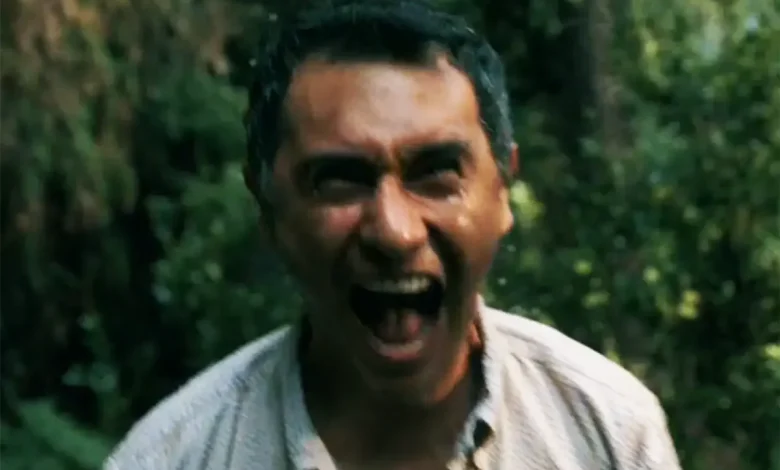
Having learned basic English with a learn-by-cassette course he listened to while driving, Manousos hacks his way through the woods with a machete, repeating “My name is Manousos Ovideo, I am not one of them, I wish to save the world” as a mantra, like Inigo Montoya.
But he runs afoul of one of the perils of the forest: the deadly chunga palm (dun dun dunnnnn!), a tree whose Cenobite-like spines are dripping with deadly bacteria. Manousos loses his footing and impales himself on one of these things, then tries to cauterize the infected wounds with his red-hot machete. That’s no way to heal a puncture wound, though, as he learns when his still-bleeding injuries cause him to pass out. The last thing he sees is a plurb medic descending from a plurb helicopter. He would almost certainly rather die than be helped, but it does not appear he’ll be granted that luxury.
Manousos’s storyline this episode is a straight-up old-school Ordeal, one of my favorite microgenres. In film, think of Deliverance, Aguirre, Sorcerer, Apocalypse Now, Stalker, Fitzcarraldo, After Hours, The Descent, The Revenant; on TV, there’s the first season of The Terror or last year’s American Primeval. These are stories in which people embark on dangerous voyages from point A to point B, getting their physical and metaphysical asses kicked consistently along every step of the way. These are purgative journeys, designed to test people’s limits. That’s the kind of journey our man Manousos finds himself on, at least until the Others come to the rescue.
There’s so much that Pluribus is doing that no other show on TV is doing right now. Those crystal blue skies! The majority of entire episodes passing in dialogue-free silence! The full commitment to the bit of playing the entire “Hello, Carol” voicemail recording every single time she dials! Pluribus makes life feel like the never-ending struggle it is, and it’s damn good at it. I don’t need the jokes and gags and bits. Just point the cameraat two people slowly being driven insane by the fact that, for all intents and purposes, they are the only two people.
Sean T. Collins (@seantcollins.com on Bluesky and theseantcollins on Patreon) has written about television for The New York Times, Vulture, Rolling Stone, and elsewhere. He is the author of Pain Don’t Hurt: Meditations on Road House. He lives with his family on Long Island.